


Vintage Enamel Spoon
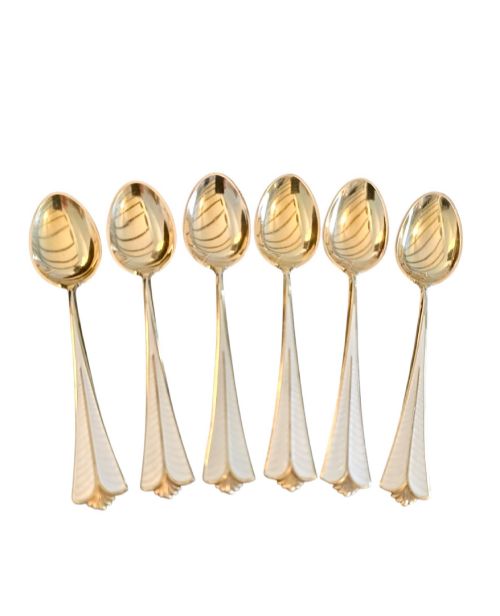
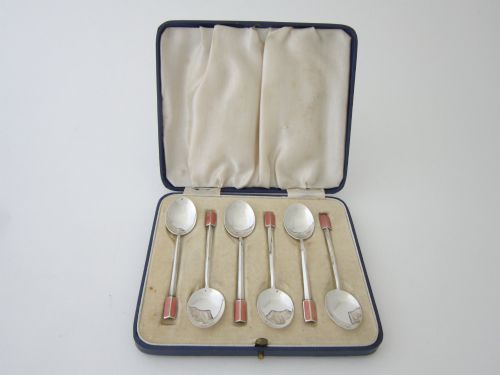
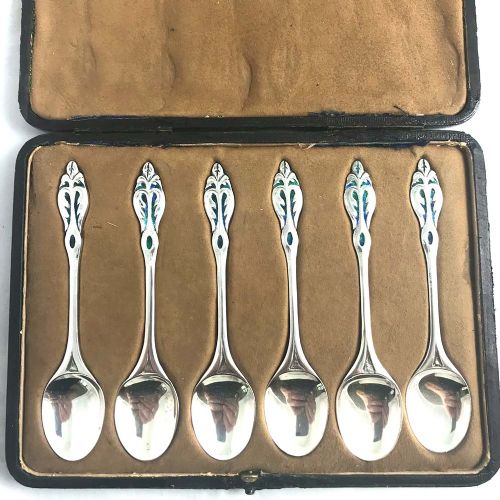
These vintage enamel spoon examples combine silver and vitreous glass colours, offering bright tableware details for collectors.
Vintage Enamel Spoon
A vintage enamel spoon brings decorative colour to tableware, spanning teaspoons, coffee spoons, and caddy spoons from the twentieth century. These small implements range from individual boxed items to full cased sets created for specific clubs, events, or retailers.
The pieces on this page draw from several design movements, most notably Art Deco geometric patterns, clean Mid-Century Modern lines, and organic Art Nouveau motifs. Most examples encountered here pair silver bases with applied coloured enamel finishes.
Materials and construction
Silversmiths formed the foundation of each spoon using sterling silver, silver gilt, or standard silver, occasionally mounting them alongside ceramic coffee cans and saucers. Protective cases often lined the interior with satin, velvet, or leatherette.
Vitreous enamel provides the colourful surface, fused to the metal through high-temperature firing. Techniques like guilloché engraved patterns beneath translucent enamel create geometric texture across the bowl backs or handle terminals.
Listings feature items spanning the early twentieth century through the 1960s, utilising sterling silver, silver gilt, and vitreous enamel.
Judging quality and execution
Quality rests in the precision of the enamel work and the weight of the underlying silver metalwork. Crisp lines in geometric Art Deco designs and intact, smooth vitreous surfaces distinguish finer craftsmanship.
Original presentation boxes, particularly those retaining fitted satin or velvet linings and marked by known retailers or makers, elevate the status of a set. Complete matched sets command more attention than assembled groups.
David Andersen·Liberty and Co·Turner and Simpson Ltd
The Vintage Enamel Spoon Glossary
- Vitreous Enamel
- A glass-like substance fused to metal through firing at high temperatures. This material creates durable, glossy coloured surfaces on spoons.
- Guilloché
- A decorative engraving technique that etches precise geometric patterns into metal. Translucent enamel layered over this work allows the pattern to show through.
- Silver Gilt
- Silver that has been coated with a thin layer of gold on its surface. This finish adds a warm tone to the spoon bowl or handle.
- Caddy Spoon
- A specialised short spoon designed for measuring loose tea leaves from a caddy. These often feature decorative bowls and short handles.
Vintage Enamel Spoon: Frequently Asked Questions
What are vintage enamel spoons used for?
These small spoons served practical roles in serving afternoon tea, coffee, or measuring loose tea leaves from caddies. Today, collectors primarily display them in fitted cases or use them for special dining occasions.
Because of their delicate vitreous glass surfaces, many surviving sets remain preserved in their original presentation boxes lined with satin or velvet.
How do I identify Art Deco spoons?
Art Deco spoons typically feature sharp geometric patterns, streamlined motifs, and strong symmetrical lines characteristic of the 1920s and 1930s. Makers applied contrasting enamel colours to emphasise these architectural shapes.
Examining the handle terminals and the reverse of the spoon bowls usually reveals the distinct stylistic geometry of the period.
Are these spoons made of solid silver?
The base metal of these spoons is typically sterling silver or standard silver, and some examples feature a gold wash known as silver gilt. The coloured portions consist of fused glass enamel rather than solid precious metal.
Maker marks and silver hallmarks stamped on the stems or backs confirm the specific metal standard used.
Why do some spoons come in fitted boxes?
Many high-quality sets were sold as complete boxed presentations intended for gifting or special occasions by prominent retailers and silversmiths. The interior linings of satin, velvet, or leatherette protected the delicate enamel from scratching.
Finding a set complete with its original case generally indicates a well-preserved history.