



Vintage Eight Drawer Chest
A vintage eight drawer chest offers serious storage with architectural presence, taking up minimal floor space while holding a proper wardrobe.
Vintage Eight Drawer Chest
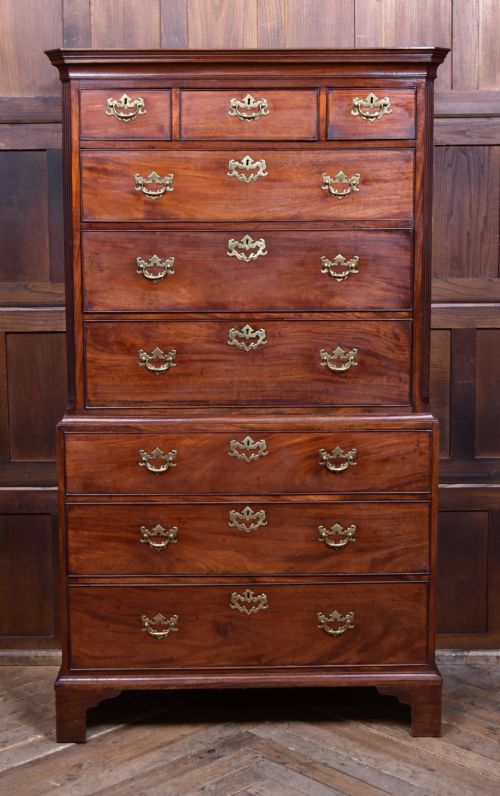
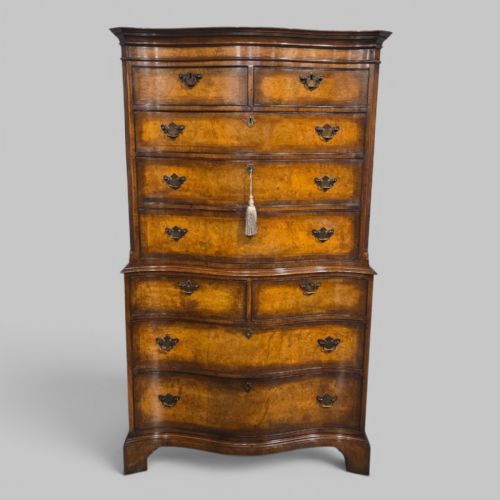
A vintage eight drawer chest provides tall storage across multiple tiers, typically seen in forms such as the classic tallboy or chest on chest. These pieces combine smaller top drawers with deeper lower drawers, creating a tiered facade that draws the eye upward.
The evidence shows these tall chests spanning periods from the 18th Century and Georgian era through Victorian, Edwardian, Arts and Crafts, and Art Deco designs. Oak and mahogany dominate the forms, alongside satinwood, burr walnut, and walnut veneer.
Buyers meet variations ranging from serpentine burr walnut and inlaid satinwood tallboys to large oak Arts and Crafts pieces and compact collectors chests. Each style brings distinct proportions and timber figuring to the bedroom or study.
Materials and Construction
Cabinetmakers constructed these chests using solid hardwoods like oak and mahogany for structural integrity, often applying figured veneers such as burr walnut, flame mahogany, and satinwood to the drawer fronts. This technique displayed rich natural grain patterns across the tall facades.
Surface ornamentation relied on timber selection, crossbanding, and inlay rather than applied metalwork, though brass handles and escutcheons provided functional contrast. Bakelite elements also appear on mid-century examples.
Childs Wellington chests exist purely because even Victorian children apparently had serious wardrobe management requirements to maintain.
Judging Quality and Craftsmanship
Quality rests in the precision of the timber matching and the depth of the cabinetwork, particularly where secondary timbers are joined within the drawer linings. Superior examples maintain crisp mouldings and seamless veneer work across multiple tiers of drawers.
Proportion and scale dictate the visual success of a tall chest, separating masterworks with balanced drawer graduations from utilitarian storage blocks. The handling of cornices and bracket feet further distinguishes regional workshop standards.
The Vintage Eight Drawer Chest Glossary
- Tallboy
- A tall chest of drawers, often comprising a chest on chest or a single elongated carcase. It maximises vertical storage without expanding the footprint.
- Chest on Chest
- A form consisting of a smaller upper chest stacked directly upon a deeper lower chest. This two-part construction made moving heavy furniture manageable for historical households.
- Collectors Chest
- A specialised cabinet fitted with multiple shallow drawers designed for storing specimens, coins, or documents. These interiors require precise internal joinery.
- Serpentine
- A curved front outline that undulates convexly at the centre and concavely at the sides. This shaping demands advanced woodworking skill.
- Crossbanding
- A decorative border of veneer laid around the perimeter of a drawer front with the grain running perpendicular to the central panel. It frames the primary wood figure.
Vintage Eight Drawer Chest: Frequently Asked Questions
Where should I place a tall chest?
These chests suit bedrooms, hallways, or dressing rooms where floor space is limited but vertical capacity is required. Their height draws the eye upward and makes efficient use of wall space.
Ensure the piece is secured to the wall if positioned on uneven historic flooring, as the tall centre of gravity demands stability.
How do I care for polished mahogany surfaces?
Dust regularly with a soft, dry cloth and apply a traditional beeswax nourish occasionally to maintain the sheen. Avoid placing the timber in direct sunlight or near heat sources.
Consistent room humidity prevents the veneers from lifting and keeps the solid carcase timbers stable over decades of use.
What is the difference between a tallboy and a standard chest?
A tallboy specifically refers to an elevated chest format, often built as two stacked sections or a singular elongated tower. Standard chests remain low and wide for surface display.
The taller format provides significantly more compartmentalised storage across eight or more separate drawers.
How do I identify Art Deco pieces?
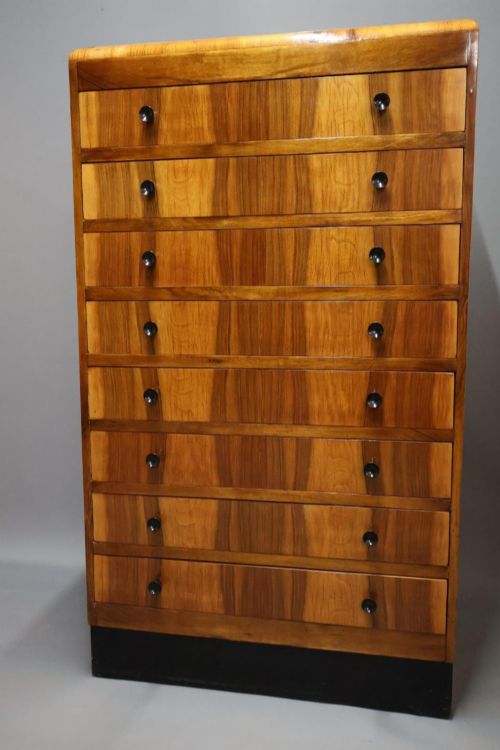
Art Deco pieces from the mid-century introduce streamlined geometry, simplified cornices, and dramatic walnut veneers. They lack the ornate carving of earlier Georgian or Victorian revivals.
Look for clean linear drawer arrangements and minimalist hardware that emphasise the natural grain of the wood.