



Vintage Cutlery Chest
A vintage cutlery chest provides disciplined storage for flatware, marrying sturdy timber construction with fitted, protective interiors.
Vintage Cutlery Chest
When you search for a vintage cutlery chest, you encounter substantial canteens, cabinets, and boxes designed to house complete flatware services. These pieces originate from periods spanning the late nineteenth century through the Art Deco era of the 1930s.
You are most likely to meet mahogany or oak specimens on this page, reflecting the dominant timber choices of Edwardian and Victorian makers. Many take the form of tabletop boxes or freestanding cabinets equipped with fitted internal trays.
The assortment includes English canteens featuring silver plate and steel services alongside empty cabinetry tailored for specific flatware collections. Each piece demonstrates the heavy-duty utility demanded by domestic households of past centuries.
How they were made
Cabinetmakers utilised dense hardwoods like mahogany, burr walnut, and oak to build carcass structures capable of supporting heavy metal contents. These timbers received polished finishes that accentuated natural grain patterns.
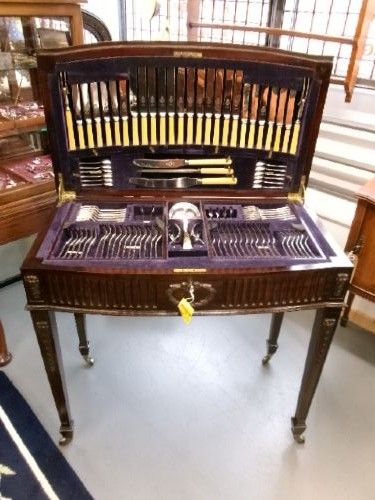
Interiors were lined with felt, velvet, or baize to cushion individual knives, forks, and spoons against friction and tarnish. Brass hardware such as carrying handles, lock escutcheons, and hinges provided robust operational detailing.
Vintage Cutlery Chest Retail Price Guide 2026
Typical asking prices for vintage cutlery chest among the pieces listed under this phrase on Sellingantiques today, from the lower quarter to the upper quarter. They describe what is for sale here now, not the wider market.
What varies in quality
The distinction between standard utility boxes and top-tier pieces rests upon the selection of timber veneers, the complexity of internal compartmentalisation, and the integration of maker attribution. Finer chests display figured grain walnut or solid mahogany carcasses joined with precise dovetailing.
Internal execution separates simpler lined trays from multi-tiered canteens featuring specifically shaped slots for hundreds of individual silver plate and steel pieces. Maker signatures from established firms add historical substance to the overall construction.
Walker & Hall, Sheffield·Mappin & Webb
The Vintage Cutlery Chest Glossary
- Canteen
- A fitted box or cabinet specifically designed to store a complete set of cutlery. It keeps flatware organised and protected from environmental wear.
- Escutcheon
- A protective plate surrounding a keyhole on the exterior of a chest. It is typically fashioned from brass to match other hardware.
- Baize
- A coarse woolen material used to line the internal trays of cutlery chests. It prevents silver and steel components from scratching during transit.
- Dovetail
- A joint used in the corners of wooden boxes, formed by interlocking wedge-shaped fingers. It provides exceptional tensile strength for heavy storage.
- Flatware
- Table utensils such as knives, forks, and spoons housed within these chests. The term distinguishes them from holloware items like teapots.
Vintage Cutlery Chest: Frequently Asked Questions
What is a cutlery chest used for?
A cutlery chest serves as a secure, organised vessel for housing large sets of domestic flatware. The fitted interior compartments keep knives, forks, and spoons separated to prevent surface damage.
Historically, these pieces safeguarded valuable silver services in dining rooms and Butler's pantries. Today, they offer practical storage that keeps complete tableware collections neatly ordered.
How do I identify an Edwardian cutlery chest?
Edwardian examples frequently utilise oak or mahogany timbers combined with structured brass mounts. The aesthetic leans towards revival styles influenced by earlier Georgian designs.
Internal layouts from this period often incorporate multiple velvet or felt-lined pull-out drawers. Maker marks stamped into the brass fittings or wood often confirm this early twentieth-century timeline.
Are these chests suitable for modern flatware?
Many vintage chests accommodate contemporary cutlery sets, provided the slot sizes match modern knife and fork dimensions. Older slots were tailored for specific nineteenth or early twentieth-century utensil shapes.
Checking internal tray depths and slot widths ensures your current flatware rests securely without crowding. Some pieces offer open tray storage that adapts more easily to varied modern services.
How should I care for the wood and lining?
Maintain the exterior timber by applying appropriate furniture wax sparingly to nourish the polished grain surface. Avoid placing chests in direct sunlight or damp environments to protect the wood joints.
Vacuum internal felt or velvet linings gently with a soft brush attachment to remove dust. Keep brass hardware clean using non-abrasive cloths to preserve the metallic finish.