




Vintage Cattle Art
Vintage cattle art brings the quiet drama of rural pastures and prized livestock directly to your walls through oils, watercolours, and carved figures.
Vintage Cattle Art
Vintage cattle art encompasses pastoral paintings, watercolours, and decorative figures that celebrate rural life, agricultural scenes, and prized livestock. You will most frequently encounter framed oil paintings and watercolours on this page, originating from the nineteenth and early twentieth centuries.
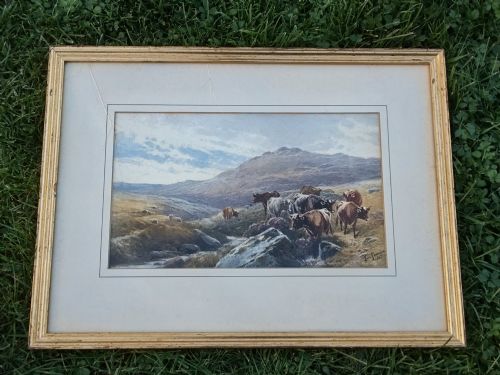
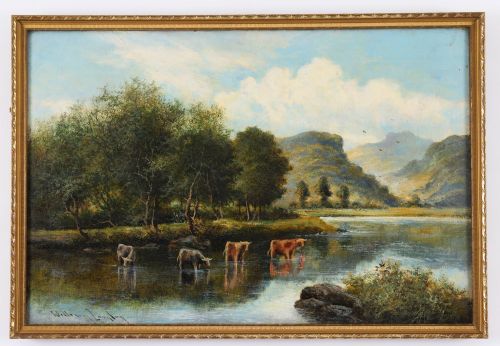
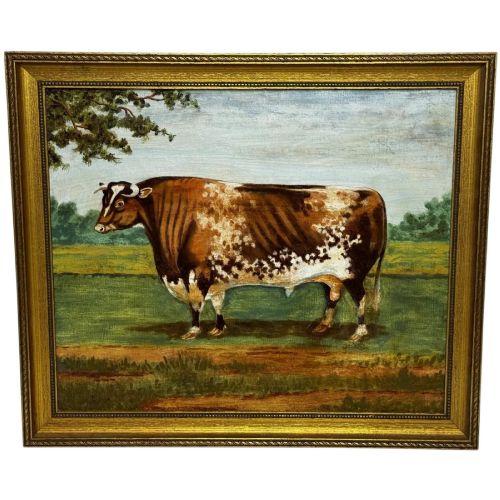
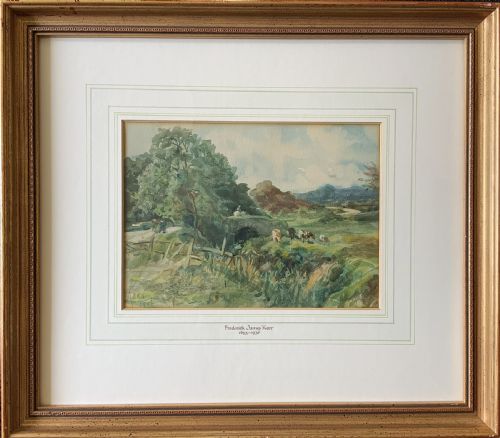
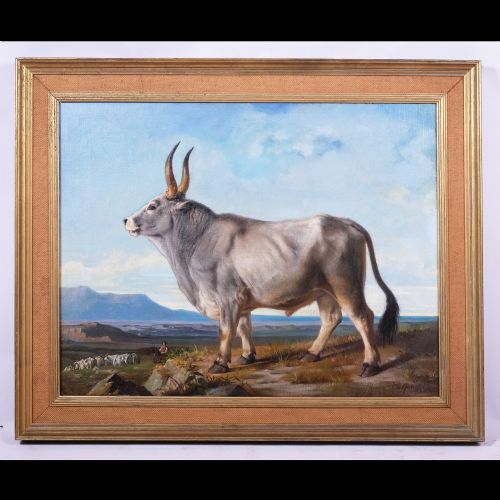
The subjects range from Scottish Highland cattle by lochs and Shorthorn bulls in green pastures to drovers crossing bridges and cows watering at rivers. These works reflect a sustained British and European interest in realism, pastoral charm, and agricultural pride.
Materials and Techniques
Artists painted primarily in oil on canvas or applied watercolour to paper, often housing the finished works in original giltwood or burr frames. Canvases capture deep, layered tones of rural landscapes, while watercolours rely on delicate washes to render light across fields and hills.
Three-dimensional pieces utilise carved wood, such as Black Forest work, or moulded paper mache to shape realistic animal figures.
Vintage Cattle Art Retail Price Guide 2026
Typical asking prices for vintage cattle art among the pieces listed under this phrase on Sellingantiques today, from the lower quarter to the upper quarter. They describe what is for sale here now, not the wider market.
Among the painted pastures, a sturdy pair of paper mache cows stands ready to graze on a quiet tabletop.
Distinctions in Quality
Quality rests upon the artist's command of anatomy, light, and atmosphere within the pastoral scene. Finer works render the texture of a beast's coat and the play of daylight across a landscape with convincing depth.
The condition of the canvas, paper, and original framing also shapes the standing of a piece. Well-preserved works retain their original pigment intensity and structural integrity without heavy restoration.
William Langley·Thomas Rowden·William H Myers·Ernest Higgins Rigg·Frederick James Kerr·Henry Robinson Hall·Ernest Pile Bucknall·Frederick James Knowles·Eugene Verboeckhoven·Alfred Grey·Claude Cardon·George Turner·William Traies·John R K Duff·William Sidney Cooper·Walter J Watson·Alfred de Breanski Sr·Owen Bowen
The Vintage Cattle Art Glossary
- Pastoral Realism
- An artistic style focused on realistic depictions of rural life, agricultural workers, and farm animals in natural settings. This approach dominated much of nineteenth-century landscape painting.
- Giltwood
- Wood that has been treated with a thin layer of gold leaf or gilt. It appears frequently on the frames enclosing period oil paintings.
- Shorthorn
- A prominent breed of British cattle frequently depicted in Victorian agricultural art to showcase prized livestock. Paintings often record the specific lineage or name of the bull.
- Black Forest carving
- Intricate wooden sculpture produced in the mountainous regions of Central Europe. Pieces typically depict animals carved from local timber.
Vintage Cattle Art: Frequently Asked Questions
What periods do these cattle artworks come from?
The pieces span from the late eighteenth century through the Victorian and Edwardian eras up to the early twentieth century. Most examples date from the nineteenth and early twentieth centuries.
Artists during these periods frequently turned to agricultural scenes and livestock as central motifs in British and European landscape painting.
How should I hang and care for oil paintings?
Oil paintings on canvas require stable indoor humidity away from direct sunlight and strong heat sources. Hang them securely using appropriate wall fixings suited to the weight of the frame.
Dust the surface gently with a soft, dry brush and avoid using water or chemical cleaners on the canvas or historic gilt frames.
Are watercolours more fragile than oil paintings?
Watercolours on paper are sensitive to prolonged exposure to direct sunlight, which can cause fading of the pigments. They benefit from placement in indirect light and protective glass framing.
Oil paint on canvas provides a more robust surface, though both mediums require careful handling to preserve the integrity of the paper or canvas support.
How can I tell a Victorian painting from an Edwardian one?
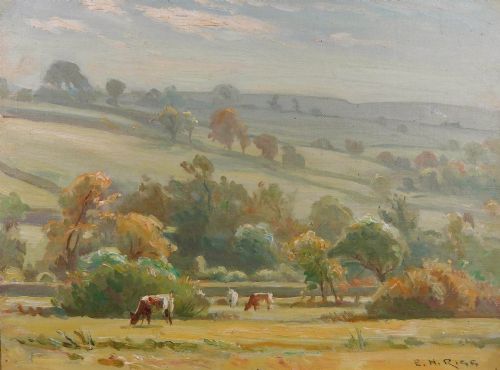
Victorian pastoral works often feature dramatic skies and deeply saturated tones, reflecting nineteenth-century romanticism and realism. Edwardian pieces sometimes lean towards a lighter palette influenced by British Impressionism.
Signatures, framing styles, and stretcher construction can also offer clues regarding the exact decade of creation.