


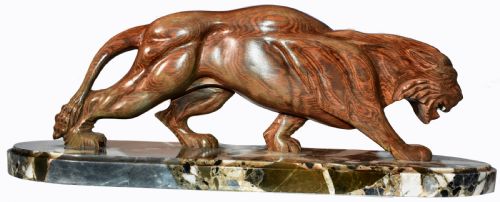

Vintage Cat Carving
These vintage cat carving pieces bring characterful feline forms into your home through skilled handwork in wood, stone and amber.
Vintage Cat Carving
A vintage cat carving encompasses sculptural representations of felines ranging from domestic cats to wild big cats, produced across the nineteenth and twentieth centuries. When searching for a vintage cat carving, you encounter diverse forms such as sculptural figures, inkwells, netsuke, and parasol handles originating from varied stylistic movements.
The selection on this page leans heavily into twentieth-century Art Deco interpretations alongside nineteenth-century Black Forest animalier work and traditional Japanese netsuke. These pieces capture the sleek lines or playful postures of cats using materials specified across the nineteenth and twentieth-century periods.
Makers and artists working in wood, marble, alabaster, and cherry amber utilised their respective stylistic vocabulary to render these feline subjects. You find domestic kittens alongside prowling panthers, tigers, and lionesses set upon bases or formed as functional objects.
Materials and methods
Carvers shaped these objects primarily from various woods including walnut and unspecified hardwoods, utilising hand tools to achieve detailed fur texture and muscle definition. Black Forest workshops specialised in this carved timber approach, creating both sculptural figures and functional items like inkwells.
Other pieces employ stone media such as marble and alabaster, often pairing a carved animal figure with a contrasting mineral base. Artisans also worked with organic materials like cherry amber for miniature netsuke, applying fine incision and polish to small-scale forms.
Vintage Cat Carving Retail Price Guide 2026
Typical asking prices for vintage cat carving among the pieces listed under this phrase on Sellingantiques today, from the lower quarter to the upper quarter. They describe what is for sale here now, not the wider market.
Six Persian kittens gather for a tea party in an oil painting by Agnes Augusta Tallboys.
Evaluating the pieces
The degree of anatomical observation and sculptural fluidity separates simpler work from superior examples. Master carvers capture the tension in a prowling panther or the relaxed curl of a netsuke cat with convincing weight and proportion.
Material selection and surface finish dictate the character of the object, whether through the deep grain of carved walnut or the smooth contrast between a wooden animal and its marble plinth. Signed works or pieces bearing specific workshop traits carry distinct historical attribution.
Eugene Emile Borga·Agnes Augusta Tallboys·Andrey
The Vintage Cat Carving Glossary
- Netsuke
- A small miniature sculpture carved from materials like cherry amber, originally used as a toggle on traditional Japanese garments. These pieces often depict animals including curled cats.
- Black Forest
- A nineteenth-century style of wood carving originating from the German and Swiss border regions, known for realistic depictions of animals such as tigers and cats.
- Art Deco
- A twentieth-century design style characterised by sleek lines and streamlined forms, frequently seen in stylized panther and lioness sculptures from the 1920s and 1930s.
- Animalier
- A nineteenth-century artistic genre dedicated primarily to the realistic portrayal of animals, encompassing sculptures in bronze, wood, and stone.
- Parasol handle
- A decorative grip attached to the top of an umbrella or parasol shaft, occasionally sculpted into the form of a cat using rock crystal, gold, and enamel.
Vintage Cat Carving: Frequently Asked Questions
What periods do these carvings come from?
The pieces span the nineteenth century through the 1930s, incorporating Victorian folk art, Belle Epoque, and Art Deco movements.
Dates within the listings reflect the stylistic conventions and production periods of each specific object.
What materials were used for these sculptures?
Carvers utilised wood, hardwood, walnut, marble, alabaster, and cherry amber to create these feline depictions.
Some items incorporate mixed media, pairing carved timber figures with stone bases or adding gold and enamel details.
How were Black Forest carvings used?
Black Forest pieces served both decorative and functional roles in nineteenth-century interiors, such as carved wood inkwells in the form of cats.
These functional items combined animalier sculpture with everyday desktop accessories.
What is an Art Deco panther carving?
Art Deco panther and lioness sculptures emphasise sleek, modern lines and stylised movement popular during the 1920s and 1930s.
Artists rendered these large cats in carved wood and alabaster, often mounting them on contrasting marble bases.