
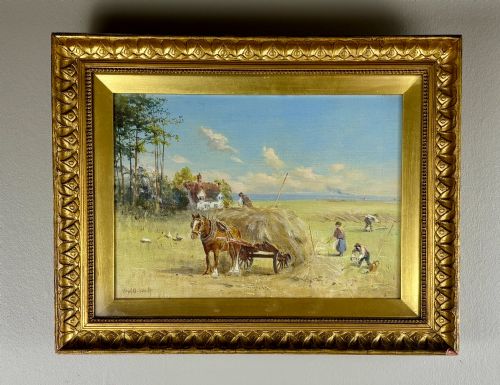


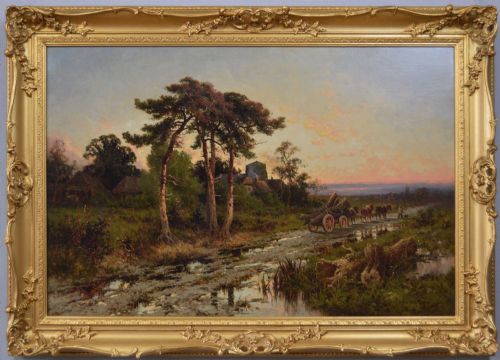

Vintage Cart Horse Artwork
These vintage cart horse artwork pieces capture the labour of the countryside, offering buyers an enduring glimpse into traditional rural life.
Vintage Cart Horse Artwork
Vintage cart horse artwork captures working animals engaged in rural labour, hauling hay, timber, seaweed, and market loads. These pieces emerge primarily from the nineteenth and early twentieth centuries, spanning periods from the Georgian era through to the nineteen thirties. Buyers will encounter framed watercolours, chalk drawings, gouache, and oil paintings on canvas.
The compositions reflect dominant aesthetic movements of their day, including British Impressionism, Victorian Pastoral, British Realism, and French Realism. Common subjects range from quiet village tracks and coastal lowtides to bustling harvest scenes and town streets. Most examples on this page are finished with period wooden or walnut frames.
Materials and technique
Artists worked primarily with oil paint on canvas or watercolour pigment and chalk on paper, often applying washes to build up light and atmosphere. These wet and dry media were selected to capture the texture of heavy coats, weathered wood, and damp earth.
Framing materials reflect the domestic interiors of their period, utilising polished wood, simple moulding, and protective glass for works on paper. These traditional assemblies preserve the pigment against light and dust while complementing the tonal palette of the paintings.
Subject matter centres on agricultural labour, including hay carts, timber hauling, seaweed gathering, and market day scenes.
Assessing quality and execution
Quality rests upon the artist's command of anatomy and movement, distinguishing stiff renderings from dynamic portrayals of heavy draught animals in motion. Skilled painters capture the weight of the load and the tension of the harness with confident brushwork and precise line.
The depth of the surrounding landscape and atmospheric lighting elevate a composition beyond simple documentation. Superior examples integrate the cart and horse seamlessly into a balanced pastoral scene, whereas lesser pieces treat the subject as a static element.
Cecil Charles Windsor Aldin·James William Booth·Léon Joseph Voirin·John Augustus Atkinson·George Hamilton Constantine·Herbert Royle·Frederick William Jackson·Walter Duncan·Frank Saltfleet·Henry H Parker·William Kay Blacklock·Alfred George Stevens·Fred Lawson·John Baragwanath King·Reginald Mills·Robert Thorne Waite·Lois Wilton
The Vintage Cart Horse Artwork Glossary
- Watercolour pigment
- A colour medium suspended in a water-soluble vehicle, used extensively on paper for translucent landscape sketches.
- Oil on canvas
- Pigment mixed with drying oils applied to stretched cloth, allowing for rich texture and blended colour.
- Gouache
- An opaque water-based medium that provides solid blocks of colour and fine detail in works on paper.
- British Realism
- An artistic movement focusing on everyday subjects and honest depictions of rural and industrial life without idealisation.
Vintage Cart Horse Artwork: Frequently Asked Questions
What periods do these paintings come from?
The works span from the early nineteenth century through to the nineteen thirties, encompassing Georgian, Victorian, Edwardian, and later periods. Each era brings distinct framing choices and stylistic approaches to rural subjects.
Earlier nineteenth century pieces lean towards detailed realism, while later works embrace the looser brushwork of British and French impressionism.
How were these artworks displayed originally?
These pieces were typically hung in domestic parlours, country homes, and offices, reflecting a widespread affection for rural industries and working animals. They served as windows to the countryside for urban and rural households alike.
Most retain their period wooden or walnut frames, which were chosen to complement the earthy tones of the compositions.
How do I care for works on paper?
Works executed in watercolour, chalk, or gouache require protection from direct sunlight to prevent the fading of delicate pigments. Glazing helps shield the paper surface from atmospheric moisture and household dust.
Keep them away from damp walls and extreme temperature fluctuations to maintain the stability of both the paper and the original frame.
How do I distinguish oil paintings from watercolours?
Oil paintings utilise heavy pigment on canvas, offering a textured surface that often displays visible brush marks and requires no protective glass. Watercolours are worked on paper under glass, presenting a smoother, more translucent finish with soft washes of colour.
Examining the piece closely under adequate light reveals whether the support is woven canvas or heavy paper.