

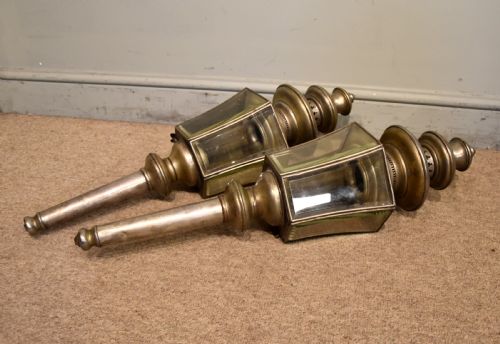


Vintage Carriage Lantern
These vintage carriage lantern examples bring authentic nineteenth and twentieth-century illumination indoors, offering robust brass, copper, and iron construction for atmospheric wall mounting.
Vintage Carriage Lantern
When you search for vintage carriage lantern designs, you encounter heavy wall-mounted lighting adapted from nineteenth-century coaching stock, railway carriages, and country houses. These pieces bridge the gap between exterior transport lighting and interior wall sconces.
The versions you meet most frequently on this page span the Victorian era through the early twentieth century, taking the form of pairs or individual copper, brass, and cast iron lanterns. Makers adapted original carriage and railway lamps into functional wall lights and wall sconces.
Origins range from English country house coaching lanterns to French Empire and Arts and Crafts interpretations. They frequently feature bevelled glass panels and patinated metal surfaces designed to withstand carriage travel before finding permanent interior placement.
Materials and construction
Makers constructed these lanterns using heavy combinations of brass, copper, cast iron, and wrought iron to endure the vibrations of horse-drawn coaches and railway lines. Verdigris patinated copper and polished brass finishes developed naturally over decades of exposure.
Glazing typically involves thick bevelled glass panes fitted securely into metal frames to diffuse the internal flame or bulb. Structural elements often incorporate gimbal mounts for movement or sturdy wall brackets for fixed illumination.
Vintage Carriage Lantern Retail Price Guide 2026
Typical asking prices for vintage carriage lantern among the pieces listed under this phrase on Sellingantiques today, from the lower quarter to the upper quarter. They describe what is for sale here now, not the wider market.
Listings feature brass, copper, and cast iron across Victorian, Arts and Crafts, and French Empire styles.
Distinctions in quality
Quality rests in the heaviness of the cast metal components and the crispness of styles like French Empire or Arts and Crafts detailing. Finer examples retain original bevelled glass panes and substantial mounting brackets rather than lightweight replacements.
The integrity of the original metal patination, whether natural verdigris on copper or polished brass, separates standard production from superior pieces. Workshop assembly and maker attribution further elevate the standing of individual lamps.
Daris
The Vintage Carriage Lantern Glossary
- Carriage Lamp
- A lighting fixture originally mounted to the exterior of a horse-drawn vehicle for night travel. These units feature heat vents at the top and sturdy mounting brackets.
- Bevelled Glass
- Glass panes with ground and polished angled edges around the perimeter. This technique adds depth and refracts light more effectively than flat glass.
- Gimbal
- A pivoted ring assembly that allows a lamp to remain level despite motion. Commonly found on pieces originating from ships or trains.
- Verdigris
- A green patina that forms naturally on copper and brass through atmospheric oxidation. Collectors prize this surface ageing for its authentic character.
- Wall Sconce
- A decorative lighting fixture fixed permanently to a wall. Many vintage carriage lanterns are adapted into this format for interior domestic use.
Vintage Carriage Lantern: Frequently Asked Questions
Where were vintage carriage lanterns originally used?
These lamps originated on the exterior of nineteenth-century horse-drawn carriages, coaches, and railway trains to illuminate dark roads and tracks. Their robust metal construction and protective glass panes were essential for enduring harsh weather and constant movement.
Over time, many of these utilitarian fixtures migrated into domestic settings as country house wall lighting. Today they serve as atmospheric wall sconces in hallways and living spaces.
How do I mount a vintage carriage lantern?
Mounting depends on the original bracket configuration attached to the back or side of the metal housing. Most pieces require secure fixings into wall studs or masonry to support the considerable weight of brass, iron, and glass.
Consult a qualified electrician to assess the internal wiring and ensure the mounting plate can safely bear the load. Many examples are adapted for modern electrical supplies while retaining their original exterior appearance.
How do I clean patinated copper and brass?
Cleaning should be approached with caution to preserve the aged surface character and verdigris developed over decades. Dusting with a soft dry cloth is usually sufficient for regular maintenance.
Avoid aggressive metal polishes that strip away historical patination unless a bright finish is specifically desired. Gentle cleaning protects the integrity of the original copper and iron surfaces.
Can I use these lanterns outdoors?
Most vintage carriage lanterns were built for exterior use on coaches and railways, possessing weatherproof metal housings and ventilation caps. However, surviving antique wiring and seals may no longer meet modern exterior safety standards.
If you plan to place a piece outside, have a professional inspect the electrical components and weatherproofing. Many buyers prefer to install them indoors where the historical finish remains protected from the elements.