



Vintage Caplock Pistols
These vintage caplock pistols bring tangible nineteenth-century engineering into your collection, offering solid walnut stocks and steel mechanisms designed for self-defence and military service.
Vintage Caplock Pistols
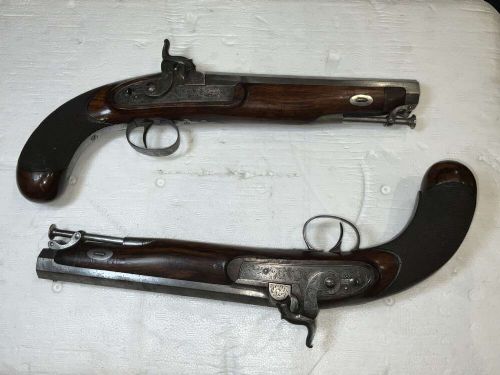
When you search for vintage caplock pistols, you encounter nineteen-century firearms designed around the percussion cap ignition system that superseded flintlock mechanisms. These pieces span the Georgian, Regency, and Victorian eras, encompassing civilian pocket arms alongside military and officers' service weapons.
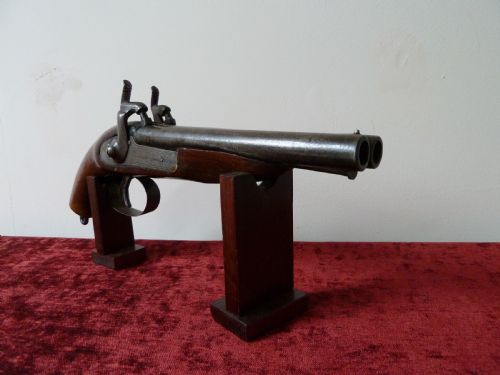
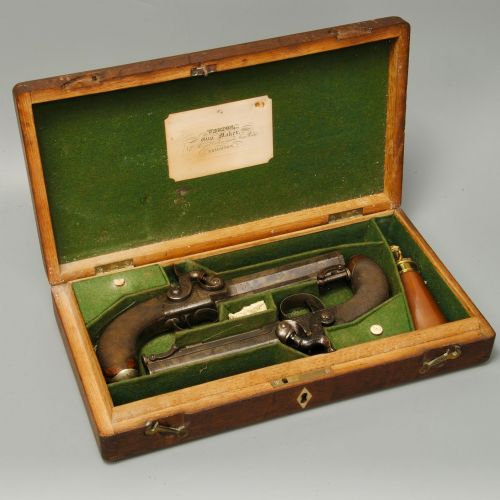
You frequently meet single and double barrel variations, as well as matched pairs housed alongside their accessories. Makers such as H. Tatham of London, Mortimer, Auguste Francotte of Liège, and government facilities at Tower are represented among these nineteenth-century designs.
The inventory covers a clear functional spread, from heavy belt pistols and military arms down to discreet gentlemens or officers pocket pistols. Each piece relies on the percussion cap method, which provided reliable ignition in damp weather compared to earlier systems.
Materials and construction
Stock construction relies heavily on figured walnut, shaped to fit the hand comfortably while housing the lock mechanism and barrel securely. Iron and steel form the barrels and internal springs, whilst brass often appears in trigger guards, ramrod pipes, and butt caps.
Makers utilised precise metalworking techniques to bore barrels and finish lockplates, sometimes lining fitted storage boxes with green baize to protect the polished metal and wood components. The transition from flintlock to percussion involved adapting existing designs or engineering new hammers to strike the copper percussion cap.
Vintage Caplock Pistols Retail Price Guide 2026
Typical asking prices for vintage caplock pistols among the pieces listed under this phrase on Sellingantiques today, from the lower quarter to the upper quarter. They describe what is for sale here now, not the wider market.
Listings feature walnut, steel, brass, iron, and baize across Victorian, Regency, and Georgian periods.
Assessing quality and craftsmanship
The reputation of the maker dictates much of the standing within this field, with signed works by known London or provincial gunmakers showing superior metal engraving and stock checkering. Unsigned military pieces prioritise utilitarian robustness over decorative flourishes, reflecting their service origins.
Finishing details on the walnut wood and the crispness of the action mechanics separate standard production arms from bespoke or exhibition quality pairs. The preservation of original barrel browning, case hardening on the lock, and matching serial numbers across paired pistols also influence overall desirability.
H Tatham London·Mortimer·Auguste Francotte
The Vintage Caplock Pistols Glossary
- Caplock
- A firearm ignition system using a small copper percussion cap placed on a nipple, struck by the hammer to detonate the powder charge. This replaced the older flintlock mechanism during the nineteenth century.
- Percussion cap
- A small metal cup containing a detonating compound that ignites gunpowder when struck by the hammer. It revolutionised reliability for firearms from the 1850s onwards.
- Belt pistol
- A relatively compact handgun intended to be tucked into a belt or sash for personal protection. These were popular with travellers and officers during the Victorian period.
- Pocket pistol
- A small, easily concealable firearm designed for civilian self-defence. They often featured folding triggers to prevent snagging on clothing.
- Baize
- A coarse woolen material resembling felt, commonly used to line fitted wooden presentation and storage cases for pistols. It protects the metal and wood finishes from scratching.
Vintage Caplock Pistols: Frequently Asked Questions
What are vintage caplock pistols?
These are nineteenth-century firearms that utilise the percussion cap ignition system rather than flint and steel. They include civilian pocket models, heavy belt pistols, and military sidearms.
Most examples date from the Victorian and Georgian eras, showcasing traditional craftsmanship in walnut and steel by makers across Britain and Europe.
How do you date a caplock pistol?
Dating relies on maker marks, proof stamps, style evolution, and sometimes engraved dates on the lockplate or barrel. Pistols from the 1850s often display specific military or civilian registration markings.
Comparing the form of the hammer, trigger guard, and stock shape against known maker timelines helps narrow down the period of manufacture.
What is the difference between a belt and pocket pistol?
Belt pistols are larger firearms meant for open carry tucked into a belt or holster, often used by officers and travellers for serious defence. Pocket pistols are significantly smaller and designed for discreet concealment.
Pocket variants frequently omit protruding belt hooks and may feature shorter barrels and folding triggers for ease of extraction.
How should I display a cased pistol pair?
Cased pairs are best kept in their original fitted wooden boxes lined with baize, away from direct sunlight and excessive humidity. Displaying them flat within a cabinet protects the delicate wood stocks and metal components.
Ensure the storage environment maintains a stable temperature to preserve the historical walnut and steel finishes without needing modern chemical treatments.