



Vintage Caplock Firearm
These vintage caplock firearm pieces are dependable 19th-century mechanical antiques offering tangible links to early percussion history.
Vintage Caplock Firearm
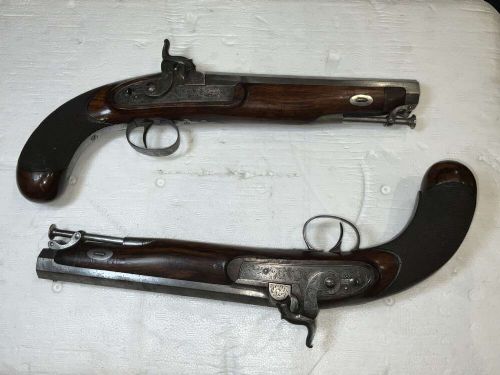
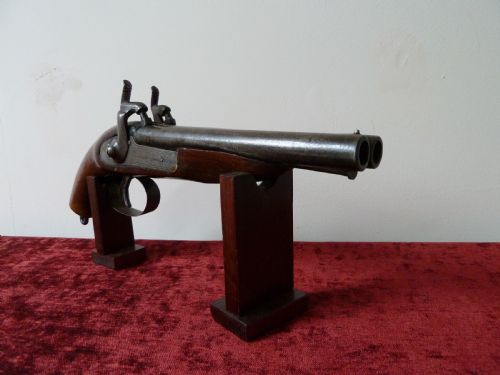
When buyers search for a vintage caplock firearm, they seek functional mechanical antiques dating predominantly from the 19th century. The pieces recorded here span the Victorian, Regency, and Georgian eras, encompassing pocket pistols, sporting rifles, and military belt pistols.
The most common formats on this page are single and double barrel percussion pistols manufactured during the mid-19th century, alongside notable specimens from earlier periods. These objects reflect both civilian gentleman use and military deployment.
How they were made
Makers constructed these arms using robust combinations of forged steel, iron, and brass for the mechanical locks, barrels, and furniture. Stocks were typically turned from dense walnut, selected for its resilience under recoil and handling.
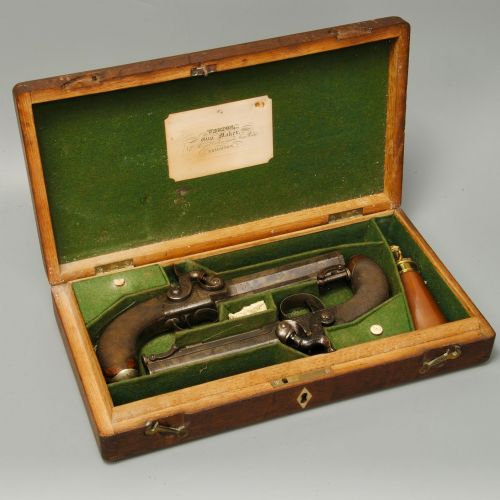
Interiors and cases occasionally incorporated baize lining for protection, while external metal components received careful finishing. The transition from flintlock to percussion cap technology defined the manufacturing era represented across these listings.
Vintage Caplock Firearm Retail Price Guide 2026
Typical asking prices for vintage caplock firearm among the pieces listed under this phrase on Sellingantiques today, from the lower quarter to the upper quarter. They describe what is for sale here now, not the wider market.
Several pocket pistols dispense with a protruding trigger entirely, relying instead on a folding design that springs free only when the hammer is cocked.
What varies in quality
Distinctions in quality rest upon the precision of the lock mechanism, the crispness of any engraving on the metalwork, and the overall integrity of the walnut stock. Maker attribution also elevates certain pieces significantly above unmarked examples.
Superior specimens display tight mechanical tolerances and harmonious proportions between metal and wood, whereas lesser examples show heavier wear or coarser finish details from standard military production.
Mortimer·Auguste Francotte
The Vintage Caplock Firearm Glossary
- Caplock
- A firearm ignition system utilising a percussion cap placed on a nipple, struck by the hammer to ignite the powder charge. This replaced the earlier flintlock mechanism.
- Percussion
- The striking of a detonating compound to ignite gunpowder within a firearm. It revolutionized reliability in damp weather conditions.
- Pocket pistol
- A compact firearm designed for discreet personal defence during the 19th century. These typically featured shorter barrels and concealed triggers.
- Belt pistol
- A sidearm equipped with a hook or balanced dimensions specifically for carrying tucked into a belt or sash. Officers and civilians utilised them extensively.
- Tower
- A designation often stamped on government-issue arms indicating production or inspection associated with the Tower of London.
Vintage Caplock Firearm: Frequently Asked Questions
What is a vintage caplock firearm?
A vintage caplock firearm is a 19th-century weapon utilising the percussion cap ignition system. These pieces include pocket pistols, belt pistols, and sporting rifles.
They represent the technological step between flintlocks and modern cartridge arms, valued today as historical mechanical antiques.
How do I identify the period?
Dating relies on stylistic markers, proof marks, and mechanical evolution. Pieces span the Georgian, Regency, and Victorian eras.
Mid-century examples often feature specific military issue markings or civil proof stamps that narrow down their decade of production.
What materials were used?
Construction primarily involved forged steel and iron for barrels and locks, paired with brass furniture. Stocks were carved from solid walnut.
Interiors of associated storage often featured fitted baize linings to protect the metal components from abrasion.
Were these used by military?
Yes, military percussion pistols formed a significant portion of production alongside civilian gentleman sidearms. Infantry and officers carried specific regulation patterns.
These military arms prioritized robust utility and standard interchangeable components over decorative engraving.