



Vintage Camelback Settee
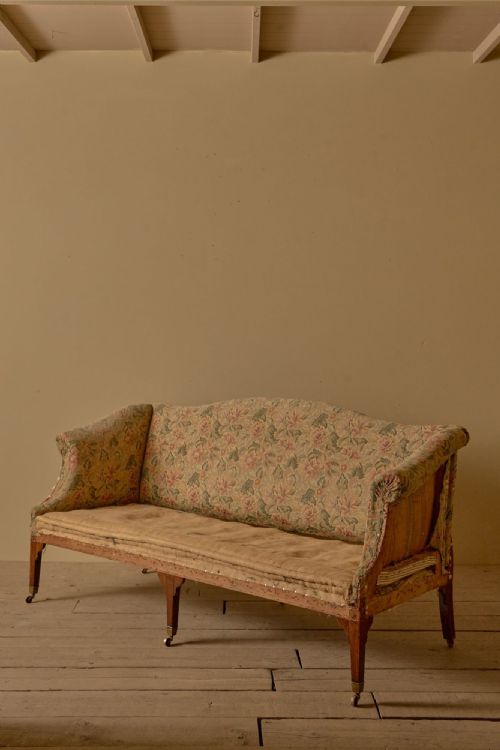
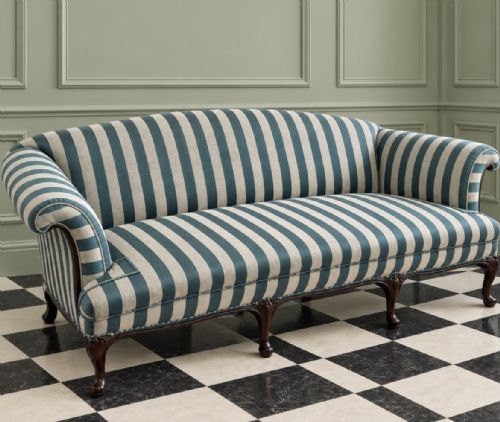
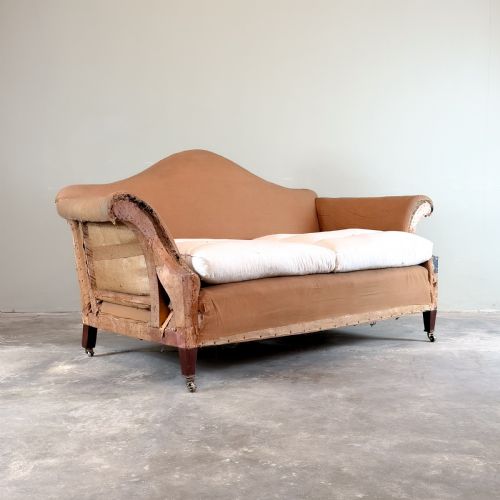
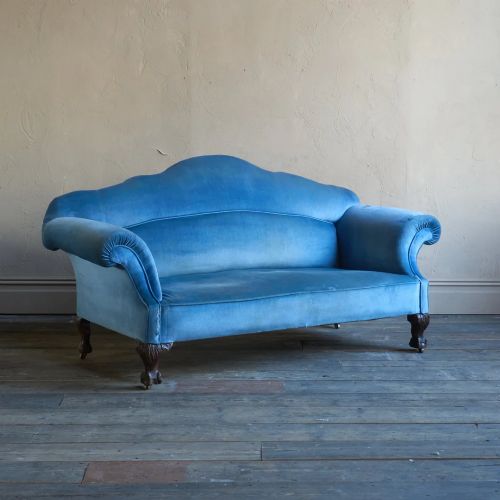
A vintage camelback settee brings arched, flowing lines and traditional upholstery into a room.
Vintage Camelback Settee
Makers drew heavily on earlier historical vocabularies, resulting in Chippendale revival, Queen Anne style, and Georgian proportions. These seating forms range from standard two-seater sofas to serpentine front designs supported by various leg configurations.
Origins trace across nineteenth century workshops and Edwardian furniture houses, sometimes bearing retail connections such as Liberty's. The structural form remains consistent even as stylistic revivals shift the decorative detailing.
Materials and construction
Frames rely primarily on solid timber foundations such as mahogany and walnut, providing the structural rigidity needed for curved woodwork. Artisans shaped these hardwoods to form the characteristic serpentine fronts and supporting legs.
Upholstery techniques involve traditional stuffing and springing finished in textiles like velvet, damask, and patterned fabric. Exposed wooden elements often feature carved details, while functional support utilises brass castors where applicable.
Vintage Camelback Settee Retail Price Guide 2026
Typical asking prices for vintage camelback settee among the pieces listed under this phrase on Sellingantiques today, from the lower quarter to the upper quarter. They describe what is for sale here now, not the wider market.
Listings span the nineteenth century, Edwardian era, and early twentieth century, utilising mahogany, walnut, and brass.
Distinguishing quality
Quality rests in the precision of the timber carving and the harmony of the proportion, particularly how the arched back sweeps down into the arms. Pieces executed in the nineteenth century with refined ball and claw leg carving demonstrate superior craftsmanship compared to simpler iterations.
The integrity of the frame construction and the fidelity to historical revival styles dictate the standing of an individual settee. Higher tier examples maintain crisp lines in the mahogany or walnut framework alongside well-balanced serpentine fronts.
The Vintage Camelback Settee Glossary
- Camelback
- A sofa or settee featuring a distinctive convex curve along the top of the backrest. This arched profile is the defining characteristic of the form.
- Serpentine front
- A furniture front that curves outward in the centre and inward toward the ends. It adds visual depth to the base of the settee.
- Ball and claw
- A furniture foot carved to represent a bird's talon clutching a ball. This classical motif frequently appears on revival pieces.
- Chippendale revival
- A late nineteenth or early twentieth century style replicating the eighteenth century designs of Thomas Chippendale. It often incorporates carved mahogany and elaborate details.
Vintage Camelback Settee: Frequently Asked Questions
Where should I place a settee?
A settee suits placement in a drawing room, hallway, or bedroom where its formal silhouette can be viewed in the round. The low back allows it to sit beneath windows without blocking light.
Because these pieces feature finished backs and decorative woodwork, they work well floating away from walls. Pairing them with antique armchairs creates a cohesive traditional seating arrangement.
Are these settees comfortable for daily use?
These seating pieces offer firm, upright support characteristic of traditional period upholstery. The sprung seats and tight backrests encourage an upright posture rather than deep lounging.
Original internal stuffing may feel firmer than modern foam cushioning. Many owners retain the historic build while ensuring the underlying webbing remains secure for regular sitting.
What is the difference between a sofa and a settee?
Historically, a settee referred to a small, upholstered wooden bench with a back and arms, designed for two people. Over time, the terms began to overlap significantly in furniture manufacturing.
In the context of nineteenth and twentieth century listings, both terms describe the same double-seating form. The specific proportions and back shape matter more than the chosen nomenclature.