




Vintage Altar Sticks
Vintage altar sticks bring solemn architectural presence to domestic rooms, offering brass and carved wood built for ecclesiastical spaces.
Vintage Altar Sticks
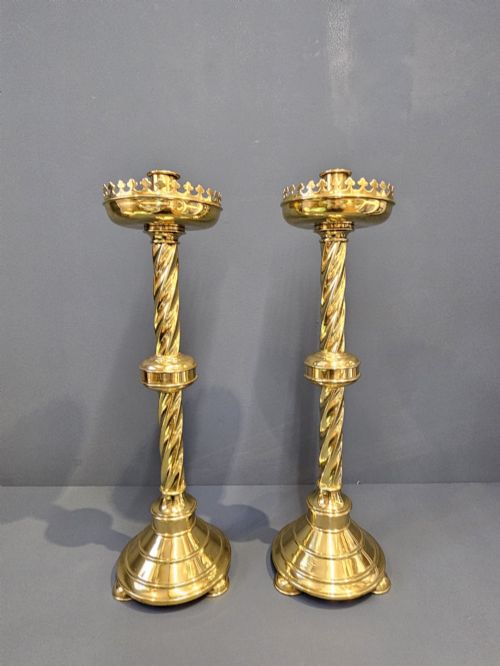
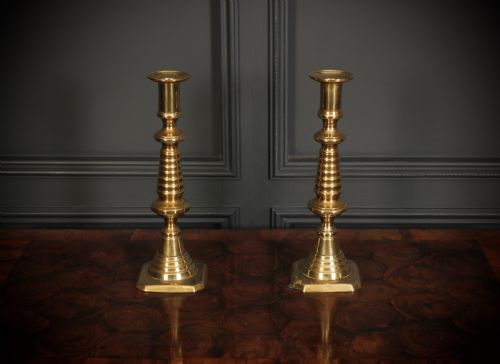
Vintage altar sticks comprise tall brass church candlesticks, carved wooden candle holders, and repurposed lamp bases originating from ecclesiastical and domestic settings. Buyers searching for vintage altar sticks encounter brass and wood examples spanning the Victorian period through the early twentieth century. Gothic Revival designs dominate the selection, bringing heavy cast metal and pointed architectural motifs into the room.
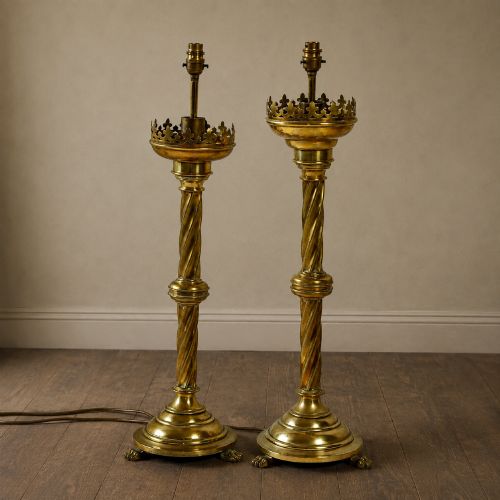
Most pieces appear in matched pairs, standing significantly taller than standard domestic table lights to illuminate church sanctuaries. Forms range from strict Victorian brass columns to French wooden candle holders and Italian gilt-wood variants. Several pieces have later adaptations as table lamps, merging historical metalwork with modern electrical wiring.
Materials and construction
Heavy cast brass forms the backbone of these pieces, often worked with Gothic Revival detailing and turned profiles. Foundries utilised solid brass construction to support the considerable height required for altar illumination, ensuring stability on stone or timber surfaces.
Carved wood provides an alternative medium, frequently finished with gesso, paint, or giltwood to emulate richer materials. Artisans shaped timber into turned shafts and decorative candle lamps, applying surface treatments that patinated through decades of ecclesiastical use.
Listings span the Victorian era through the 1930s, uniting heavy brass church metalwork with carved French and Italian gilt-wood.
Assessing quality and proportion
Weight and metal gauge distinguish substantial Victorian church metalwork from lighter domestic reproductions. The thickness of the brass casting determines the physical presence of the stick, while crispness in the turned joints reveals the skill of the original workshop.
Surface integrity and original gilding separate well-preserved examples from heavily stripped or altered pieces. The harmony of the proportions, particularly the balance between the heavy base and the slender stem, dictates the visual success of the object.
T Thomason & Co
The Vintage Altar Sticks Glossary
- Gothic Revival
- An architectural and decorative style drawing on medieval pointed arches and structural forms, prevalent in nineteenth-century church furnishings. This aesthetic shapes much of the heavy brass metalwork seen in ecclesiastical pieces.
- Pricket stick
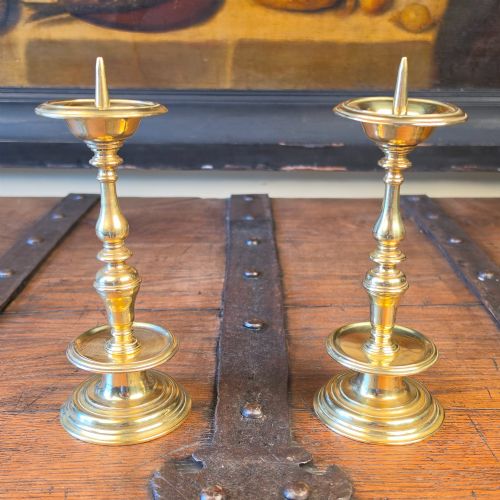
- A candlestick featuring an upward-facing metal spike designed to secure a wax candle rather than a socket holding it. These items traditionally sat upon church altars before the widespread adoption of socketed candle holders.
- Giltwood
- Timber coated with a thin layer of gold leaf or gilt paint to simulate solid gold enrichment. Italian and French workshops utilised this finish on carved candle lamps.
- Gesso
- A plaster-like mixture applied to wood surfaces as a smooth base for painting or gilding. This material allows intricate decorative mouldings to adhere firmly to a wooden core.
Vintage Altar Sticks: Frequently Asked Questions
How tall are vintage altar sticks?
These pieces generally stand much higher than domestic candlesticks because they were designed to project light across large church chancels. Heights frequently exceed thirty centimetres, giving them a commanding vertical presence on sideboards or mantelpieces.
Buyers should measure their intended display space carefully to ensure the height complements surrounding furniture without overwhelming smaller rooms.
Were these originally for candles or lamps?
The majority began life as solid wax candle holders utilised in ecclesiastical rituals during the nineteenth century. Workshops often fabricated heavy brass pricket sticks or socketed candlesticks specifically for church altars.
Many surviving examples have subsequently been converted into electric table lamps while retaining their historic metal stems and weighted bases.
How do I care for antique brass?
Historic brass benefits from minimal intervention to preserve the dark, accumulated patination built up over decades. Gentle dusting with a dry cloth keeps the surface clean without removing the historical character of the metal.
Avoid harsh chemical polishes that strip away the aged finish and diminish the visual depth of Victorian castings.
How do I identify Gothic Revival pieces?
Gothic Revival items feature distinct architectural elements borrowed from medieval cathedrals, such as trefoils, heavy collars, and stepped triangular bases. Makers cast these objects in thick brass to emulate structural stonework and ecclesiastical ironmongery.
This aesthetic stands apart from smoother Baroque or classical designs through its emphasis on vertical lines and pointed motifs.