


Victorian Venice Painting
A victorian venice painting captures the watery light and grand palazzos of the lagoon through nineteenth-century brushwork.
Victorian Venice Painting
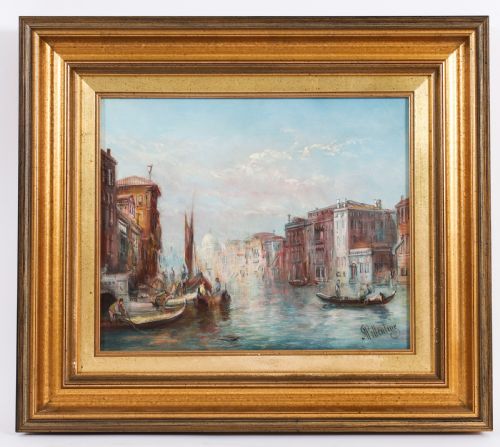
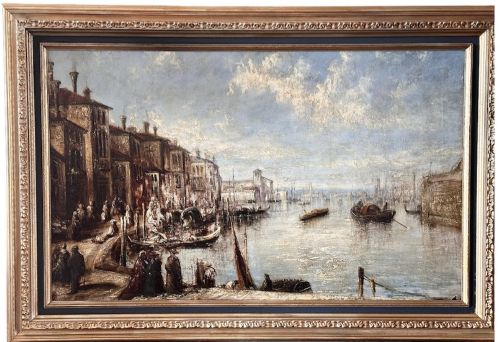
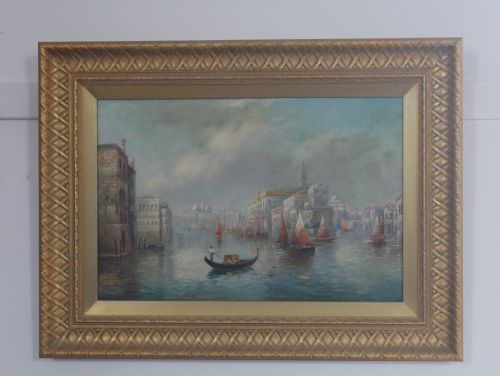
These works capture the architectural landmarks and bustling waterways of the Italian city during the nineteenth century. Common subjects include the Grand Canal, the Doge's Palace, the Dogana, and the church of Santa Maria della Salute. Most examples date from the Victorian era and the closing decades of the nineteenth century.
Buyers will encounter both expansive townscape oils and delicate paper watercolours. The compositions frequently depict daily lagoon life, gondolas, and atmospheric sunsets over the water. Artists recorded these topographical scenes directly from travels to Italy during the period.
Materials and construction
The works utilise oil paints applied to stretched canvas or wood panels, alongside watercolours rendered on paper. Canvases are frequently housed within period wooden frames, often finished in giltwood or gilded wood that complements the warm tones of the painted lagoon.
Painters built up the cityscapes using layered pigments to capture the distinct reflection of light on water and stone. Watercolourists employed washes on paper to achieve luminous skies and transparent lagoon depths, while oil painters utilised heavier brushwork for architectural mass.
Listings feature works created across the nineteenth century, spanning oil paintings on canvas and watercolours on paper.
What separates the finest examples
Quality rests in the precision of architectural perspective and the handling of atmospheric light across the water. Superior works render the subtle colour shifts of the Venetian sky and lagoon with distinct clarity rather than formulaic repetition.
The handling of figures and gondolas within the composition adds depth and narrative interest. Works framed in their original period giltwood mouldings retain a stronger historical integrity than those with later replacements.
Alfred Pollentine·Francis Moltino·Jane Vivian·Hercules Brabazon Brabazon·Frank Wasley
The Victorian Venice Painting Glossary
- Grand Canal
- The main water-traffic artery of Venice, frequently depicted by nineteenth-century artists winding past historic palazzos.
- Dogana
- The historic customs house situated at the confluence of the Grand Canal and the Giudecca Canal. It forms a central architectural focal point in many lagoon views.
- Santa Maria della Salute
- A monumental seventeenth-century Roman Catholic church dominating the entrance to the Grand Canal. Its prominent dome appears repeatedly in Victorian townscapes.
- Giltwood
- Wood carved and coated with gold leaf or gold paint, commonly used for the ornate frames enclosing these paintings.
- Watercolour
- A painting method in which the paints are made of pigments suspended in a water-based solution, typically applied to paper in these nineteenth-century depictions.
Victorian Venice Painting: Frequently Asked Questions
How do I identify a Victorian Venice painting?
Examine the materials, framing styles, and the specific architectural landmarks depicted within the composition. Nineteenth-century works typically employ oil on canvas or watercolour on paper, showing characteristic wear on original wooden or gilt frames.
Look closely at the artist signatures and recorded dates where available. The costume of any figures depicted and the specific treatment of the lagoon architecture align with nineteenth-century painting conventions.
What are the common subjects in these paintings?
Artists focused heavily on iconic civic and religious landmarks surrounding the Venetian lagoon. The Grand Canal, the Doge's Palace, and Santa Maria della Salute appear with great regularity.
Scenes also encompass wide views from the Giudecca Canal and the open lagoon. These compositions often incorporate gondolas, trading vessels, and local inhabitants to animate the waterways.
Are these works created in oil or watercolour?
Both mediums are prevalent among nineteenth-century depictions of the city. Oil paintings were typically executed on canvas or wood panels, offering rich textures and deep colour saturation.
Watercolour paintings on paper capture a lighter, more luminous atmosphere. Both mediums were favoured by travelling artists recording their journeys to Italy.
How should I frame and display my painting?
Display the artwork away from direct sunlight and fluctuating humidity to protect the canvas, paper, and giltwood frames. Maintaining stable indoor environments preserves the integrity of the nineteenth-century materials.
Retain original period frames where possible, as they complement the historical context of the artwork. Consult a professional conservator if the canvas or paper requires cleaning or stabilization.