


Victorian Venetian Oil Canvas
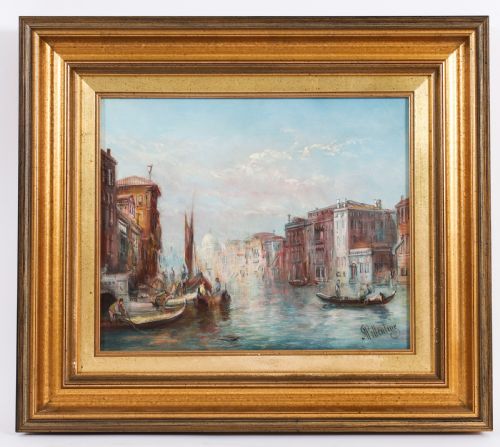
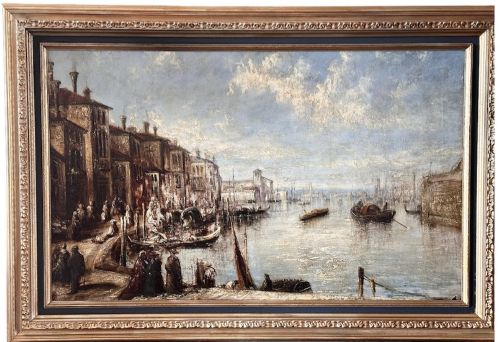
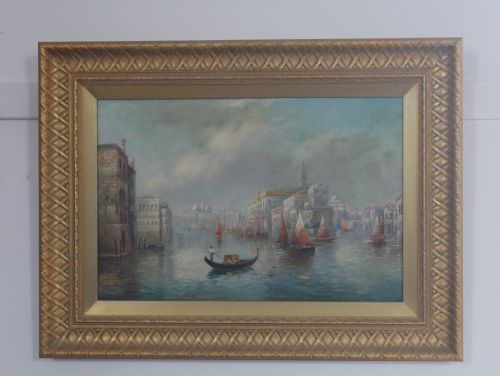
These Victorian Venetian oil canvas works capture the luminous atmosphere of the lagoon, bringing nineteenth-century Italian scenes straight to your wall.
Victorian Venetian Oil Canvas
When you search for a victorian venetian oil canvas, you encounter nineteenth century paintings depicting iconic waterborne scenes such as the Grand Canal, the Doge's Palace, and the lagoon. These oil paintings celebrate the topography and romantic spirit of Venice during the Victorian era.
The most common examples on this page are townscape oil paintings by named artists, framed in giltwood or gilded wood. They portray famous landmarks like the Santa Maria della Salute and the Dogana under broad nineteenth century romanticism styles.
Subjects range from bustling canal processions to quiet architectural studies, all rendered on canvas using traditional oil techniques. They provide a direct window into how British and European artists viewed the Italian city during the decades around eighteen eighty and eighteen ninety.
What varies in quality
The distinction between tiers rests upon the precision of the architectural draughtsmanship and the artist's command of atmospheric light. Stronger works render the intricate marble details of palaces and the transparent ripples of water with distinct clarity.
Framing also influences the overall standard, as original period giltwood and gilded wood surrounds complement the canvas far better than later replacements. The reputation of the artist, such as Alfred Pollentine or Jane Vivian, naturally elevates the standing of a piece.
Listings feature canvases spanning from eighteen seventy up to eighteen ninety, showcasing the height of Victorian interest in Venetian townscapes.
Alfred Pollentine·Francis Moltino·F.D. Campo·Jane Vivian·William Raymond Dommersen
The Victorian Venetian Oil Canvas Glossary
- Oil on Canvas
- Pigment mixed with a drying oil, applied to a stretched fabric support. This combination allowed nineteenth century artists to achieve deep tonal gradations and luminous colour.
- Giltwood
- Wood carved and coated with gold leaf or a metallic powder finish. It provides traditional reflective framing for Victorian fine art.
- Dogana
- The historic customs house of Venice situated at the confluence of the Grand Canal and the Giudecca Canal. It frequently appears as a focal point in nineteenth century townscapes.
- Townscape
- A genre of painting focused on urban views, streets, and canals. These works document historic architecture and daily activity in Victorian cities.
- Romanticism
- An artistic movement emphasising emotion, individualism, and awe of nature and history. In Venetian paintings, this style manifests in dramatic skies and warm, atmospheric colour palettes.
Victorian Venetian Oil Canvas: Frequently Asked Questions
Who painted these Venetian scenes?
The works listed here are attributed to various nineteenth century painters who specialised in Italian townscapes. Artists such as Alfred Pollentine, Jane Vivian, and William Raymond Dommersen recorded the architecture and waterways of Venice during the Victorian era.
Their paintings document specific locations like the Grand Canal and the Doge's Palace, often signed and dated within the eighteen seventies, eighties, and nineties.
How should I frame an oil painting?
Many of these works retain their period giltwood or gilded wood frames, which complement the nineteenth century aesthetic. If framing needs attention, consult a specialist who understands traditional wooden mouldings and gold leaf application.
Keep frames dusted gently with a soft brush and avoid moisture or direct sunlight to preserve both the canvas and the carved wood surround.
Where were these paintings created?
Artists travelled from Britain and across Europe to paint Venice firsthand, capturing the unique light and atmosphere of the lagoon. Some works may have been finished in studio settings in Rome or Venice based on earlier observational sketches.
This movement of artists produced a wealth of townscape oil paintings that catered to Victorian collectors eager for Italian subjects.
How do I identify a Victorian oil painting?
Look at the materials and style indicators, such as oil on canvas supports paired with nineteenth century romanticism or Victorian fine art conventions. Dates inscribed on the canvas or stretcher frames, alongside artist signatures, often confirm the period.
The use of heavy giltwood frames and specific architectural subjects like the Santa Maria della Salute further helps anchor the piece in the late nineteenth century.