

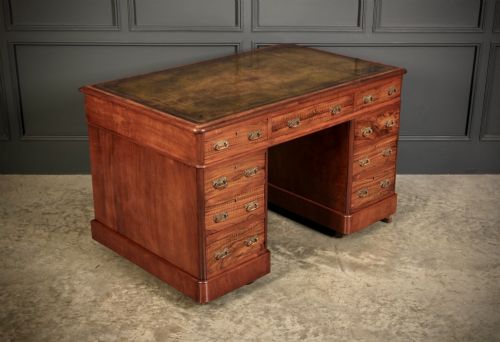
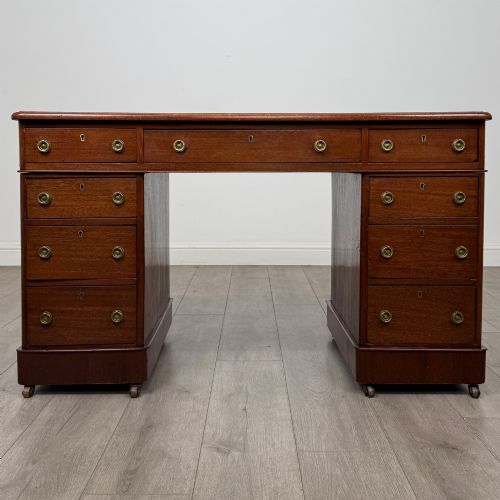


Victorian Twin Drawer Desk
A victorian twin drawer desk brings functional nineteenth century craftsmanship into a modern study with rich timber and traditional leather inserts.
Victorian Twin Drawer Desk
A victorian twin drawer desk sits firmly in the nineteenth century tradition, often appearing as a writing table or pedestal form. These pieces emerge from workshops spanning the period from eighteen fifty to nineteen thirty, showing how workspace furniture evolved to meet domestic and professional needs.
The layout typically involves side-by-side drawers beneath the writing surface or dual pedestals flanking a central kneehole. Mahogany, oak and burr walnut dominate the construction, providing robust surfaces designed for daily correspondence and study.
Materials and Construction
Cabinet makers relied heavily on solid hardwoods like mahogany and oak, frequently applying figured burr walnut veneers to primary surfaces. Brass handles, drawer locks and occasionally castors completed the functional hardware.
Writing surfaces were traditionally inset with panels of leather, often tooled with gilt borders. Turned supports and carved detailing appeared across various examples, reflecting the stylistic shifts within the Victorian era.
Victorian Twin Drawer Desk Retail Price Guide 2026
Typical asking prices for victorian twin drawer desk among the pieces listed under this phrase on Sellingantiques today, from the lower quarter to the upper quarter. They describe what is for sale here now, not the wider market.
Secret drawers hidden within pedestals give these desks a delightful capability for concealing private letters.
Judging Quality
The standard of timber selection largely dictates the standing of a piece, with finely figured mahogany and rich burr walnut commanding attention. Original leather inserts with intact tooling reflect superior preservation.
Cabinetmaking precision shows in the crispness of turned supports, the tightness of drawer joints and the retention of original brass fittings. Subtle carved details and balanced proportions distinguish finer examples from standard utility pieces.
Edwards & Roberts
The Victorian Twin Drawer Desk Glossary
- Pedestal desk
- A form featuring two supporting banks of drawers beneath the main writing surface. These units create a substantial footprint in a room.
- Burr walnut
- A highly decorative wood veneer taken from the growth burls of the walnut tree. It produces swirling, intricate patterns across desk fronts.
- Kneehole
- The central recessed space beneath a desk designed to accommodate the user's legs. It separates the supporting pedestals.
- Writing table
- A lighter form of desk focused on a flat top surface with integrated drawers. These tables often stand on slender turned legs rather than heavy pedestals.
Victorian Twin Drawer Desk: Frequently Asked Questions
How do I care for the leather top?
Clean the surface gently with a dry or barely damp cloth to remove dust without disturbing the leather.
Apply a specialist leather balsam periodically to maintain suppleness and protect the gilt tooling from cracking.
Where should I place a pedestal desk?
Position the piece away from direct sunlight and heat sources to prevent the timber and veneers from drying out.
Allow sufficient clearance around the pedestals and kneehole for comfortable daily seating and movement.
Were these desks used for writing or administration?
The layout served both personal correspondence and formal business administration throughout the nineteenth century.
Many examples include multiple drawers for organising stationery, documents and writing instruments.