

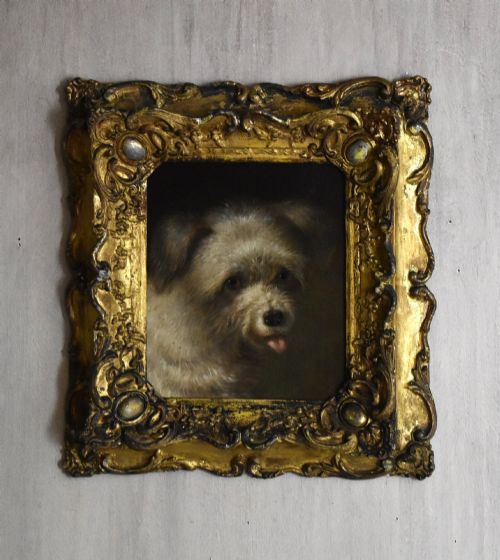
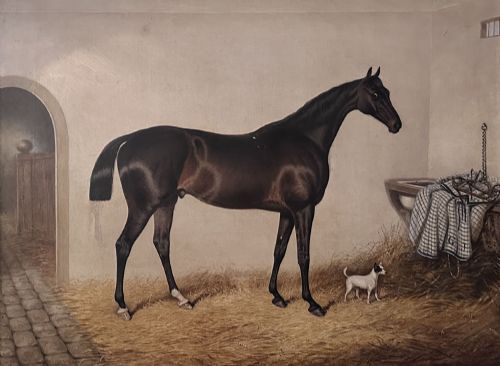


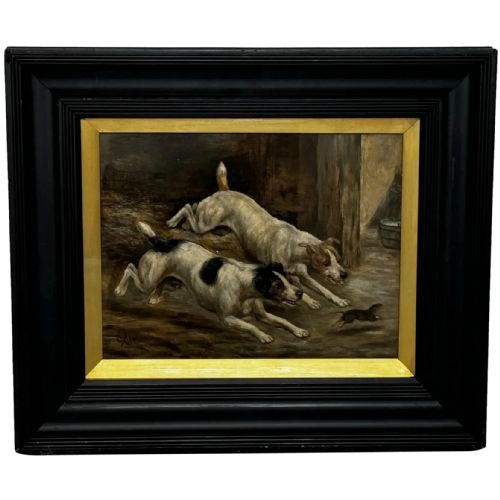


Victorian Terrier Oil Painting
These Victorian terrier oil paintings capture the spirit and grit of working dogs in oils on canvas.
Victorian Terrier Oil Painting
A victorian terrier oil painting brings the lively character of working dogs directly onto canvas, capturing the distinct personality of breeds like the Jack Russell, Scottish terrier, and fox terrier. These works range from intimate single-dog portraits in walled gardens to dramatic barn scenes of terriers tracking or guarding against rats.
Buyers will encounter various formats on this page, including solitary studies, lively pairs, and multi-dog compositions set in farmyards or rural landscapes. The selections span the nineteenth century into the early twentieth century, reflecting both mainstream Victorian realism and sporting art traditions.
Materials and construction
Artists painted primarily with oil paint on stretched canvas, building rich textures and deep tones for the animals' coats and surrounding barn interiors. Wood often forms the structural stretcher frames that support these canvases, maintaining the tension of the cloth over decades.
Many surviving examples are finished with giltwood or gold leaf frames that enhance the warmth of the palette. The physical application relies on traditional nineteenth-century brushwork, combining fine detail in the dogs' eyes and fur with looser, atmospheric backgrounds.
Recorded object types include oil paintings, fine art, and portrait studies executed in Victorian realism and sporting art styles.
Factors that define quality
The distinction between standard works and exceptional pieces lies in the anatomical accuracy and the psychological capture of the animal. Master painters render the intelligent expression, coarse wire hair, and muscular tension of a terrier with a convincing energy that lesser hands miss.
Compositional complexity also elevates a piece, shifting quality from a simple static portrait to a dynamic narrative scene like a ratting hunt in a barn. The handling of light across the canvas and the integration of original period framing further distinguish the finest examples.
Valentine T. Garland·Martin Theodore Ward·Sir Edwin Landseer·John Emms·George Armfield·Edward Armfield·Samuel Fulton
The Victorian Terrier Oil Painting Glossary
- Oil paint
- A slow-drying paint made from pigment particles suspended in a drying oil, typically linseed. This medium allows for subtle blending and rich tonal depth.
- Canvas
- A heavy woven fabric, usually linen or cotton, stretched tightly across a wooden frame to serve as the painting surface. It provides a durable ground for nineteenth-century oil works.
- Giltwood
- Wood that has been thinly coated with gold leaf or gold paint. Frames of this material are common on fine nineteenth-century art.
- Sporting art
- Depictions of rural sports, horses, and working dogs that gained immense popularity in Britain during the nineteenth century. These works document the pursuits and animals of the period.
- Follower
- An artist whose work closely imitates the style and subject matter of a more famous master without being a direct copy. Such pieces reflect the broader artistic influence of prominent painters.
Victorian Terrier Oil Painting: Frequently Asked Questions
What breeds appear in these paintings?
The works feature various terriers including Jack Russells, Scottish terriers, fox terriers, Cairn terriers, and West Highland terriers.
Artists also depicted hound types and mixed working dogs alongside the terriers in farmyard and hunting contexts.
Where were these paintings displayed originally?
Victorian dog portraits hung primarily in country houses, sporting lodges, and urban parlours to celebrate valued working pets.
Owners often commissioned them to record the specific likeness and ability of a favourite working terrier.
How do I care for an oil painting on canvas?
Keep the canvas away from direct sunlight and damp conditions to prevent paint cracking and wood warping.
Dust the surface gently with a soft, dry brush and avoid using any liquid cleaners on the paint or frame.
How can I tell the period of the painting?
Examine the materials of the stretcher frame, the weave of the canvas, and the style of the giltwood framing.
Signature styles, artist records, and historical subject matter like nineteenth-century farmyard ratting scenes also help date the work.