

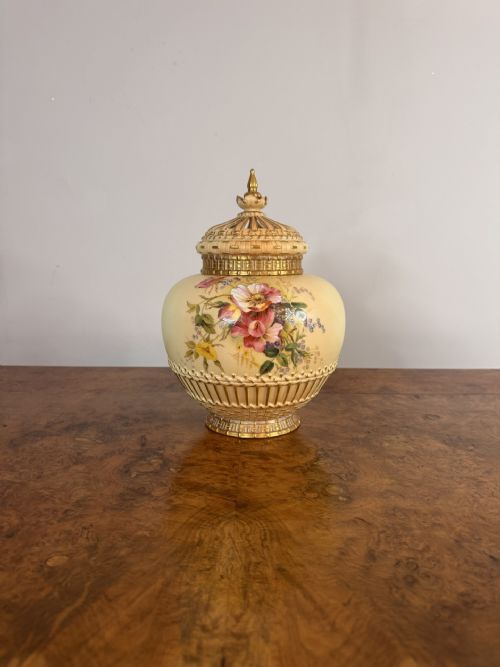
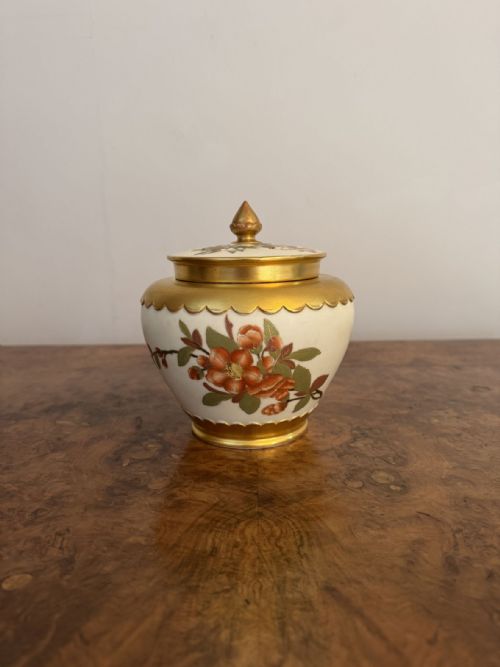


Victorian Potpourri Jar
These Victorian potpourri jar examples bring scented dried petals and leaves into the historic drawing room with colour and craftsmanship.
Victorian Potpourri Jar
A Victorian potpourri jar is a lidded vessel designed to hold scented botanical mixtures, commonly encountered as vases, urns, and ginger jars from the nineteenth century. The examples on this page span the Victorian and Edwardian periods, including pieces from the eighteen-seventies through to nineteen-ten.
Forms vary from large lidded pots to paired urns and ginger jars, often featuring crown covers or pierced lids intended to release fragrance. English factories such as Royal Worcester and Mason's Ironstone dominate the selections, alongside continental porcelain manufacturers.
Makers utilise distinct decorative styles including Blush Ivory finishes, Rococo Revival shaping, and English Imari palettes. Buyers encounter everything from robust ironstone bodies to delicate porcelain painted with floral motifs.
Materials and manufacture
Potters shaped these vessels from ceramic bodies such as porcelain, ironstone, and bone china, firing them to create durable containers suitable for domestic display. Artisans applied hand-painted designs, enamels, and gilding over the glaze to enrich the surfaces.
Intricate details like crown covers and pierced lids required careful ceramic moulding and cutting to allow the contained fragrance to circulate effectively. Gilders added gold leaf and gilt accents to highlight handles, rims, and moulded motifs.
Victorian Potpourri Jar Retail Price Guide 2026
Typical asking prices for victorian potpourri jar among the pieces listed under this phrase on Sellingantiques today, from the lower quarter to the upper quarter. They describe what is for sale here now, not the wider market.
Crown covers were ingeniously pierced so that parlour guests could enjoy the scent of roses without ever seeing the dried leaves.
Assessing quality and execution
Quality rests in the crispness of the moulding and the delicacy of the hand-painting upon the ceramic body. Finer vessels display precise gilding and subtle shading within the floral or scenic enamel work.
The sophistication of the form distinguishes standard production wares from ambitious factory output. Pierced covers executed with clean symmetry reflect greater technical skill than simpler, heavier lids.
Royal Worcester·Mason s Ironstone·Wolfsohn Dresden·Sitzendorf Porcelain
The Victorian Potpourri Jar Glossary
- Blush Ivory
- A specialised porcelain finish developed by Royal Worcester featuring a warm, matte cream ground often decorated with soft floral colours and gilding.
- Potpourri
- A mixture of dried petals and spices placed in a lidded vessel to scent a room.
- Ginger Jar
- A high-shouldered ceramic storage vessel with a domed lid, frequently adapted during the period to hold potpourri.
- Gilt
- A thin layer of gold applied to the ceramic surface to ornament handles, rims, and panels.
- Crown Cover
- A pierced or domed lid designed to allow scent to escape while keeping the potpourri contained inside the vessel.
Victorian Potpourri Jar: Frequently Asked Questions
How were potpourri jars used?
Victorian households placed these lidded jars in reception rooms and parlours to freshen indoor air with botanical fragrances. The scented mixture of dried petals, spices, and oils remained inside while the aroma drifted through the pierced covers.
When not actively perfuming a room, the decorative vessels functioned as mantel ornaments or centrepieces on parlour tables.
How do I care for my jar?
Protect antique porcelain and ironstone by dusting gently with a soft, dry cloth without using liquid cleaners that might harm historic gilding or enamels. Avoid placing vessels in direct sunlight to preserve hand-painted colours.
If you choose to use the jar for modern potpourri, line the interior with tissue paper to protect the historic ceramic surface from oils.
How do I identify the period?
Dating relies on factory marks stamped or painted on the base, stylistic traits like Blush Ivory finishes, and manufacturing techniques characteristic of the nineteenth century. Examining the paste, glaze, and gilding style helps distinguish Victorian production from later copies.
Reference marks specific to makers such as Royal Worcester or Mason's Ironstone provide precise chronological placement.