


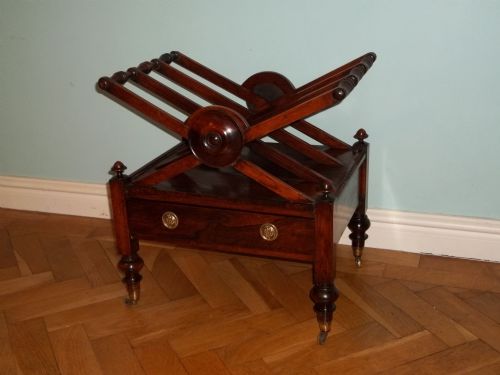


Victorian Periodical
A victorian periodical or magazine stand organises the journals of the day in mahogany, rosewood, walnut, and tubular brass.
Victorian Periodical
These items take the form of magazine racks, canterbury stands, and revolving bookcases designed to hold publications. You will most frequently meet mahogany canterburys and brass-mounted revolving stands originating across the nineteenth century.
Makers adapted traditional furniture forms to suit the growing volume of printed reading material in the home. The selection spans compact stands and multi-tiered revolving designs intended for the parlour or study.
How they were made
Constructed primarily from solid timbers like mahogany, rosewood, and walnut, many pieces incorporate turned components and polished surfaces. Workshops paired these woods with metal wire and tubular brass to form sturdy framework and revolving mechanisms.
Joinery techniques typical of the period ensure stability in slotted dividers and freestanding frames. Brass fittings add structural support and mobility to rotating book and magazine holders.
What varies in quality
Distinction across the range lies in the selection of cabinet timbers and the precision of the turning work. Finer pieces demonstrate careful attention to the grain of walnut and mahogany alongside robust brass hardware.
The sophistication of the design, such as whether a stand incorporates a smooth revolving mechanism or intricate fretwork divisions, separates standard examples from exceptional ones.
Howard and Sons of London
The Victorian Periodical Glossary
- Canterbury
- A low stand fitted with upright divisions for holding sheet music, books, or periodicals. These pieces usually feature carrying handles and small legs.
- Revolving bookcase
- A freestanding fixture designed to rotate on a central pivot, allowing easy access to publications from any seated position. Brass mechanisms often facilitate the rotation.
- Magazines and periodicals
- Serial publications containing articles, stories, and illustrations that surged in popularity during the nineteenth century. Furniture was specifically designed to house them.
- Tubular brass
- Hollow metal tubing utilised in the construction of stands and racks during the Victorian era. It provided a lightweight yet durable alternative to solid metal.
Victorian Periodical: Frequently Asked Questions
What is a canterbury stand?
A canterbury is a compartmentalised stand originally built to keep sheet music and reading material tidy beside a chair.
In modern rooms, the vertical dividers serve just as well for contemporary magazines and journals.
How do revolving stands work?
Revolving stands rest on a central brass spindle or bearing that allows the upper tiers to turn freely.
This mechanism lets readers select publications without needing to walk around the entire piece of furniture.
What woods were used?
Cabinetmakers relied heavily on rich timbers including mahogany, rosewood, and walnut for these items.
These woods were chosen for their durability and polished appearance in nineteenth-century interiors.
Where were these stands placed?
Households positioned these racks in drawing rooms, parlours, and studies where family members gathered to read.
They kept current periodicals within arm's reach of seating areas.