


Victorian Opal Engagement Ring
These victorian opal engagement ring pieces combine iridescent play-of-colour with enduring nineteenth-century settings, offering a romantic alternative to conventional diamonds.
Victorian Opal Engagement Ring
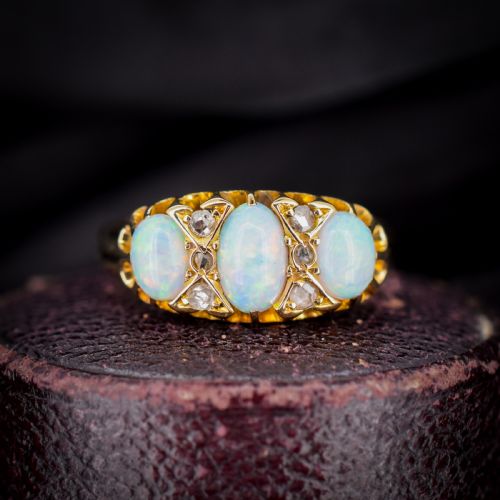
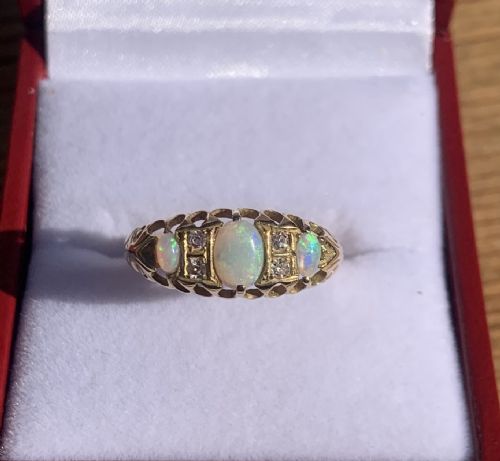
A victorian opal engagement ring brings together the distinctive fiery iridescence of natural opals with period diamond accents, predominantly set in warm eighteenth-carat yellow gold. Most examples follow established nineteenth-century formats such as the trilogy, the cluster, or the single-stone solitaire.
The selection ranges across the nineteenth century, featuring dated pieces from eighteen-seventy, eighteen-eighty, and eighteen-ninety alongside fully hallmarked examples from Chester and Glasgow. While Victorian and Edwardian periods dominate, forms span simple claw-set designs to elaborate multi-stone clusters incorporating rubies.
Buyers encounter rings where cabochon-cut opals take centre stage, flanked by old-cut or rose-cut diamonds that catch the candlelight differently than modern stones. The resulting jewels reflect the sentimental jewellery traditions of the Victorian era, designed to celebrate betrothal with character and individual charm.
Materials and construction
Goldsmiths of the period relied heavily on eighteen-carat yellow gold and silver-topped gold to mount their gemstones securely by hand. Settings typically utilise claw or cluster configurations designed to maximise the light entering the cabochon opal.
Opals are shaped into smooth cabochons rather than facets, a technique that preserves the stone's internal play-of-colour and fluid optical effects. Diamonds accompanying the central stones are frequently rose-cut or old-mine cut, bedded securely within traditional metalwork.
Victorian superstition held that opals brought bad luck unless they were your birthstone, a clever marketing myth started when Queen Victoria boldly bought and gifted them anyway.
Distinctions in quality
The primary distinction lies in the vibrancy and coverage of the opal's play-of-colour, alongside the structural integrity of the gold setting. Superior examples display vivid spectral flashes across the entire stone rather than dull or muted patches.
Fine craftsmanship shows in the balanced proportion between the central opal and its surrounding diamond cluster, with clean claw work and legible hallmarks indicating regional assay offices.
The Victorian Opal Engagement Ring Glossary
- Cabochon
- A gemstone shaped with a smooth, rounded, convex upper surface rather than flat facets. This traditional cut is essential for displaying the shifting spectral colours within opals.
- Trilogy ring
- A finger ring featuring three principal gemstones set in a row. In these pieces, an opal typically occupies the centre position flanked by diamonds.
- Cluster ring
- A jewellery design where a central gemstone is encircled by a border of smaller stones, usually diamonds. This arrangement amplifies the visual presence of the main gem.
- Rose-cut diamond
- An antique diamond cut featuring a flat base and a domed crown composed of triangular facets. This style produces a soft, translucent gleam rather than brilliant scintillation.
- Hallmark
- An official stamp applied to precious metals indicating purity, origin, and sometimes the year of manufacture. Chester and Glasgow assay marks frequently appear on these pieces.
Victorian Opal Engagement Ring: Frequently Asked Questions
How do I care for an antique opal ring?
Opals contain natural water content and possess a softer Mohs hardness than diamonds, requiring gentle handling during daily wear. Avoid exposing them to harsh chemicals, ultrasonic cleaners, or sudden thermal shocks.
Store the ring safely away from harder jewellery pieces to prevent scratching the polished cabochon surface. Regular inspection of the claw settings by a specialist ensures the stones remain secure.
Can these rings be resized easily?
Many eighteen-carat gold rings can be adjusted by a skilled jeweller experienced in antique metalwork. The process depends upon the band's thickness and whether any decorative shoulders or hallmarks risk disruption.
Consulting a professional ensures the structural integrity of the original claw settings and shank remains uncompromised during alteration.
How do I identify a Victorian opal ring?
Look for characteristic nineteenth-century manufacturing traits such as hand-formed gold claws, traditional rose-cut diamonds, and authentic British assay office hallmarks. The use of eighteen-carat yellow gold is standard across this specific group of jewels.
Stylistic conventions like the three-stone trilogy or tight floral cluster format further point toward Victorian and Edwardian workshops.