

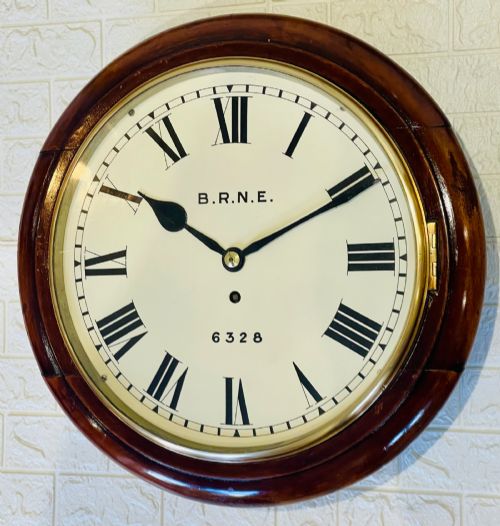
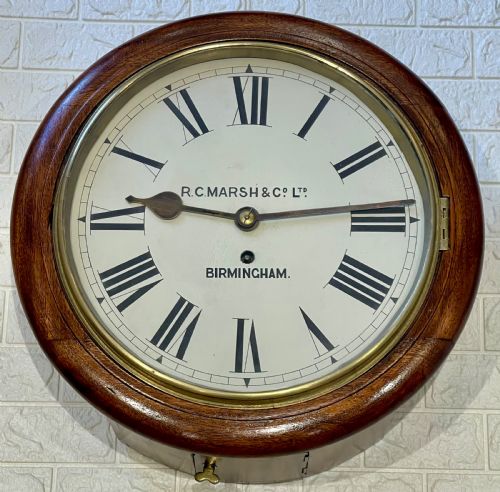


Victorian Office Clock
A victorian office clock is a reliable timepiece built to keep time in public rooms and workspaces, offering sturdy construction and clear dial faces.
Victorian Office Clock
When you search for a victorian office clock, you encounter wall-mounted timepieces housed in sturdy timber cases. These clocks originated in public spaces, railway stations, and administrative offices during the nineteenth century.
The versions you meet most frequently on this page feature robust cases made from mahogany or oak. They rely on clear painted steel dials protected by glass to ensure time is easily readable across a room.
Most examples date from the Victorian era and the broader nineteenth century, with occasional pieces extending into the early twentieth century. Their forms remain strictly functional, designed for clear visibility rather than ornate display.
How they were made
Maker workshops constructed the outer surrounds using dense hardwoods like mahogany and golden oak, shaped into circular or octagonal frames. These wooden enclosures protected the delicate mechanical movements mounted behind the dial.
Dials were typically formed from painted steel, featuring bold numerals and minute markers that remained legible in large rooms. A hinged brass bezel held the protective glass face securely over the dial.
Victorian Office Clock Retail Price Guide 2026
Typical asking prices for victorian office clock among the pieces listed under this phrase on Sellingantiques today, from the lower quarter to the upper quarter. They describe what is for sale here now, not the wider market.
The site listings include fusee movements housed in mahogany and oak cases dating from the nineteenth century.
What varies in quality
Quality rests in the precision of the fusee movement and the selection of the timber case. Finer pieces display carefully chosen mahogany or oak veneers and clean, unblemished dial lettering.
The presence of named makers or institutional origins elevates certain pieces above standard commercial examples. A well-preserved dial and crisp case mouldings distinguish better preserved timepieces.
John Walker·J C Ralls
The Victorian Office Clock Glossary
- Fusee
- A conical pulley used in clock movements to maintain even tension on the chain as the mainspring unwinds. This mechanism improves the timekeeping accuracy of the clock.
- Wall clock
- A timepiece designed to be hung directly on a vertical surface rather than placed on a mantel or floor. These clocks were essential for coordinating schedules in public and private rooms.
- Bezel
- The metal ring, often made of brass, that holds the glass cover in place over the clock face. It usually opens on a hinge to allow access to the hands.
- Convex dial
- A clock face that curves outward toward the viewer rather than lying completely flat. This shape reduces glare from windows and gas lighting.
Victorian Office Clock: Frequently Asked Questions
Where were these clocks originally used?
These clocks were designed for municipal buildings, railway stations, and administrative offices where accurate timekeeping was essential for daily operations.
Their robust construction ensured they could withstand the heavy foot traffic and demanding environments of nineteenth-century public spaces.
How do I wind a fusee wall clock?
Winding requires a dedicated key inserted into a small hole on the dial face, which tensions the internal chain via the fusee cone.
Care must be taken not to overwind the mechanism, ensuring the movement continues to run smoothly and reliably.
Are these clocks suitable for modern homes?
Their clean circular forms and practical wooden cases allow them to fit naturally into kitchens, hallways, and home studies.
They bring an understated architectural presence to a wall while fulfilling a daily practical function.
How do I distinguish a railway clock from a school clock?
Railway clocks often bear specific company or station lettering on the dial, reflecting their origin in transport infrastructure.
School and office clocks tend to feature plainer faces focused entirely on legible numbers for workers or students.