
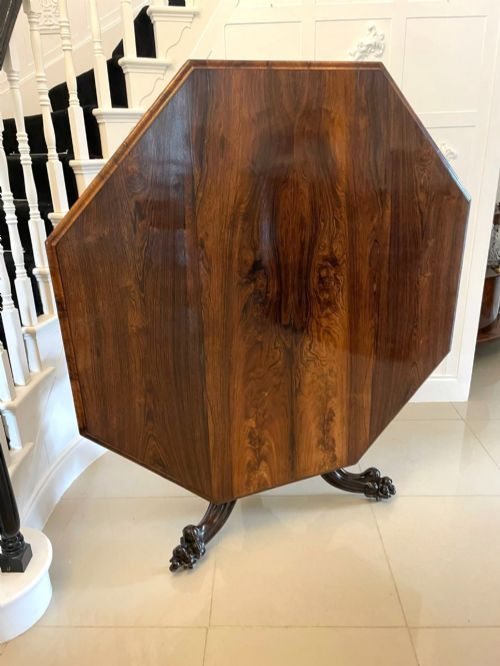


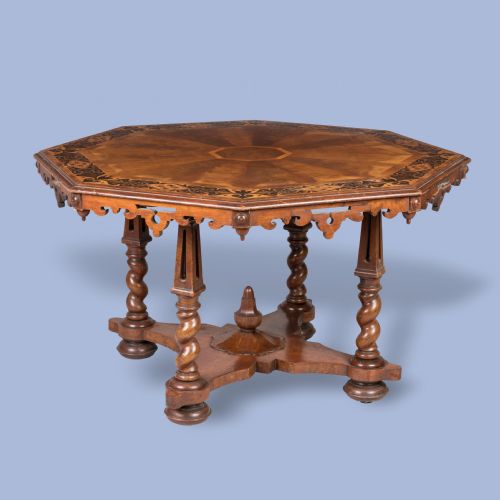


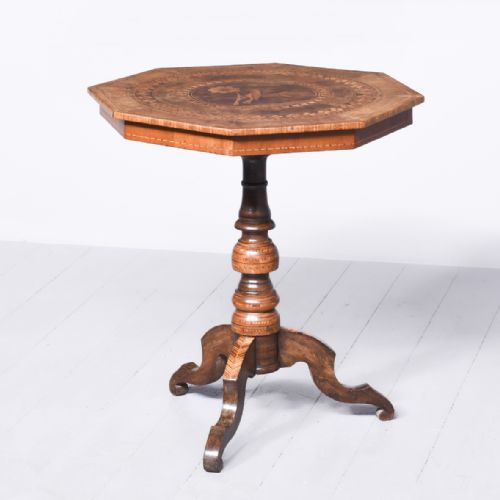
Victorian Octagonal Tilt Table
These Victorian octagonal tilt table examples offer clever multi-function design, serving as compact side pieces that stow away easily when pivoted upright.
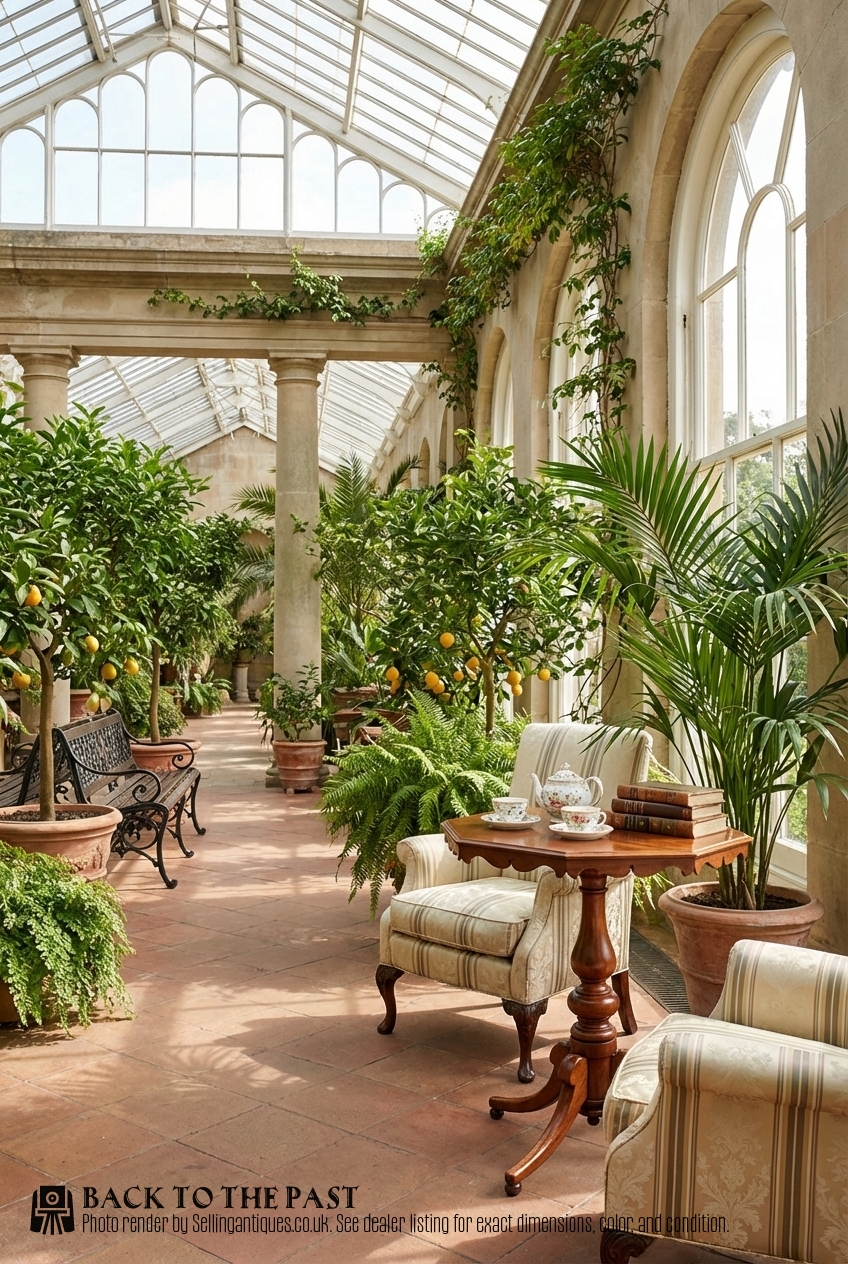
Victorian Octagonal Tilt Table
A Victorian octagonal tilt table combines a geometric top with a pivoting mechanism that allows the surface to fold vertically against the central pillar. These practical furnishings appear frequently in walnut, mahogany, and rosewood, often featuring octagonal tops supported by tripod or pedestal bases.
Makers produced these versatile surfaces during the nineteenth century for drawing rooms and parlours where space management mattered. Examples span from plain mahogany tripod designs to highly decorative specimens incorporating marquetry, specimen woods, and Sorrento or Killarney inlay.
Buyers browsing this selection will encounter various forms including side tables, occasional tables, and occasional lamp tables. The nineteenth-century date range dominates the offerings, alongside related regional interpretations like Anglo-Indian colonial pieces and Italian Sorrento work.
How they were made
Cabinet makers utilised dense timbers like mahogany, rosewood, and walnut for the structural pillars and tilt mechanisms. These solid woods provided the necessary weight and durability to support the pivoting top without wobbling.
Decorative surfaces frequently employed intricate marquetry, burr veneers, and multi-coloured specimen wood inlays arranged in geometric patterns. Skilled artisans applied these delicate veneers over stable secondary woods to prevent warping across the octagonal spans.
What varies in quality
The refinement of the tilt mechanism and the stability of the central pivot dictate the upper tier of execution. Superior pieces operate smoothly without lateral play in the hinge when locked flat.
Material selection and inlay complexity separate standard production from exceptional workshop output. Tables featuring dense burr walnut, elaborate marquetry, or diverse specimen woods demonstrate greater artisan investment than plain mahogany equivalents.
Gillows·James Winter
The Victorian Octagonal Tilt Table Glossary
- Tilt top
- A hinged table surface that pivots ninety degrees to stand vertically when not in use. This clever mechanism allowed nineteenth-century households to reclaim floor space easily.
- Marquetry
- Decorative patterns created by fitting different coloured veneers into a prepared wooden ground. Artisans used this technique to form floral, geometric, or architectural motifs on table tops.
- Specimen wood
- Furniture surfaces constructed from multiple distinct and often exotic timber varieties. Makers arranged contrasting grains and colours to display natural botanical diversity.
- Tripod base
- A pedestal support terminating in three distinct feet. This configuration ensures stable placement on uneven nineteenth-century floorboards.
- Burr walnut
- Timber harvested from the gnarled growths of walnut trees, yielding rich swirling grain patterns. Cabinet makers prized these veneers for high-status table tops.
Victorian Octagonal Tilt Table: Frequently Asked Questions
Can I use an octagonal tilt table daily?
These tables adapt well to everyday use as lamp stands or occasional surfaces for holding books and drinks. Their sturdy pillar and tripod bases provide reliable support for normal domestic objects.
Protect the polished veneer surfaces from moisture and heat by using coasters and mats. Tilting the top upright when not in use also prevents accidental surface damage in busy rooms.
How do I identify Sorrento work?
Look for intricate microscopic wood inlay depicting architectural ruins, musicians, or geometric strapwork, typically originating from Italy during the nineteenth century. The makers used pale and dark timbers to create detailed pictorial panels.
This specific style of marquetry appears on several occasional tables in the selection, often combined with walnut or olivewood carcases.
What is the difference between a side table and a centre table?
Centre tables are designed to stand free in the middle of a room, featuring finished decorative detail on all sides and an octagonal or circular format. Side tables typically sit flush against a wall or beside seating furniture.
Both forms utilise the pivoting tilt top structure across the nineteenth-century examples found in this inventory.