


Victorian Mahogany Pharmacy Cabinet
These Victorian mahogany pharmacy cabinet examples are robust working pieces built to hold medical supplies, offering sturdy storage and authentic historical character.
Victorian Mahogany Pharmacy Cabinet
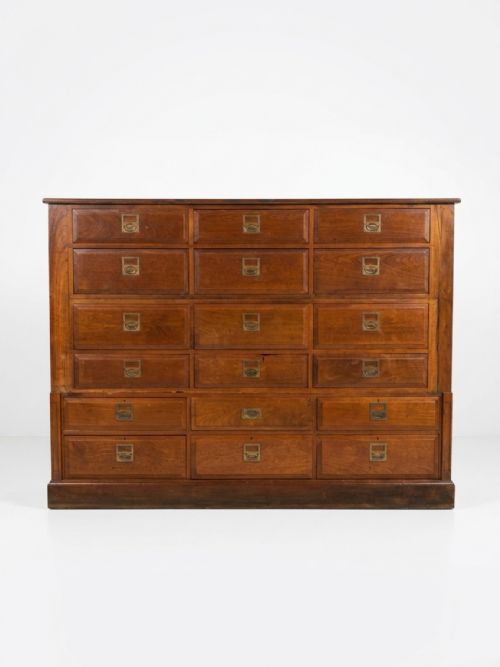
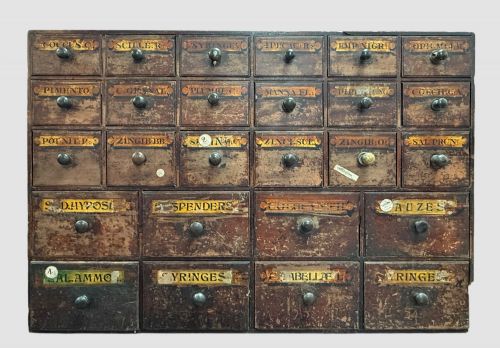
A Victorian mahogany pharmacy cabinet is a functional storage unit designed for chemists, apothecaries, and medical practices during the nineteenth century. These pieces range from substantial bank of drawers units and shop fittings to smaller countertop display cabinets and portable apothecary boxes.
Buyers browsing this selection will most frequently encounter nineteenth-century drawer banks and chemist storage units constructed from solid mahogany. These heavy utilitarian items reflect the commercial and medical demands of the Victorian period, serving originally to organise drugs, powders, and instruments.
The objects span wall-hanging pharmacy cabinets, veterinary storage units, and retail display counters rather than purely domestic furniture. Their primary appeal lies in this authentic commercial utility, combining disciplined internal partitioning with robust timber construction.
How they were made
Cabinet makers utilised dense mahogany for the primary exterior carcases and structural frames to withstand daily dispensary use. Secondary timbers such as pine frequently appear inside drawer linings and backing boards, keeping hidden structural elements practical and robust.
Current listings demonstrate the prevalence of mahogany, glass, and brass across nineteenth-century chemist shop fittings and bank of drawers forms.
What varies in quality
Quality rests upon the integrity of the original timber construction and whether internal fittings remain intact. Pieces retaining their original brass hardware, glass bottles, and fitted compartments hold greater documentary value than altered examples.
The sophistication of the joinery and the scale of the piece dictate its standing, with large chemist shop fittings and bank of drawers units demonstrating superior commercial craftsmanship compared to basic utility boxes.
The Victorian Mahogany Pharmacy Cabinet Glossary
- Bank of drawers
- An assemblage of multiple small drawers stacked together in a modular grid, designed for sorting and storing dry medicines or powders in a dispensary.
- Apothecary box
- A portable wooden chest fitted internally with glass bottles and scales, used by medical practitioners for travelling visits.
- Shop fitting
- Heavy furniture built specifically for commercial retail premises rather than domestic rooms, engineered for heavy public use.
- Countertop display cabinet
- A glazed enclosure designed to sit upon a shop counter to showcase goods directly to customers.
- Carcase
- The main structural body or frame of a cabinet without doors, drawers, or applied decorative mouldings.
Victorian Mahogany Pharmacy Cabinet: Frequently Asked Questions
What is a pharmacy cabinet?
A pharmacy cabinet is a utilitarian storage unit built for chemists and medical practitioners to house medicines, instruments, and dry ingredients safely.
These pieces typically feature numerous small drawers, cupboards, or glazed display areas designed for maximum organisation in a dispensary.
How were apothecary boxes used?
Apothecary boxes served as portable pharmacies for doctors and practitioners travelling to patients outside fixed clinics.
Inside, fitted compartments held stoppered glass bottles, scales, and mortars securely during transit.
Are these pieces domestic furniture?
Most items listed are commercial shop fittings rather than domestic furnishings, having originated in Victorian chemists and retail premises.
Their heavy construction reflects a functional purpose meant to endure constant daily handling in a working environment.
What materials are used?
Mahogany forms the primary visible timber across these cabinets, prized for its durability and rich dark grain.
Secondary woods like pine appear in hidden areas such as drawer carcases, alongside functional brass handles and glass components.