



Victorian Mahogany Dessert Table
These robust pieces of functional dining furniture known as a victorian mahogany dessert table offer tiered convenience and rich timber grain for modern rooms.
Victorian Mahogany Dessert Table
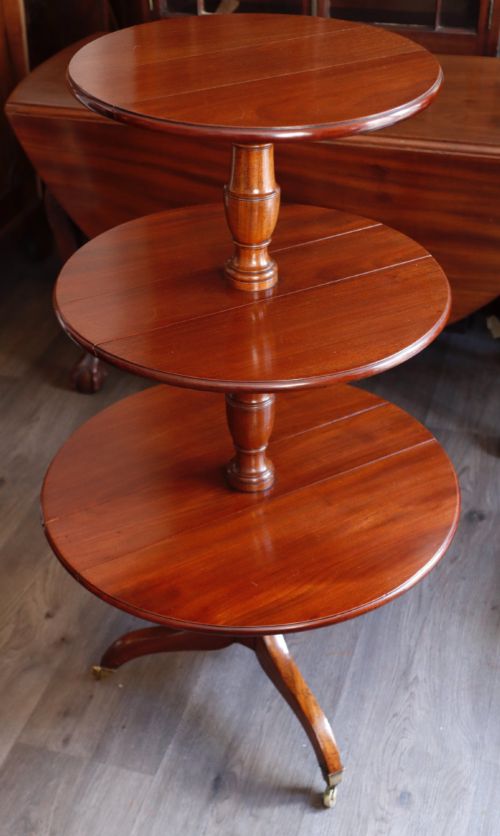
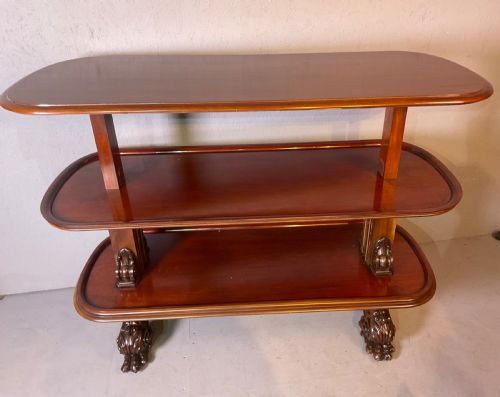
A victorian mahogany dessert table typically takes the form of a tiered dumb waiter, buffet, or serving table designed to hold dishes and silverware near the dining table. These items serve as practical furniture for hosting, offering multiple levels supported by turned columns or central pedestals.
The pieces on this page span the Victorian era alongside earlier Georgian, Regency, and William IV periods, reflecting how dining traditions evolved across the nineteenth century. Buyers encounter circular tiers, rectangular buffet stands, and metamorphic designs suited to different interior spaces.
Materials and construction
Cabinet makers utilised dense mahogany for its deep colour and durability, shaping solid boards and applying veneers to create polished tiers and supporting columns. Brass components, including castors on the base of these stands, permitted smooth movement across dining room floors.
Joinery techniques relied on sturdy turned uprights, pegging, and structural framing to support the weight of multiple heavy wooden shelves loaded with plates or glassware. Original castors and precise tier turnery remain standard physical markers of the period.
Several tiered stands roll smoothly on their original brass castors, ready to glide across the floor with yesterday's dessert service.
Assessing the standard
Quality rests in the richness of the timber grain, the crispness of the turned pillars, and the integrity of the original castors. Finer examples display balanced proportions across their multiple tiers and retain a deep, warm patina through decades of polishing.
Construction details distinguish standard utility from superior workshop output, particularly in the weight of the mahogany boards and the subtlety of edge moulding. Untouched brass hardware and firm joints indicate better preservation over time.
Maple & Co
The Victorian Mahogany Dessert Table Glossary
- Dumb waiter
- A tiered stand used in dining rooms to hold food and utensils without the aid of servants. These movable tiers rotate or remain fixed depending on the specific design.
- Buffet table
- A long serving surface or tiered stand intended for the display and service of food during meals. This form provides substantial surface area in the dining room.
- Castor
- A small wheel attached to the base of furniture legs to permit easy rolling across carpets and wooden floors. Brass versions frequently appear on nineteenth century dining furniture.
- Tiered table
- Furniture constructed with multiple horizontal surfaces arranged vertically above one another. This configuration maximises display and storage space within a compact footprint.
Victorian Mahogany Dessert Table: Frequently Asked Questions
What is a victorian mahogany dessert table used for?
These pieces function primarily as serving furniture, holding dessert courses, plates, and glassware within arm's reach of the main dining table. Their multiple tiers provide practical surface area without cluttering the main room.
Historically, they reduced the need for constant staff presence during long meals by keeping extra dishes nearby. Today, they serve equally well as display stands or occasional furniture in studies and living rooms.
How do I identify the period of these tables?
Dating relies on stylistic clues such as the turnings of the central columns, the shape of the shelves, and the form of the base. Georgian and Regency pieces tend to feature lighter proportions and distinct pedestal configurations, while Victorian examples often embrace heavier three tier structures.
Materials and hardware also provide guidance, as brass castors and fastening methods shifted across the nineteenth century. Examining the construction of the joints helps separate early nineteenth century work from later revival pieces.
Are these tables suitable for modern dining rooms?
Their compact vertical footprint makes them practical additions to contemporary spaces where floor area is limited. The tiered design offers functional display space for ceramics, books, or plants.
Moving them is straightforward thanks to original castors, allowing them to shift position easily during gatherings. Their rich mahogany timber introduces traditional warmth into modern interiors.
What does metamorphic mean in these pieces?
Metamorphic furniture incorporates mechanical mechanisms that allow the piece to transform into different configurations or heights. In the context of tiered stands, this involves folding or adjusting shelves for varied use.
Such designs demonstrate nineteenth century ingenuity in creating space saving furniture for formal homes. These adaptable pieces remain sought after by collectors interested in mechanical ingenuity.