
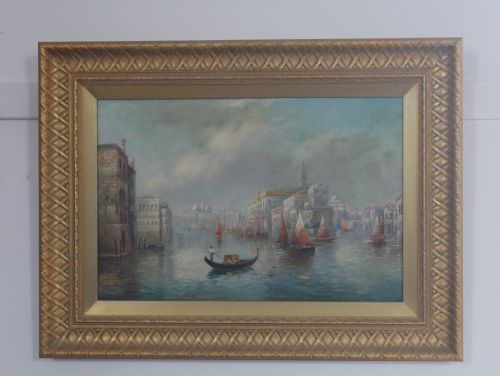


Victorian Italian View Painting
These Victorian italian view painting works capture the light and architecture of the Mediterranean, offering the exact romantic escape nineteenth-century collectors desired.
Victorian Italian View Painting
When you examine a Victorian italian view painting, you are looking at nineteenth-century depictions of sun-drenched canals, alpine lakes, and historic townscapes created during the height of the Grand Tour. These works capture the enduring British fascination with Italian light, topography, and architecture.
The pieces listed on this page span the nineteenth century, including specific dates such as eighteen seventy, eighteen eighty, and eighteen ninety, alongside broader Victorian and Regency periods. You will encounter both finished gallery canvases and more intimate works on paper.
Oil paintings dominate the selection, frequently portraying iconic Venetian landmarks like the Grand Canal, the Dogana, and the Lagoon. Alongside these oils appear delicate watercolours recording specific Italian landscapes and coastal towns such as San Remo.
How They Were Made
Artists of this period primarily utilised oil on canvas or watercolour on paper to record their travels, applying pigments with the characteristic realism and romanticism of the nineteenth-century school. These mediums allowed painters to render the shimmering reflections of water and the warm Mediterranean atmosphere.
Many of these works are housed in their original surrounds, incorporating wood frames finished with gold leaf and gilt details. The craftsmanship of the period is evident in these ornate giltwood settings, which frequently complement the coastal and architectural subject matter.
The listings span the nineteenth century, featuring works executed in oil on canvas and watercolour on paper, alongside original giltwood frames.
What Varies in Quality
Quality in a Victorian italian view painting rests on the hand of the artist, the precision of the architectural draughtsmanship, and the handling of atmospheric light. Pieces bearing documented signatures or attributions to known nineteenth-century painters command closer attention for their accomplished brushwork.
The framing also distinguishes the pieces, with exceptional period giltwood frames enhancing the visual impact of the canvas or watercolour. Furthermore, the condition of the pigment and the clarity of the composition determine the overall desirability of each work.
F.D. Campo·William Raymond Dommersen·Jane Vivian·Alfred Pollentine·Hercules Brabazon Brabazon·J. Yates·T. Williams·Arthur Severn·Thomas Brabazon Aylmer
The Victorian Italian View Painting Glossary
- Oil on Canvas
- A painting medium where pigments bound in drying oil are applied to a stretched cloth support. This technique allowed artists to achieve rich colour saturation and subtle gradations of light.
- Watercolour
- A painting method where fine pigments are suspended in a water-soluble vehicle, typically executed on paper. It was frequently utilised by nineteenth-century artists recording rapid impressions during their travels.
- Giltwood
- Wood that has been treated with a thin layer of gold leaf or gilt powder. It provides the ornate, reflective borders standard on many nineteenth-century picture frames.
- Grand Tour
- A traditional trip through Europe, particularly Italy, undertaken by upper-class young men and artists in the eighteenth and nineteenth centuries. It generated a vast demand for topographical view paintings.
- Townscape
- A genre of artwork focusing on urban views, streets, and architectural landmarks. In this context, it usually describes detailed representations of Venetian canals and historic squares.
Victorian Italian View Painting: Frequently Asked Questions
Where were these paintings displayed?
These watercolours and oils were typically hung in the drawing rooms and libraries of nineteenth-century British homes. They served as sophisticated reminders of foreign travel and classical education.
Today, they suit traditional living spaces, studies, or hallways where their rich architectural detail can be appreciated up close.
How do I care for a nineteenth-century watercolour?
Waterworks on paper require protection from direct sunlight to prevent the pigments from fading over time. Glazing helps shield the delicate paper surface from atmospheric dust and moisture.
Maintain stable room temperatures to ensure the paper and backing materials remain preserved for years to come.
What subjects are most common?
Venetian waterways and architecture form the core of these subjects, featuring prominent landmarks such as the Grand Canal and the Dogana. Mountainous lakeside settings and coastal towns also appear frequently.
These motifs reflect the favoured itineraries of travellers journeying through Italy during the Victorian era.
How do I distinguish an oil from a watercolour?
Oils are painted on canvas or wood panels with a textured, heavier pigment application that often shows visible brushstrokes. Watercolours are executed on paper under glass, presenting a more translucent and fluid appearance.
Examining the surface closely reveals the distinct characteristics of each medium.