



Victorian House Gong
A victorian house gong brings the resonance of the nineteenth century straight into the modern hallway.
Victorian House Gong
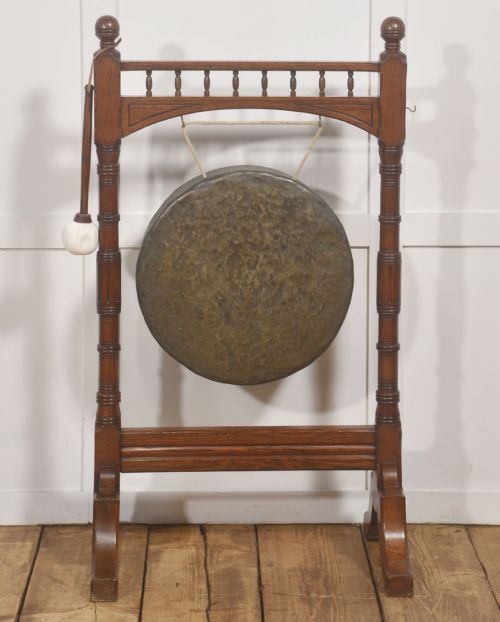
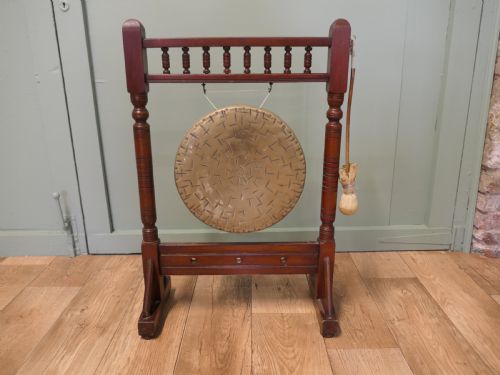
A victorian house gong is a striking instrument designed to summon household members to meals or announce visitors. These pieces typically take the form of a brass or metal disc suspended from a wooden or iron frame.
Originating in larger country houses and town residences, these gongs served both a practical purpose and a decorative function. They remain popular today for their imposing presence and rich, resonant tone.
How they were made
Makers utilised sturdy timbers such as oak and mahogany to construct the supporting frames, often employing deep carving to decorate the wood. Wrought iron also appears as a primary structural material for more industrial or rustic frames.
The hanging mechanism typically relies on robust cord, leather, or rope to support the heavy metal disc while allowing it to swing freely. Brass and copper form the resonant gongs themselves, sometimes accompanied by unusual decorative elements like cattle horn or specialised mounts.
Victorian House Gong Retail Price Guide 2026
Typical asking prices for victorian house gong among the pieces listed under this phrase on Sellingantiques today, from the lower quarter to the upper quarter. They describe what is for sale here now, not the wider market.
One unexpected nineteenth century example incorporates cattle horn into its design, proving that country house utility had a wild streak.
What varies in quality
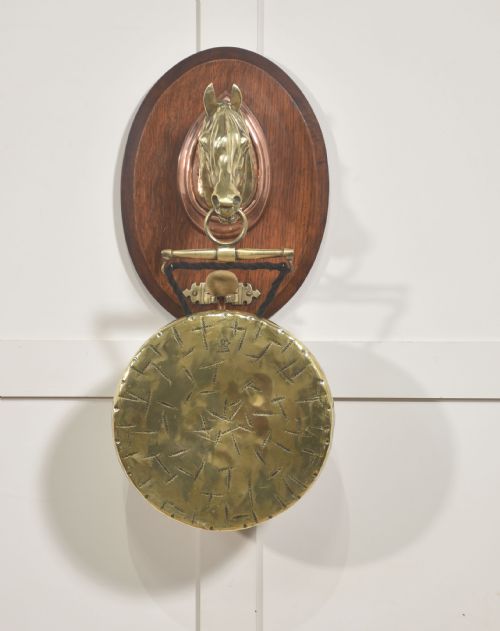
The distinction between standard examples and finer pieces rests largely upon the ambition of the woodwork and the quality of the metal casting. Heavy carving on an oak frame and the incorporation of specific motifs like horse head mounts elevate certain pieces above simple utility.
Proportion and scale also dictate quality, ranging from modest wall hanging designs to monumental floor standing versions. The acoustic properties of the metal disc and the durability of the suspension materials complete the measure of craftsmanship.
The Victorian House Gong Glossary
- Dinner gong
- A percussion instrument used in large households to announce meals, typically consisting of a metal disc struck with a mallet.
- Arts and crafts
- A design movement emphasising handcraftsmanship, simple forms, and traditional materials, often seen in the framing of these gongs.
- Gothic revival
- An architectural and decorative style drawing inspiration from medieval forms, frequently characterised by pointed arches and heavy timber.
- Cattle horn
- An organic material occasionally utilised in the decoration or construction of nineteenth century household accessories.
Victorian House Gong: Frequently Asked Questions
How do you hang a wall gong?
Wall hanging versions require a secure fixing point capable of supporting the combined weight of the wooden frame and the metal disc. It is essential to anchor the bracket directly into a wall stud or use appropriate heavy duty fixings.
Once mounted securely, ensure the gong hangs freely without touching the wall surface to allow proper resonance when struck.
How do you clean the brass gong?
Cleaning depends on whether you prefer to maintain an aged patina or achieve a polished brightness. Gentle dusting with a soft cloth is usually sufficient for regular maintenance.
Avoid harsh chemical cleaners that might strip the historic surface character from the nineteenth century metal.
What materials were used?
The frames are constructed primarily from oak and mahogany, with occasional examples utilising wrought iron. The hanging discs themselves are fashioned from brass or copper.
Additional materials such as leather, cord, rope, and even cattle horn appear as decorative mounts or suspension components.