


Victorian Hound Artwork
Victorian hound artwork brings nineteenth-century sporting life into the home through oil paintings, watercolours and prints that capture the energy of the field.
Victorian Hound Artwork
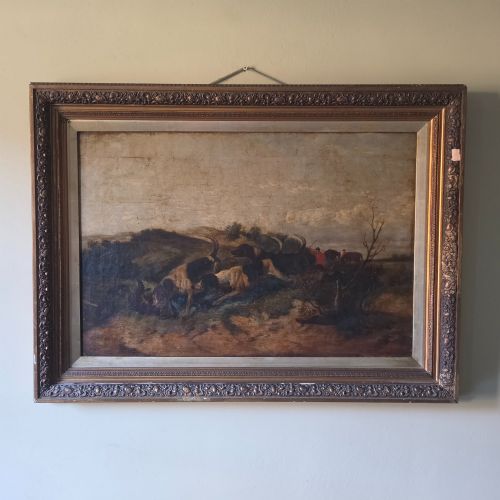
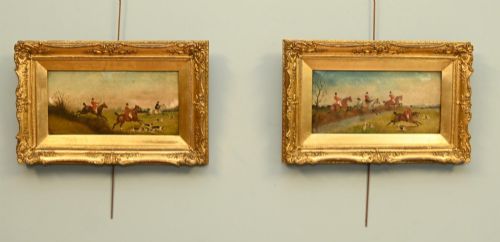
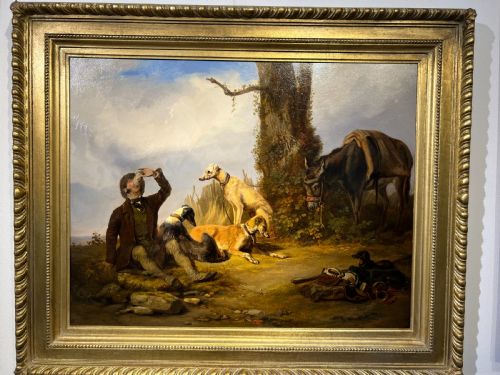
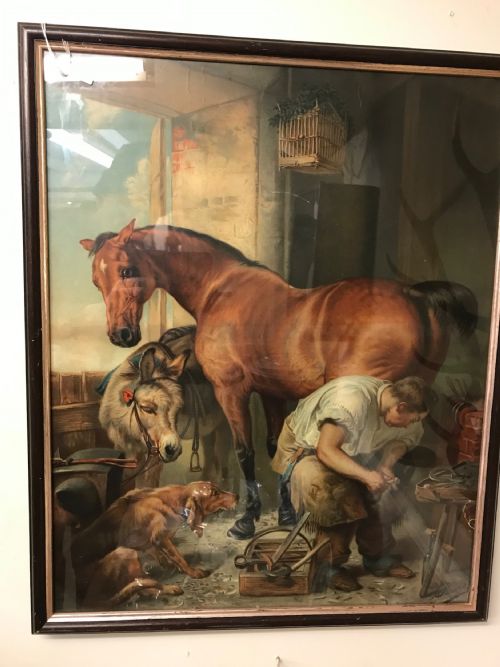
Victorian hound artwork encompasses nineteenth-century depictions of dogs, pack hunts and sporting scenes rendered in oil on canvas, oil on board, and watercolour. These pieces celebrate the central role of hunting animals in the visual culture of the era, ranging from intimate portraits of individual retrievers and spaniels to vast canvases depicting full hunts in winter snow.
Buyers most frequently encounter oil paintings from the nineteenth century alongside framed prints and watercolours dated across the Victorian period and into the early twentieth century. The subjects shift between dynamic field action, such as hounds going over a hedge or baying a bear, and static portraiture of specific breeds.
The origins span English and continental workshops, with many works tied directly to the traditions of Victorian sporting art. Works appear framed in giltwood or simple wooden surrounds, preserving the visual language of nineteenth-century domestic interiors.
Materials and construction
Artists of the period painted primarily with oil on canvas or prepared wooden boards, applying pigment to build rich textures in fur, foliage and winter landscapes. Watercolours on paper provide a lighter, more immediate medium for detailed studies of greyhounds, lurchers and hunting packs.
Canvases stretched over wooden frames were frequently housed in gilded or moulded wooden frames, sometimes accented with gold leaf. Engravings and prints utilised paper stock, translating painted compositions into multiples for broader distribution.
Several hounds gaze out from these canvases with expressions of profound dignity, as though posing for stern Victorian parliamentarians.
Judging quality
Quality rests upon the artist's command of anatomy, expression and movement, distinguishing stiff decorative depictions from works by accomplished animal painters who captured the distinct musculature and character of breeds like the Grand Griffon Vendéen or Welsh hounds. Superior brushwork registers the tension in a hound on the scent and the interplay of light across winter snow.
The depth of the composition and the integrity of the original support matter greatly, as does the survival of the period framing. Works that retain their original giltwood or wood surrounds offer a more complete historical artefact than those remounted in later centuries.
Sir Edwin Henry Landseer·Arthur Wardle·Colin Graeme Roe·Fannie Moody·Jules Chardigny·Alfred Duke·George Goodwin Kilburne·Thomas Blinks·Philip Eustace Stretton·Henry Frederick Lucas-Lucas·Edward B Herberte·Herbert Dicksee
The Victorian Hound Artwork Glossary
- Oil on canvas
- Pigment suspended in drying oil applied to a woven fabric stretched across a wooden frame. This medium allowed nineteenth-century artists to build deep, luminous colour layers for animal portraits.
- Giltwood
- Wood carved and coated with a thin layer of gold leaf or metallic gilt powder. It forms the traditional opulent border for nineteenth-century oil paintings.
- Sporting art
- A genre of painting and illustration dedicated to rural sports, horses, hounds and field pursuits. It flourished in Britain during the Victorian era.
- Etching
- A printmaking process where lines are bitten into a metal plate with acid before being inked and pressed onto paper. This technique produced fine-lined dog imagery popular in domestic interiors.
- Watercolour
- Pigments suspended in a water-based, transparent solution applied to paper. It was frequently used for rapid field sketches and finished canine studies.
Victorian Hound Artwork: Frequently Asked Questions
What subjects appear in Victorian hound artwork?
These works depict individual dog portraits, pack hunts in winter snow, coursing greyhounds, and dramatic combat scenes involving hounds and bears.
The focus remains on the anatomy, character and athletic pursuits of sporting dogs as recorded by nineteenth-century animal artists.
How were these paintings displayed originally?
Landowners and sporting enthusiasts hung these framed canvases and watercolours in country houses, libraries and studies to celebrate their passion for the field.
They served as both status symbols and tributes to prized hunting dogs and renowned packs.
How do I care for an antique oil painting?
Keep the canvas away from direct sunlight, dampness and extreme temperature fluctuations that can cause the paint layer to crack or warp.
Dust the surface gently with a soft, dry cloth and avoid using liquid cleaners on either the canvas or the frame.
How can I tell a print from an original painting?
Examine the surface closely under a magnifying glass to check for the raised brushstrokes and layered texture characteristic of oil paint.
Prints and engravings display a flat dot pattern or uniform ink surface across the paper beneath the glass.