







Victorian Heavy Sideboard
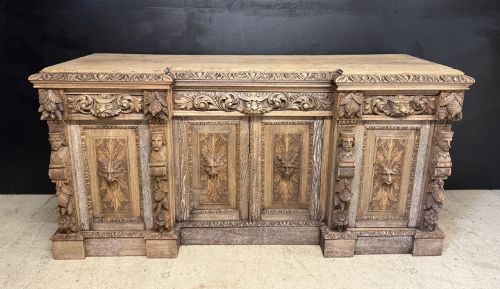
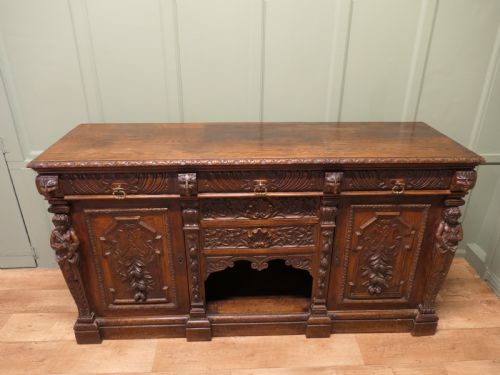
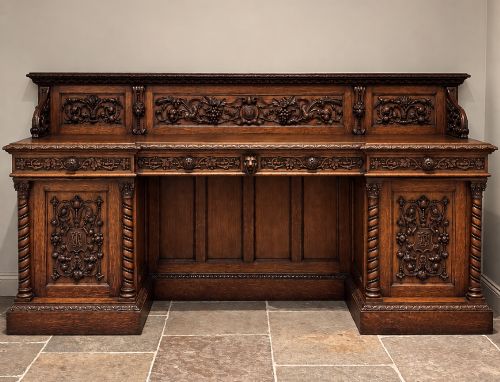
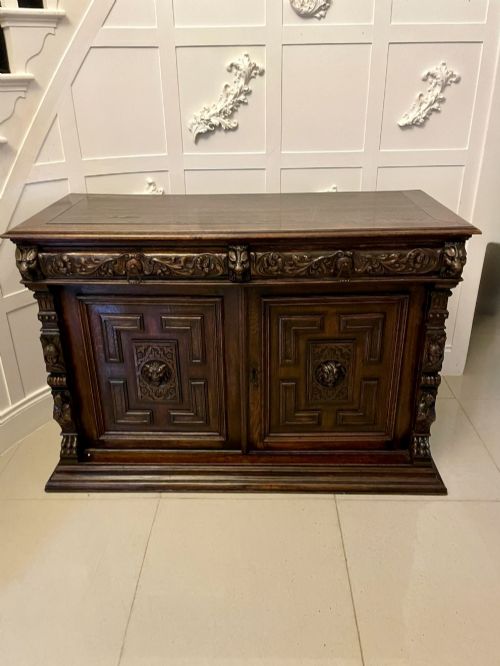
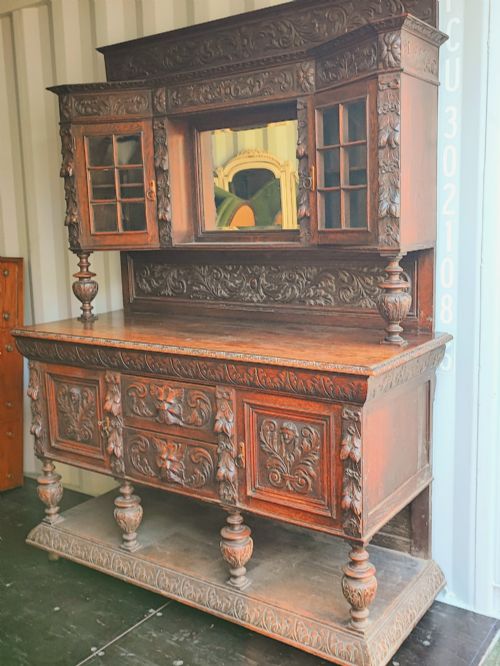
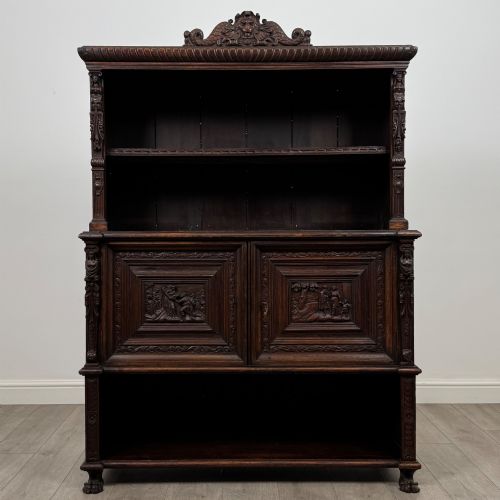
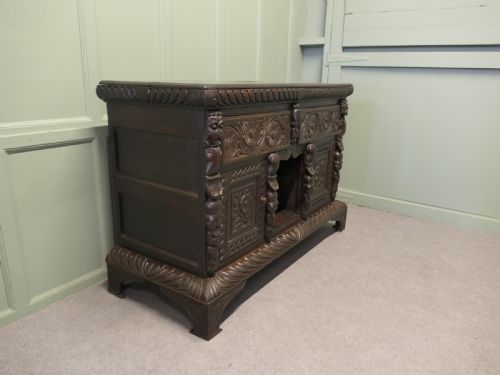
These substantial pieces are a victorian heavy sideboard, built to anchor a dining room with solid timber and dense carving.
Victorian Heavy Sideboard
A victorian heavy sideboard brings together solid oak construction and architectural presence, frequently seen in forms with mirror backs, tiered buffets, and deep cupboards. These pieces are designed for formal dining rooms, offering substantial storage behind carved doors and panelled frames.
The styles range widely across the period, taking in Renaissance Revival, Gothic Revival, and Jacobean Revival motifs. Many examples incorporate figural elements such as Green Man carvings, alongside heavily panelled doors and carved scenes.
Most entries on this page date from the nineteenth century, particularly the middle and later decades. They reflect a Victorian taste for imposing furniture that signals domestic permanence and material weight.
Materials and construction
Oak serves as the primary timber across these pieces, often worked in heavy sections to support deep relief carving and large panelled doors. Brass hardware, mirror glass, and bevelled glass frequently appear as secondary materials on mirror back buffets and cabinets.
Joinery methods rely on traditional framing and panelling to stabilise large expanses of timber against seasonal movement. Carving is executed directly into the solid oak, ranging from foliate scrolls to distinct figural heads.
Victorian Heavy Sideboard Retail Price Guide 2026
Typical asking prices for victorian heavy sideboard among the pieces listed under this phrase on Sellingantiques today, from the lower quarter to the upper quarter. They describe what is for sale here now, not the wider market.
Listings span periods from the early nineteenth century through to the nineteen thirties, with a strong concentration around eighteen eighty.
Judging quality in heavy sideboards
Quality rests in the crispness and depth of the carved detail, where sharp undercutting distinguishes accomplished workshops from mechanical production. The selection of the oak timber, particularly grain alignment across wide doors and friezes, dictates visual balance.
Proportion and architectural cohesion separate grand examples from utilitarian cupboards. Integration of secondary elements like bevelled mirror glass and brass fittings determines the overall finish of the piece.
The Victorian Heavy Sideboard Glossary
- Green Man
- A decorative motif depicting a human face entwined with or sprouting foliage. It appears frequently in nineteenth-century architectural woodwork.
- Renaissance Revival
- A nineteenth-century design movement drawing on sixteenth-century classical ornament. It employs heavy mouldings, pilasters, and figural cartouches.
- Buffet
- A low sideboard or serving table intended for the display of plate and the service of food. Many incorporate enclosed cupboards beneath a serving surface.
- Bevelled Glass
- Plate glass with an angled edge ground and polished to a narrow margin. This technique catches light and adds depth to mirror backs.
Victorian Heavy Sideboard: Frequently Asked Questions
What rooms suit a heavy sideboard?
These large oak pieces require generous floor space and high ceilings to sit comfortably without dominating a domestic interior. They function effectively in traditional dining rooms or large hallway spaces.
Their substantial depth and height demand solid wall placement, away from narrow thoroughfares where the projection of doors and carving might obstruct movement.
How do revival styles differ?
Renaissance Revival pieces utilise architectural elements such as columns, pilasters, and heavy pediments borrowed from classical precedent. Gothic Revival examples lean toward pointed arches, trefoils, and medieval tracery.
Jacobean Revival furniture favours geometric mouldings, split spindles, and strapwork panels that recall seventeenth-century English joinery.
How should I care for heavy oak?
Solid oak furniture benefits from stable indoor humidity to prevent timber movement and splitting across large panels. Regular dusting with a dry cloth maintains the finish without chemical buildup.
Application of traditional wax polish helps nourish the grain and protects the carved surface from drying out over time.
Are mirror backs original?
Large mirror backs set into carved wooden frames formed an integral part of many Victorian sideboard designs from the middle of the nineteenth century onward. They were intended to reflect light and display table silver.
Bevelling on the glass surface is typical of better quality production from the latter half of the Victorian era.