




Victorian Harbour Wall Art
Victorian harbour wall art brings maritime activity, coastal towns, and bustling quaysides into domestic rooms through period paintings and prints.
Victorian Harbour Wall Art
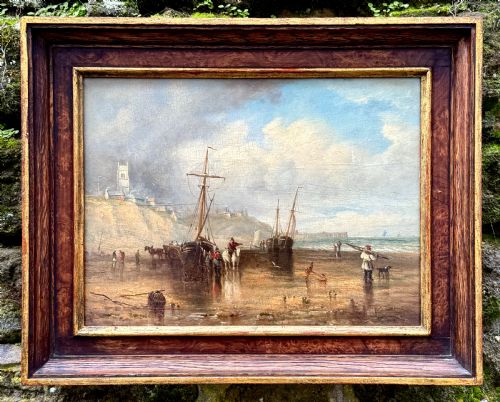
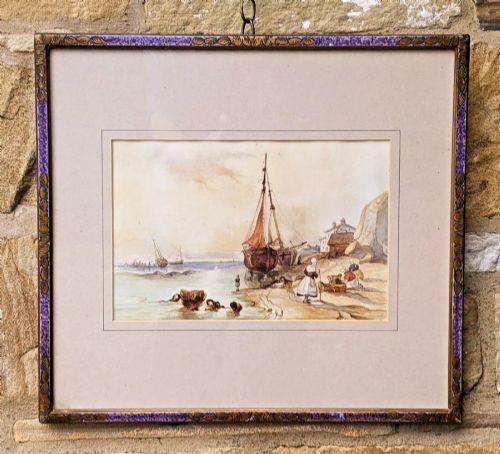
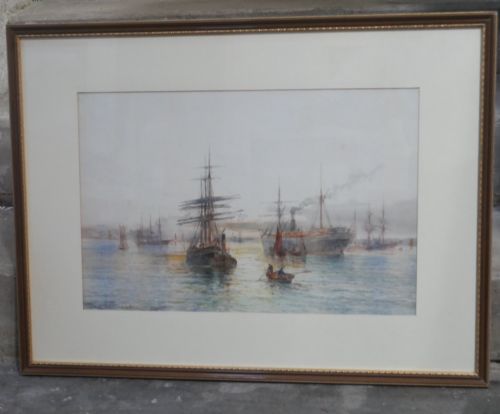
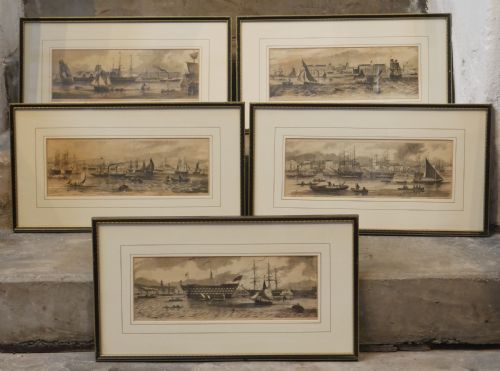
Victorian harbour wall art comprises paintings, watercolours, and engravings depicting maritime scenes, coastal towns, and quaysides. These works capture the working life of ports such as Whitby, St Ives, and Portsmouth during the nineteenth and early twentieth centuries.
The selections on this page centre on original oils and watercolours framed in wood and giltwood. Buyers frequently encounter coastal landscapes featuring sailing vessels, fishing boats, and historic dockyards executed by British and European artists.
Materials and techniques
Artists of this period utilised oil on canvas and watercolour pigment on paper to render marine subjects. Works are typically mounted behind glass and housed within wood or giltwood frames, occasionally with hand-enamelled polychrome decoration.
Techniques range from detailed marine realism documenting specific rigging and architecture to broader atmospheric watercolours capturing changing coastal light.
Several watercolours preserve the exact historic skyline of Whitby Abbey standing sentinel over generations of returning fishing boats.
Variations in quality
Quality in these maritime works rests upon the artist's command of light, water movement, and architectural perspective. Finer examples display confident brushwork and precise topographical detail rather than formulaic composition.
The preservation of the pigment and the originality of the associated frame influence the standing of a piece within the broader range.
Thomas Bush Hardy·James Webb·Charles William Wyllie·Frank Rousse·Hubert Thornley
The Victorian Harbour Wall Art Glossary
- Watercolour pigment
- A water-soluble colour medium applied to paper to create translucent washes and fine details. It was a favoured medium for British topographical and marine artists working outdoors or in studios.
- Giltwood
- Wood carved and coated with a thin layer of gold leaf or gilt finish. Frames of this material are common companions to nineteenth-century oil paintings.
- Engraving
- A printmaking technique where an image is incised into a metal plate to hold ink. Naval engravings record maritime vessels and docks with linear precision.
- Canvas
- A heavy woven fabric stretched across a wooden support to serve as a surface for oil painting. It provides the textural foundation for many nineteenth-century coastal scenes.
Victorian Harbour Wall Art: Frequently Asked Questions
What subjects do these paintings show?
These works depict British and European coastal scenes, including fishing harbours, busy rivers, and moored sailing vessels.
Artists focused on locations such as Whitby, Portsmouth, and the River Thames to record maritime trade and coastal life.
How should I frame a watercolour?
Watercolours require mounting behind glass to protect the paper and pigments from atmospheric moisture and direct sunlight.
Traditional wood or giltwood frames complement the period aesthetic of nineteenth-century works.
Are these works original antiques?
The selection consists of nineteenth and early twentieth-century pieces created during the Victorian and Edwardian eras.
Materials include period paper, canvas, and traditional wood frames consistent with the dates recorded in the titles.
How do I identify a marine painting?
Marine paintings are recognised by their primary focus on the sea, ships, coastal architecture, and harbour infrastructure.
Artists of the period often signed their work directly on the canvas or within the watercolour composition.