


Victorian Gold Hook Earrings
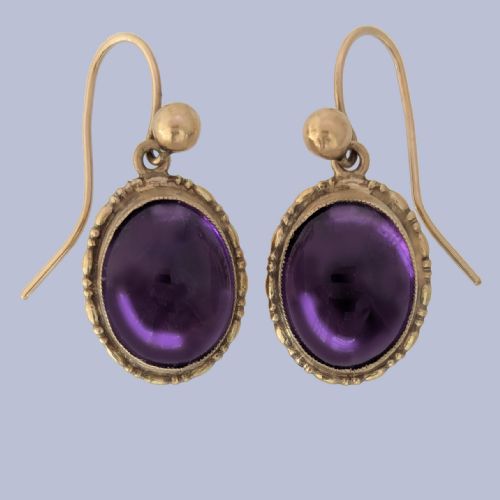
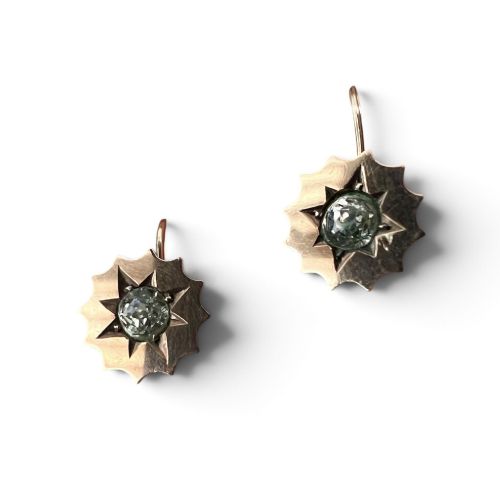
Victorian gold hook earrings bring genuine nineteenth-century character to the ear, combining secure shepherd's hook wires with rich yellow and rose gold.
Victorian Gold Hook Earrings
Victorian gold hook earrings encompass a range of nineteenth-century drop and dangle designs, often secured with simple wire hooks. These pieces span from the mid-nineteenth century through the Edwardian era and into the early twentieth century.
Buyers will encounter both authentic Victorian pieces and later twentieth-century interpretations, including Edwardian style and Art Deco variations. Gemstones such as amethyst, garnet paste, peridot, ruby, diamond, and pearl frequently punctuate the metalwork.
How they were made
Goldsmiths utilised nine-carat, fifteen-carat, and eighteen-carat gold, occasionally combining yellow and rose hues within a single mounting. Silver and silver gilt also appear, particularly in earlier cluster and dangle formations.
Lapidaries shaped natural coral, pearls, Whitby jet, and faceted gemstones including amethysts, garnets, peridots, and diamonds to fit secure bezels and prong settings. Wire hook fittings, including shepherd's hook variations, were shaped by hand to suspend the drops comfortably.
Materials across these listings span nine-carat and fifteen-carat gold, silver, coral, pearl, Whitby jet, amethyst, garnet paste, peridot, and diamond.
What varies in quality
The distinction between standard items and superior examples lies in the depth of hand-engraving and the complexity of wirework. Elaborate motifs, such as Etruscan Revival granulation or articulated snake heart drops, demonstrate advanced goldsmithing.
The selection of materials further differentiates the range, moving from paste stones and silver gilt to substantial fifteen-carat or eighteen-carat gold settings housing natural pearls, coral, and fine gemstones.
The Victorian Gold Hook Earrings Glossary
- Shepherd's hook
- A curved wire finding that slips through the pierced earlobe to suspend a drop earring securely without a separate backing. This fitting allows the piece to sway gently with movement.
- Whitby jet
- A dense, black fossilised wood lignite harvested from the northeast coast of England and carved into mourning jewellery and ornaments. It gained immense popularity during the Victorian period.
- Silver gilt
- Sterling silver that has been coated with a thin layer of gold through chemical or electrochemical methods. This technique provided the appearance of solid gold at a more accessible cost.
- Paste
- Hand-cut and polished lead glass used to imitate gemstones in antique jewellery. High-grade paste exhibits sharp facets and vivid colouration.
- Etruscan Revival
- A nineteenth-century design movement inspired by ancient archaeological discoveries in Italy. It is characterised by fine wirework, granulation, and classical geometric motifs.
Victorian Gold Hook Earrings: Frequently Asked Questions
How do I secure antique hook earrings?
Antique shepherd's hook wires rely on the natural curve of the metal to stay in place within the pierced earlobe. Many wearers add small clear silicone stoppers to the back of the wire for extra security during daily wear.
Because the wires are often handmade from softer gold alloys, handle them gently when inserting and removing them to avoid bending the shape.
Are these earrings suitable for daily wear?
Solid gold Victorian earrings tolerate regular wear well, provided you store them carefully in a dedicated box when not on the ear. Gemstones like pearls and coral require extra care, as they are softer and sensitive to harsh chemicals or cosmetics.
Remove your earrings before swimming, exercising, or sleeping to protect delicate wire hook fittings and organic materials from accidental strain.
How can I tell a Victorian pair from later styles?
Examine the construction of the hook fittings and the back of the metalwork, as nineteenth-century smiths frequently employed hand-cut components and distinct wire shapes. Hallmarks, where present, help date the gold purity and manufacturing origin.
Stylistic cues also guide identification, such as the naturalistic motifs of the mid-nineteenth century contrasting with the geometric lines of later twentieth-century revivals.
What materials are most common in these designs?
Gold dominates the selection, appearing in nine-carat, fifteen-carat, and eighteen-carat variations, often split between yellow and rose shades. Silver and silver gilt also feature alongside organic elements like coral, pearls, and Whitby jet.
Gemstones range from amethysts and garnets to diamonds and peridots, frequently set into floral clusters and pendant drops.