



Victorian Glass Trinket Dish
These Victorian glass trinket dish pieces bring functional dressing table elegance to a room, offering small lidded boxes, shallow dishes, and jars in bright colours and precious metals.
Victorian Glass Trinket Dish
When you search for a victorian glass trinket dish, you encounter small receptacles designed for dressing tables and vanity sets, originating from the nineteenth century up to the Edwardian period. The selections encompass pieces identified variously as trinket boxes, dressing table jars, butter dishes, and decorative scallop shell dishes.
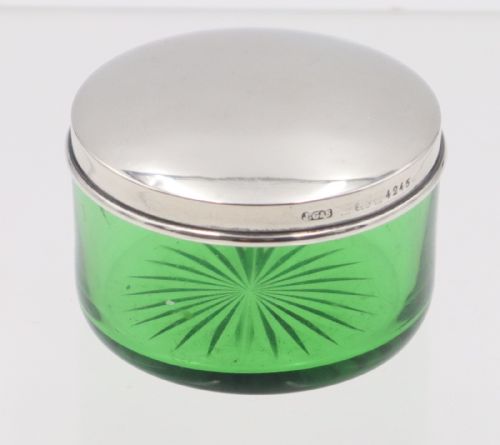
The objects span English and French workshops, utilising distinctive hues such as green, Bristol blue, and cranberry glass. Many examples incorporate fitted mounts, lids, or rims made of silver, silver plate, or fifteen-carat gold.
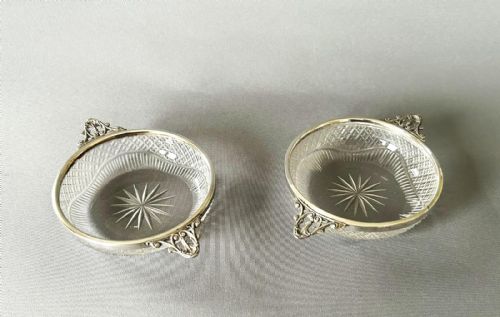
The forms range from circular boxes and double heart-shaped dishes to hinged boxes and lidded jars. While some items appear singly, others survive as pairs or as part of larger dressing table sets.
Materials and methods
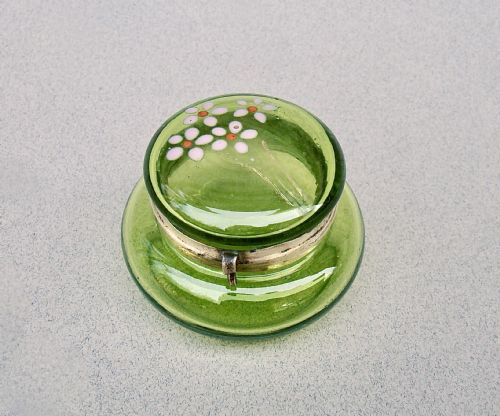
The construction relies heavily on moulded, blown, or cut glass combined with metalwork mounts. Enamel decoration appears frequently on coloured glass bodies, applied by hand to create surface patterns.
Metal components such as silver, silver plate, and gold leaf provide structural rims, hinged lids, and decorative gilt edges. Opaline glass and cranberry glass form the primary coloured bodies seen across these items.
Specialised techniques include the detailed white enamel painting associated with Mary Gregory styles on green glass, alongside precision cutting on clear glass vessels fitted with metal tops.
Several glass dishes take the form of scallop shells, bringing a touch of Victorian seaside taste directly onto the dressing table.
Judging quality
Quality rests upon the clarity and weight of the glass, the precision of the cut facets, and the richness of the underlying colour. Heavy, well-proportioned vessels with crisp cutting sit at the upper end of the range.
The standard of secondary materials matters greatly, particularly the gauge of the silver or gold used for mounts and lids. Finer items exhibit intact enamel work, secure hinges, and carefully applied gold leaf or gilt edges.
The Victorian Glass Trinket Dish Glossary
- Opaline glass
- An opaque or translucent glass developed in pale tints, frequently moulded into decorative items like shell dishes.
- Cranberry glass
- A rich red glass coloured with gold chloride, popular for nineteenth-century tableware and dressing table items.
- Mary Gregory
- A style of decorative glassware featuring silhouette figures painted in white enamel, typically set against green glass.
- Silver plate
- A base metal foundation coated with a thin layer of silver, commonly used for the rims and hinges of boxes.
- Cut glass
- Glass shaped and patterned by abrasive wheels, producing sharp facets that catch the light.
Victorian Glass Trinket Dish: Frequently Asked Questions
What are victorian glass trinket dish items used for?
These pieces served historically on dressing tables to hold small personal items such as pins, rings, and jewellery. Today they function as decorative containers or display objects in bedrooms and living spaces.
Their compact size makes them suitable for holding modern small accessories while retaining their original nineteenth-century character.
How do I date a glass trinket box?
Dating relies on stylistic clues, manufacturing techniques, and any associated metal mounts or hallmarks. Pieces from the Victorian era often display specific colour palettes like cranberry or Bristol blue alongside heavy cut patterns.
Edwardian examples and items from around nineteen hundred often feature lighter cut glass designs with simplified metal hardware.
Are these items made of solid silver?
Mounts and lids vary significantly between pieces, utilising sterling silver, silver plate, or fifteen-carat gold alongside the glass bodies. Some boxes feature unmarked precious metal components typical of nineteenth-century manufacture.
Examining the mounts reveals whether a piece utilises solid precious metal or plated base metals around the glass.
Where were these glass pieces made?
The available pieces originate primarily from English and French makers active during the nineteenth and early twentieth centuries. French workshops produced items such as opaline glass shell dishes and enamelled Bristol blue jars.
English makers contributed pieces ranging from cranberry glass butter dishes to green glass boxes featuring enamelled decoration.