

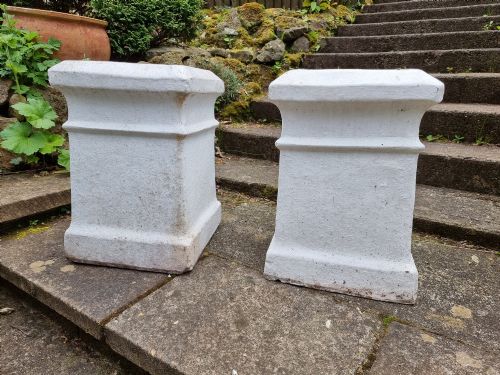


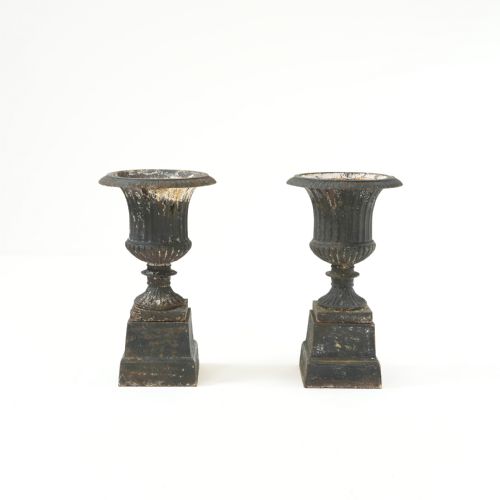


Victorian Garden Plinths
Victorian garden plinths are sturdy architectural supports designed to elevate urns, statues and planters in outdoor settings.
Victorian Garden Plinths
Victorian garden plinths are architectural column supports and display columns that elevate urns, statues and planters in outdoor settings. When you search for victorian garden plinths, you encounter robust supports designed to add height and classical proportion to garden displays.
The selection includes cast iron column planters, stoneware plinths and terracotta display columns dating primarily from the nineteenth century. Many examples appear in pairs, designed to flank paths, doorways or terrace edges with formal symmetry.
Stylistically, these pieces draw heavily on classical revival and neoclassical traditions, featuring decorative elements such as acanthus leaves and gadrooning. Alongside dedicated pedestals, you find repurposed chimney pots and columns adapted for garden use.
Materials and construction
Makers utilised durable materials suited to outdoor exposure, predominantly casting iron, terracotta, stoneware and cast stone. Cast iron pieces offered intricate detail and structural strength, often finished with protective paint layers.
Terracotta and salt-glazed stoneware were moulded and fired to withstand weathering, providing porous or dense surfaces that acquired natural patina over time. Plaster and lead also appear in specific sculptural and decorative supports within the range.
Victorian Garden Plinths Retail Price Guide 2026
Typical asking prices for victorian garden plinths among the pieces listed under this phrase on Sellingantiques today, from the lower quarter to the upper quarter. They describe what is for sale here now, not the wider market.
One nineteenth-century chimney pot clearly changed career paths entirely to spend its retirement functioning as an outdoor sundial.
Factors of quality
Quality rests upon the crispness of the casting or moulding, particularly in decorative details like acanthus leaves and gadrooning. Sharp relief and well-defined edges distinguish superior ironwork and terracotta from softer, worn examples.
The integrity of the material and the survival of original painted or weathered surfaces dictate the character of each piece. Pairs that retain matching proportions, original components and uniform patination command greater architectural coherence.
Dunfermline Clay Company·Andrew Handyside
The Victorian Garden Plinths Glossary
- Plinth
- A heavy base or square block supporting a statue, vase or column. It provides a stable foundation on uneven ground.
- Campana Urn
- A bell-shaped garden vessel with a flaring rim and tapered body. These are frequently mounted directly onto pedestals.
- Gadrooned
- Decorated with a series of convex curves or flutes moulded in a parallel row. This ornamental carving often encircles the body of an urn or the top of a column.
- Salt Glazed
- A ceramic finish achieved by throwing common salt into the kiln during firing, producing a characteristic pitted texture. This glaze seals stoneware against moisture damage.
- Neoclassical
- A style inspired by the classical art and architecture of ancient Greece and Rome. It emphasises symmetry, straight lines and restrained ornamentation.
Victorian Garden Plinths: Frequently Asked Questions
How are garden plinths used?
Garden plinths elevate planters, urns and statues to create focal points and introduce vertical structure into planting schemes. They frame doorways, paths and terrace corners with formal balance.
Positioning them on firm, level ground ensures stability for heavy cast iron or stone items. Pairing them allows for symmetrical arrangements in classic garden designs.
Can plinths stay outside all winter?
Most nineteenth-century cast iron, stoneware and cast stone plinths endure winter weather well due to their robust composition. Ensuring proper drainage prevents trapped water from expanding and cracking porous materials.
Terracotta and plaster pieces benefit from sheltered placement or careful covering during freezing conditions. Checking for accumulated moisture in hollow columns protects the material over time.
How do I date a garden plinth?
Dating relies on examining material composition, casting marks and stylistic details like neoclassical or classical revival motifs. Nineteenth-century examples often exhibit heavier construction and specific foundry methods.
Comparing surface patination, paint layers and wear patterns helps determine the age of iron and terracotta pieces. Maker stamps or registry marks provide direct evidence of production periods.
Are cast iron plinths very heavy?
Cast iron plinths possess substantial weight, which provides stability against strong winds and accidental knocks in outdoor spaces. This heft makes them difficult to move without assistance or lifting equipment.
Positioning them requires careful planning of the final location before installation. Their weight also ensures they remain secure on paved terraces and garden lawns.