





Victorian Fireplace Clock
A victorian fireplace clock anchors a mantelpiece with heavy marble, bronze, and striking movements.
Victorian Fireplace Clock
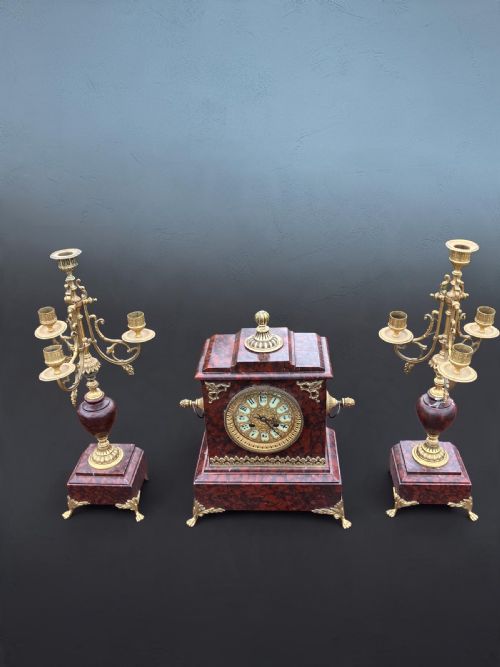
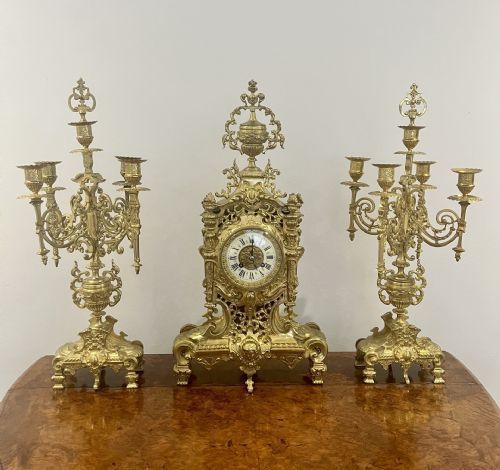
A victorian fireplace clock brings heavy stone and intricate metalwork to the mantelpiece, serving as both timekeeper and architectural centrepiece. These domestic timepieces range from simple drumhead models to elaborate three-piece garniture sets featuring matching side urns or candelabra.
The pieces appearing on this page span the nineteenth century, drawing heavily on French styles like Napoleon III, Neo-Classical, and Rococo Revival alongside traditional British formats. Buyers meet substantial black slate, variegated marble, and polished brass rather than light modern alternatives.
How they were made
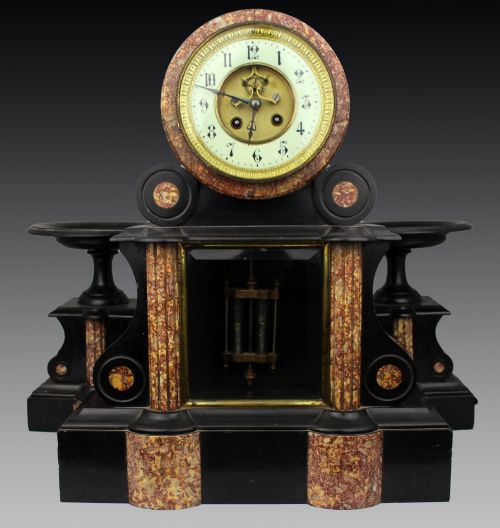
Makers constructed these clocks using heavy mineral slabs of black slate and white or rouge marble, shaped to resemble classical architecture. Bronze, brass, and gilt metal mounts were cast and applied to the stone bodies, often framing porcelain dials and enamel numerals.
Movements relied on mechanical eight-day mechanisms, sometimes housing double fusee or bell-chiming systems driven by coiled springs. Skilled metalworkers cast decorative bezels and handles, while specialised enamelers painted delicate floral motifs onto porcelain panels.
Several heavy slate and marble models weigh enough to require two people and a sturdy mantelpiece just to keep the hearth safe.
What varies in quality
Lesser examples employ faux marble finishes over simpler base materials or standard mass-produced movements without maker signatures. The integration of matching side pieces in a garniture set also separates grander drawing-room clocks from standard chamber pieces.
Japy Frères·PH Mourey·Budgen Croydon·Lemerle Charpentier·James Ritchie and Son·Wm Gilbert
The Victorian Fireplace Clock Glossary
- Garniture
- A set consisting of a central clock flanked by two matching decorative objects, such as urns or candelabra designed for a mantelpiece.
- Movement
- The internal mechanical assembly of gears, springs, and escapements that drives the clock hands and strikes the hours.
- Fusee
- A conical pulley used in better mechanical clocks to ensure even power delivery as the mainspring unwinds.
- Drumhead clock
- A timepiece featuring a circular clock face housing mounted directly atop a rectangular or serpentine stone base.
- Champlevé
- An enamelling technique where troughs are dug into metal surfaces and filled with vitreous enamel before firing.
Victorian Fireplace Clock: Frequently Asked Questions
What is a clock garniture?
A clock garniture is a matched decorative set designed for display on a fireplace mantel, consisting of a central clock accompanied by matching side ornaments like urns.
These sets create a balanced, symmetrical focal point above the hearth, echoing the architectural style of the room.
How do I wind an eight day clock?
An eight day clock requires winding approximately once a week using a matching metal key inserted into the winding holes on the dial.
Care must be taken not to overwind the mainspring, turning the key only until firm resistance is felt.
Are these clocks suitable for daily use?
Most nineteenth-century mantel clocks function reliably as daily timekeepers if they have undergone professional servicing and cleaning.
Placed on a sturdy, level mantelpiece away from direct heat sources, their mechanical movements can run accurately for decades.
How do I identify a French movement?
French movements often bear the stamped maker mark of workshops such as Japy Frères or detailed foundry signatures on the back brass plates.
They frequently feature silk-suspension or pendulum regulations and distinct bell-striking arrangements hidden behind the rear access door.