
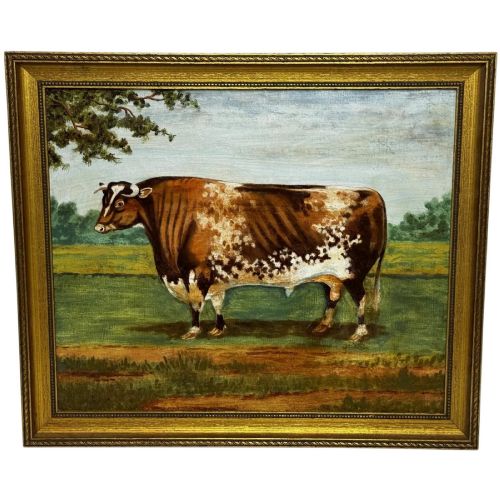


Victorian Farm Landscape Painting
A victorian farm landscape painting captures the agricultural rhythms and livestock of the nineteenth century through the eyes of period artists.
Victorian Farm Landscape Painting
A victorian farm landscape painting depicts rural scenes populated by cattle, sheep, horses, and farmworkers engaged in daily agrarian labour. These works stem from nineteenth-century British and continental schools, recording the pastoral economy before mechanisation altered the countryside.
The most common examples on this page are oil paintings on canvas and watercolours on paper, often retained in their original giltwood frames. Subjects range from quiet pastures with resting sheep to bustling farmyards with cart-horses, poultry, and dairy cattle.
The compositions reflect various regional traditions, including Victorian rural realism and British pastoral painting. Artists recorded specific rural tasks such as ploughing, haymaking, and tending livestock.
How They Were Made
These works rely primarily on oil paint applied to stretched canvas or wooden panels, alongside watercolours executed on paper. Artists built up their compositions using layered brushwork to render the textures of animal coats, foliage, and weathered farm buildings.
Supports were housed in wooden or giltwood frames that protected the delicate paint layers and paper surfaces over the decades. Pigments were mixed by hand or sourced from nineteenth-century suppliers to achieve naturalistic tones for fields, sky, and livestock.
Nineteenth-century artists clearly had to negotiate with very opinionated ducks, chickens, and pigs crowding the farmyards.
What Varies in Quality
Quality depends upon the artist's command of animal anatomy, perspective, and atmospheric light within the landscape. Master painters of the period captured the musculature of working shire horses and the individual wool texture of sheep with anatomical precision.
The condition of the pigment layer and the integrity of the original canvas or paper support distinguish better-preserved examples. Works that retain their period giltwood frames and show minimal restoration offer greater historical fidelity.
Franz van Severdonck·John Frederick Herring Jnr·Samuel Joseph Clark·Eugene Verboeckhoven·Charles Vickers·John Linnell·Pierre Emmanuel Dielmans·Claude Cardon·Thomas Sidney Cooper·Frederick William Jackson·Henry Birtles·Thomas Mackay·George Cole·Georgina Lara·William Greaves·Robert Gallon·Charles James Adams·Thomas Henry Thomas
The Victorian Farm Landscape Painting Glossary
- Oil on canvas
- A painting technique using pigments bound in a drying oil medium applied to a woven fabric support. This combination allowed artists to blend tones smoothly and build rich surface textures.
- Giltwood
- Timber carved and coated with a thin layer of gold leaf or metallic powder. It was commonly used for framing nineteenth-century fine art.
- Watercolour
- A painting method where coloured pigments are suspended in a water-soluble vehicle on paper. It produces translucent washes suited to capturing atmospheric skies and open fields.
- Rural realism
- An artistic approach focusing on unidealised depictions of agricultural life and country labourers. This style documented authentic rural conditions without romantic sentimentality.
- British School
- A collective term for artists born or trained in Britain. It encompasses generations of painters working within shared national traditions of landscape and genre art.
Victorian Farm Landscape Painting: Frequently Asked Questions
How do I identify a Victorian farm painting?
Look for characteristic nineteenth-century agricultural subjects, such as shire horses, shorthorn cattle, and thatched farm buildings rendered in oil paint or watercolour.
Signatures, dates, and framing styles often provide further clues to the specific decade of creation.
Where were these paintings displayed?
These works typically hung in the dining rooms and parlours of nineteenth-century homes, celebrating rural wealth and livestock ownership.
Today, they suit traditional interiors, studies, and period properties seeking an authentic pastoral atmosphere.
How should I care for an oil painting?
Keep the artwork away from direct sunlight, high humidity, and rapid temperature fluctuations to protect the canvas and paint layers.
Dust the surface gently with a dry, soft brush and avoid using liquid cleaners on the paint or frame.
What is the difference between oil and watercolour?
Oil paintings utilise pigments suspended in drying oil on canvas or wood, allowing for deep colours and textured brushstrokes. Watercolours use water-soluble pigments on paper, creating lighter, translucent effects.