



Victorian Equestrian Brooch
These Victorian equestrian brooch pieces capture nineteenth-century sporting life in gold and gemstone, offering collectors wearable miniatures of horseshoes, hunting bugles, and riding caps.
Victorian Equestrian Brooch
A victorian equestrian brooch brings together the motifs of the nineteenth-century hunting field and stable, taking the form of horseshoes, hunting bugles, and jockey caps. You will most frequently meet these pieces rendered in yellow gold, often shaped as horseshoe frames studded with seed pearls or turquoise.
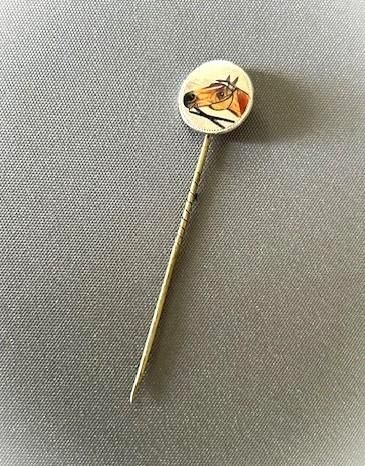
The objects span the Victorian and Edwardian eras, encompassing both substantial brooches and smaller stick pins designed to secure a cravat or lapel. Alongside silver and silver gilt iterations, the form draws on sporting iconography that defined personal ornamentation of the period.
Makers of the era utilised specific symbolic shapes, such as the horseshoe for good fortune and the jockey cap for racing enthusiasm. These jewels served as markers of identity for those devoted to equestrian pursuits and country sports.
How they were made
Goldsmiths constructed these jewels primarily in nine-carat, fifteen-carat, and eighteen-carat yellow gold, alongside silver and silver gilt settings. Metalwork techniques involved hollow or solid casting for dimensional forms like bugles and caps, complemented by hand-wire work for horseshoe frames.
Gemstones and organic materials were carefully selected and set by hand into the precious metal bases. Seed pearls and turquoise beads appear closely spaced along horseshoe channels, while larger stones like garnets and diamonds form the bodies of jockey caps.
Victorian Equestrian Brooch Retail Price Guide 2026
Typical asking prices for victorian equestrian brooch among the pieces listed under this phrase on Sellingantiques today, from the lower quarter to the upper quarter. They describe what is for sale here now, not the wider market.
Materials recorded across the selection include seed pearls, turquoise, garnets, diamonds, and rock crystal.
What varies in quality
The distinction between standard production and finer pieces lies in the precision of the miniature elements and the selection of materials. Higher quality examples display meticulously matched natural seed pearls or vibrant turquoise cabochons secured evenly within substantial gold weight.
Detailing on figural pieces, such as the engraved peak of a jockey cap or the crisp twist of a hunting bugle, separates workshop output. Superior pieces retain the integrity of their tiny components and complex pin mechanisms without distortion or thinning of the precious metal.
The Victorian Equestrian Brooch Glossary
- Seed pearl
- A very small natural pearl, often drilled and threaded onto wire or glued into channels to create a continuous shimmering border on nineteenth-century jewels.
- Turquoise
- An opaque blue-to-green mineral frequently cut into smooth cabochons and set into nineteenth-century gold work for its bright contrast against yellow metal.
- Silver gilt
- Sterling silver that has been coated with a thin layer of gold, providing the appearance of a solid gold object while utilising a silver base.
- Stick pin
- A long pin with a decorative head, worn upright in a cravat, tie, or lapel during the Victorian period.
- Essex crystal
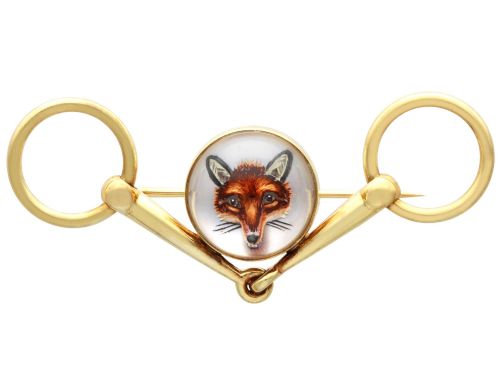
- Reverse-crystal intaglio where an artist carved and painted a tiny image into the back of a domed rock crystal, creating a lifelike three-dimensional miniature.
Victorian Equestrian Brooch: Frequently Asked Questions
How were these pins worn?
Victorians pinned them to lapels, collars, cravats, or hats as everyday decorative accessories that signalled a passion for horses and country sports.
Larger versions functioned as traditional dress brooches, while slender stick pins secured neckwear in place.
How do I date a piece?
Dating relies on material standards like fifteen-carat gold, stylistic cues from the Victorian and Edwardian periods, and construction methods.
Examining the pin stem, clasp type, and setting style helps distinguish mid-nineteenth-century work from later Edwardian examples.
What materials are common?
Yellow gold in nine, fifteen, and eighteen-carat purities forms the primary structure for most surviving pieces.
They are frequently embellished with natural seed pearls, turquoise cabochons, garnets, diamonds, and occasionally reverse-painted rock crystal.