



Victorian Earthenware Jardiniere
A victorian earthenware jardiniere brings indoor planting to life with heavy coloured glazes and moulded botanical forms.
Victorian Earthenware Jardiniere
A victorian earthenware jardiniere is a sturdy ceramic plant vessel designed to sit on tabletops, floors or matching pedestals inside the home. These pots house potted palms, ferns and flowering plants while protecting interior surfaces from water.
Most examples you encounter date from the late nineteenth century and span the Victorian, Edwardian and Art Nouveau periods. They range from modest domestic planters to monumental two-piece jardiniere and stand combinations.
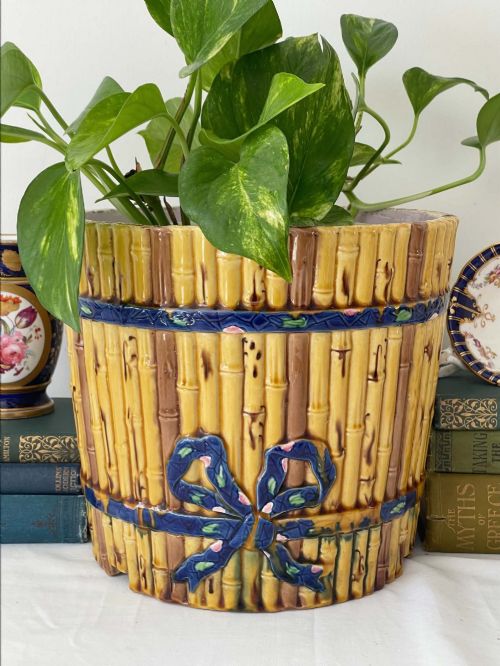
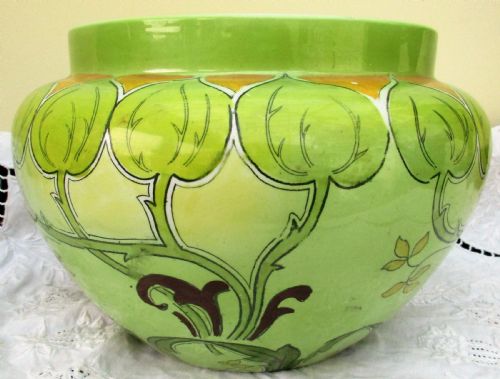
Makers utilised various stylistic revivals and modern movements, producing everything from naturalistic rockwork and bamboo to flowing linear motifs. The typical piece reflects the era's obsession with bringing exotic greenery indoors.
Materials and construction
Potters shaped these vessels using earthenware and stoneware clays, often building them in sections when combining a planter with a tall pedestal base. The body is typically thick and heavy to support large decorative plants and resist tipping.
Glazes define the surface character, employing glossy majolica coloured lead glazes, iridescent lustre finishes, faience painting or matte slip decoration. These impermeable coatings protected the porous ceramic body from moisture while creating rich visual depth.
Victorian Earthenware Jardiniere Retail Price Guide 2026
Typical asking prices for victorian earthenware jardiniere among the pieces listed under this phrase on Sellingantiques today, from the lower quarter to the upper quarter. They describe what is for sale here now, not the wider market.
Several Victorian planters take the form of majestic swans and grinning griffins, proving that nineteenth-century botanists took their foliage with a side of theatre.
What separates the best from the rest
Quality rests upon the ambition of the modelling and the precision of the glaze application. Pieces that display crisp relief moulding, hand-painted details and complex, multi-fired lustre or majolica glazes stand apart from plain utility pots.
The presence of a matching original pedestal or stand elevates a piece considerably, particularly when the architectural lines and glaze schemes integrate seamlessly between the upper bowl and the base.
W.A. Adderley·Burmantofts Art Pottery·Doulton Burslem·Doulton Lambeth·Clement Massier·Minton·Royal Doulton·Royal Worcester·Julius Dressler·George Jones·William Adams and Sons·Linthorpe Pottery·Woodlesford Art Pottery
The Victorian Earthenware Jardiniere Glossary
- Majolica
- A type of earthenware covered with an opaque tin glaze and painted with metallic oxide colours that fire to rich hues. This technique allowed Victorian potters to achieve vibrant greens, blues and aubergines.
- Jardiniere
- A large ornamental pot or planter designed to hold growing plants rather than cut flowers. The term derives from the French word for gardener.
- Faience
- Tin-glazed earthenware decorated with coloured pigments before firing. It offers a smooth, absorbent surface ideal for painted floral and abstract patterns.
- Lustre glaze
- A metallic film applied to the ceramic surface to create an iridescent, shimmering effect. This technique produced shifting rainbow sheens popular in late Victorian and Art Nouveau pottery.
- Jasperware
- A fine-grained, unglazed stoneware developed to display contrasting white cameo reliefs against a solid coloured body. It provides a crisp, neoclassical aesthetic distinct from glossy majolica.
Victorian Earthenware Jardiniere: Frequently Asked Questions
How were these jardiniere pots originally used?
Victorian households placed large potted palms and ferns directly into these ceramic vessels to decorate drawing rooms, conservatories and hallways. They acted as decorative cachepots to hide plain terracotta flowerpots and catch drainage water.
Wealthy homeowners often paired large jardinieres with matching ceramic pedestals to elevate heavy plants into focal points within high-ceilinged rooms.
How can I tell Art Nouveau from Victorian pieces?
Victorian designs tend to lean towards classical symmetry, rich majolica colours, naturalistic bamboo textures and heavy botanical reliefs. These earlier pieces emphasise historical revival styles and structured ornamentation.
Art Nouveau examples introduce flowing, asymmetric lines, stylised plant tendrils and iridescent lustre glazes that reflect a break from traditional Victorian rigidity.
Are matching pedestals common to find?
Complete sets featuring both the jardiniere bowl and its original matching pedestal are scarcer because the separate pieces were easily separated, knocked over or broken over generations. Many surviving bowls have lost their stands.
When a jardiniere and its tall base survive together as a matching pair, they form a much more substantial and sought-after decorative statement.