



Victorian Domed Top Trunk
A victorian domed top trunk is a utilitarian travel chest or storage piece defined by its curved lid, offering sturdy historical character for modern interiors.
Victorian Domed Top Trunk
When you search for a victorian domed top trunk, you encounter robust storage pieces originating from the nineteenth century and the early nineteen hundreds. These items function as blanket chests, travel luggage, and heavy storage coffers designed for mobility and household utility.
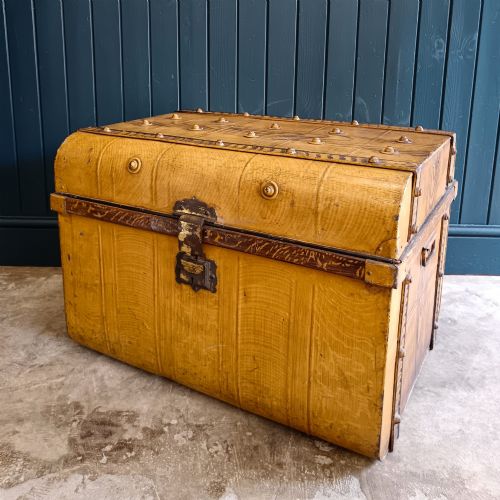
The versions most commonly met on this page span the Victorian era, utilising durable woods like pine and oak alongside protective outer coverings such as leather, canvas, and metal. Their distinctive curved lids were originally engineered to shed rainwater during transit and to allow extra clearance for bulky garments inside.
Stylistic influences range from rustic country and folk art to baroque revival and Anglo-Indian designs, showing that these practical containers served both humble domestic roles and more ornate decorative functions in period homes.
How they were made
Construction relies heavily on sturdy timber carcases built from pine or oak, shaped with curved wooden ribs to support the characteristic domed lids. Artisans reinforced these wooden structures with exterior layers of leather, painted metal, tin, or canvas to withstand the rigours of nineteenth-century travel.
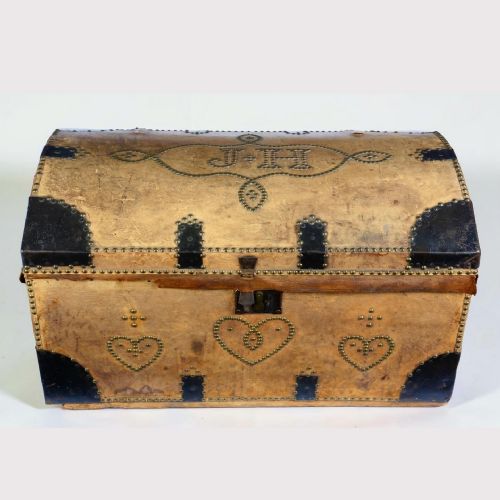
Metal components such as iron and brass feature prominently as structural protection and decorative ornamentation. Workshops applied heavy brass studwork, iron brackets, and corner plates to secure high-stress joints and protect the edges from impact.
Victorian Domed Top Trunk Retail Price Guide 2026
Typical asking prices for victorian domed top trunk among the pieces listed under this phrase on Sellingantiques today, from the lower quarter to the upper quarter. They describe what is for sale here now, not the wider market.
Some nineteenth-century travellers hammered decorative brass studs into their leather trunks simply to spell out their initials before boarding a transatlantic steamer.
What varies in quality
Quality separates simple utilitarian storage from finer decorative examples through the choice of materials and the complexity of exterior decoration. Plain pine iterations focus purely on robust construction, whereas pieces featuring inlaid walnut, profuse brass studwork, or faux-wood painted metal demonstrate higher craftsmanship.
The integrity of the original covering materials and hardware defines the upper tier of the range. Trunks retaining intact leather, original canvas, functioning brass fittings, and documented maker attribution command stronger interest than heavily altered or stripped carcases.
Arthur Wannop
The Victorian Domed Top Trunk Glossary
- Dome top
- A curved lid style designed to shed water and increase internal packing capacity. This curved profile is characteristic of travel chests from the nineteenth century.
- Studwork
- Decorative or reinforcing metal tines hammered into the exterior of leather or wood chests. Brass studwork often creates geometric patterns across Victorian luggage.
- Steamer trunk
- A low-profile travel chest designed to fit beneath a steamship berth. These pieces often feature metal reinforcement and flat or slightly domed lids.
- Coffer
- A heavy wooden chest traditionally used for storing valuables or textiles. Continental examples often display intricate inlay and carved details.
- Pine
- A soft timber widely utilised for domestic storage chests and blanket boxes throughout the nineteenth century. It accepts paint finishes and staining readily.
Victorian Domed Top Trunk: Frequently Asked Questions
What were domed top trunks used for?
These trunks served primarily as durable luggage for nineteenth-century travellers journeying by rail, ship, or carriage. Their curved lids allowed travellers to pack bulky garments while helping moisture run off the top during transit.
In domestic settings, families utilised them as blanket chests and general storage repositories at the foot of beds or in attics. Their robust construction protected contents from dust, pests, and damp conditions.
How do I clean a leather trunk?
Maintenance requires gentle cleaning with a soft, dry cloth to remove accumulated dust from the surface and crevices. Avoid harsh chemical cleaners or excessive moisture that can damage nineteenth-century leather and brass studwork.
If the material feels dry, apply a minimal amount of conservation-grade leather dressing using a clean cloth. Test any treatment on a hidden area first to ensure the finish remains stable.
Are these trunks waterproof today?
Original nineteenth-century construction methods and materials do not guarantee a modern waterproof seal. Canvas, leather, and wood have aged over generations, and gaps can develop around the lid edges.
Store these pieces in temperature-controlled indoor environments rather than damp outbuildings or cellars. Using them for decorative display and dry storage preserves their historical integrity.
How can I tell the period?
Dating relies on observing construction techniques, hardware materials, and secondary woods like pine or oak. Mid-nineteenth-century examples often display heavy brass studwork and hand-forged iron components.
Later Victorian and turn-of-the-century pieces incorporate machine-made steel framing, painted metal sheeting, and specific manufacturer labels. Comparing the interior lining papers and exterior fasteners helps narrow down the decade of manufacture.