



Victorian Cottage Interior Painting
A victorian cottage interior painting captures domestic life through genre scenes rendered in oil and watercolour during the nineteenth and early twentieth centuries.
Victorian Cottage Interior Painting
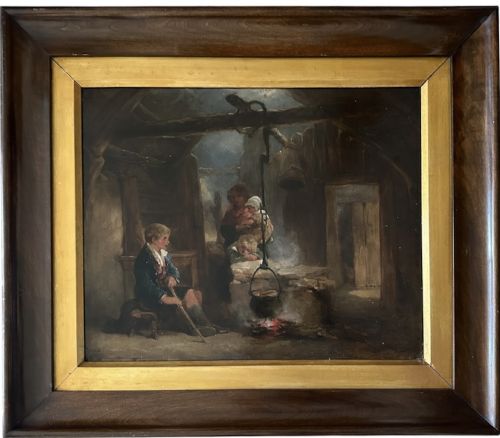
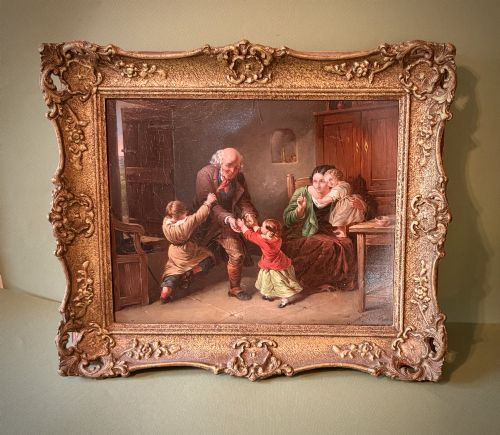
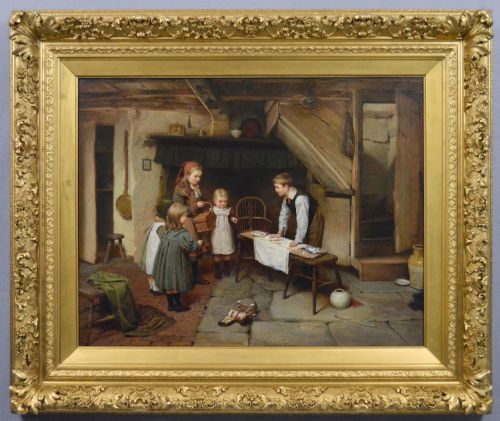
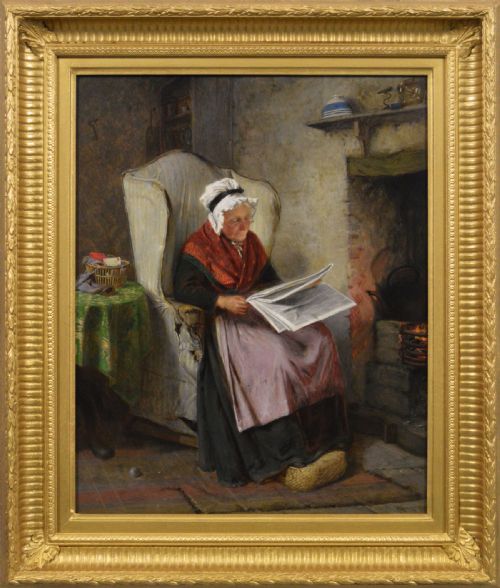
A victorian cottage interior painting depicts domestic scenes within rural homes, often focusing on family moments, fireside rests, and everyday household tasks. These works document nineteenth-century domesticity through depictions of mothers, children, and elderly residents surrounded by cottage furnishings.
The version most commonly met on this page is the oil painting on canvas or panel, frequently framed in gilt wood and gesso. Such works range from intimate portrayals of spinning maids to lively groups accompanied by domestic animals.
Originating largely within nineteenth-century British and European realism, these pieces reflect a period interest in narrative genre art. Artists utilised detailed settings to evoke warmth and sentiment within the domestic sphere.
Materials and methods
Artists relied primarily on oil paint applied to canvas or wood panels, building rich surfaces that capture the play of light within dim domestic spaces. Watercolours on paper also appear, offering a lighter medium for similar interior narratives.
Many of these works retain their original frames, constructed from wood finished with gesso and gold leaf. The interaction between the painted canvas and the gilded surround forms an integral part of the finished object.
Cottage inhabitants rarely sit alone; pigs, ponies, guinea pigs, and donkeys frequently crowd the floorboards alongside the human family members.
Judging the work
Quality rests upon the artist's ability to handle narrative detail and expression within the figures, distinguishing carefully observed genre studies from more formulaic domestic scenes. The complexity of the composition, particularly in multi-figure interactions with animals or objects, defines the stronger pieces.
The preservation of the paint surface and the integrity of the original wood and gesso frame contribute significantly to the standing of the work. Finer examples maintain the original luminosity of the oil pigments without extensive overpaint.
George Whitton Johnstone·Harry Brooker·Haynes King·George Smith·Alfred Provis·Robert Gemmell Hutchison·Jonathan Pratt·Charles Hunt Jnr
The Victorian Cottage Interior Painting Glossary
- Genre painting
- Depictions of everyday life and ordinary people engaged in non-heroic activities. This form became particularly popular during the nineteenth century for its narrative accessibility.
- Oil on panel
- A painting executed on a flat wooden board rather than stretched canvas. This support provides a rigid surface often favoured for smaller interior scenes.
- Gesso
- A plaster-like mixture applied to wood frames before gilding. It provides a smooth base for intricate moulding and gold leaf application.
- Watercolour painting
- Works executed using water-soluble pigments on paper. This medium produces translucent effects distinct from the heavy impasto of oil.
Victorian Cottage Interior Painting: Frequently Asked Questions
What subjects appear in these paintings?
The subjects focus on domestic life, including mothers with children, fireside rests, and women spinning wool. Domestic animals frequently share the cottage floor with the human figures.
Scenes often capture specific moments like tea time, bedtime, or visits from relatives, reflecting nineteenth-century ideals of rural home life.
Are these works dated accurately?
Dates typically reflect the active period of the artist or the specific decade of creation recorded in the listing. Many pieces belong to the nineteenth century, spanning from the eighteen-sixties to the early nineteen-hundreds.
Signatures and exhibition records, such as those from the Royal Academy, help anchor the chronology of individual works.
How should I care for an oil painting?
Oil paintings require stable indoor humidity and protection from direct sunlight to prevent the canvas from sagging and the pigments from fading. Dusting should be undertaken gently with a soft, dry brush.
Frames made of gesso and gold leaf also need careful handling to avoid chipping the delicate mouldings.
What mediums were used?
The primary medium is oil paint applied to either canvas or wood panel, producing rich and durable surfaces. Watercolours on paper also represent a smaller portion of the works.
Frames are predominantly constructed from wood embellished with gesso and gold leaf.