





Victorian Conversation Couch
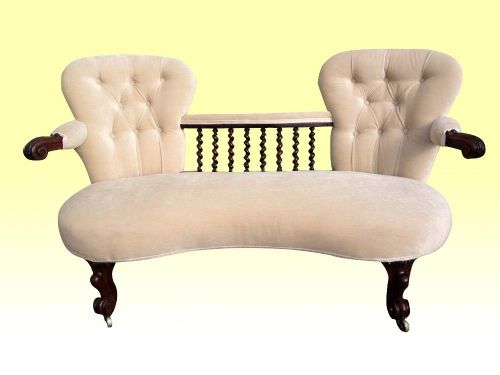
A victorian conversation couch offers face-to-face seating, and you want one for its distinct seating arrangement and period timber frame.
Victorian Conversation Couch
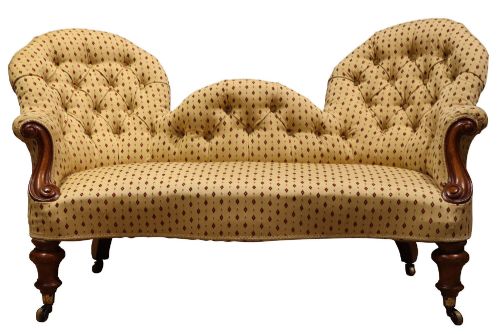
A victorian conversation couch brings together specific forms like settees, double end sofas, and conversation seats designed for seated dialogue. These pieces date from the nineteenth century, including specific years like eighteen fifty and around eighteen sixty.
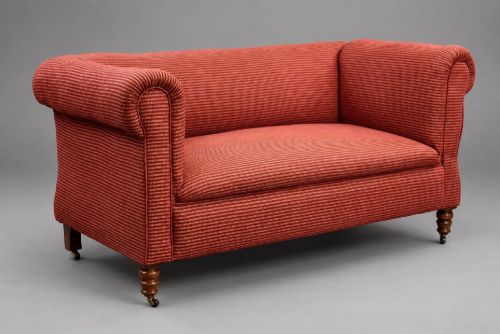
The most common versions on this page are Victorian settees, double end sofas, and specific conversation seats built with timber frames and upholstered surfaces. You will also encounter related nineteenth-century seating forms such as chaise longues and twin high-back sofas.
Makers of this period built these seats in styles spanning the Victorian era, including Victorian Rococo Revival. They served formal reception rooms where guests needed to converse comfortably without turning their chairs.
How they were made
The frames rely on solid timbers such as mahogany, walnut, and rosewood, often shaped into serpentine outlines or turned with barley twist details. Showwood timber is left exposed around the upholstered sections to highlight the grain and colour of the wood.
Upholstery techniques include deep buttoning and velvet upholstery, sometimes combined with leather. Supporting elements include brass fittings and timber frames designed to hold complex multi-directional seating arrangements.
Victorian Conversation Couch Retail Price Guide 2026
Typical asking prices for victorian conversation couch among the pieces listed under this phrase on Sellingantiques today, from the lower quarter to the upper quarter. They describe what is for sale here now, not the wider market.
Listings feature Victorian timber frames in mahogany, walnut, and rosewood, alongside upholstered finishes in fabric, velvet, and leather.
What varies in quality
Quality rests on the crispness of the timber carving and the elegance of the wood selection, whether mahogany, walnut, or rosewood. Superior examples display refined showwood frames and balanced proportions rather than plain, heavy timbers.
The execution of the upholstery work, such as deep buttoning and the choice of fabric or leather, dictates the finish of the piece. Better proportioned settees and conversation seats maintain structural harmony across their complex double-ended or swivel forms.
The Victorian Conversation Couch Glossary
- Showwood
- Timber framing left visible around the upholstered portions of a seat. This allows the grain of mahogany, walnut, or rosewood to contribute to the appearance.
- Barley twist
- A decorative turning technique resembling a twisted rope. It appears on the wooden supports of nineteenth-century frames.
- Double end sofa
- A sofa with symmetrically raised ends allowing a person to recline at either side. They often feature serpentine fronts and button upholstery.
- Rococo Revival
- A nineteenth-century style drawing on eighteenth-century Rococo ornament. It uses asymmetrical curves and naturalistic floral carvings on timber frames.
Victorian Conversation Couch: Frequently Asked Questions
What is a conversation couch?
A conversation couch is a nineteenth-century seating form designed so two or more people can sit facing each other for talk. They take various shapes, including double-end settees and specific conversation seats.
These pieces belong to the Victorian period and combine exposed timber frames with upholstered seating areas. Their layout breaks from standard straight sofas to encourage social interaction.
How do I identify a Victorian piece?
You identify a Victorian piece by looking at the combination of period timber types and revival styles. Common woods include mahogany, walnut, and rosewood.
Details such as deep buttoning, serpentine frames, and barley twist turnings point directly to nineteenth-century manufacture. The presence of showwood timber frames further confirms the period.
Where should I place one?
These seats suit large reception rooms, drawing rooms, or open living spaces where they can sit away from walls. Because they offer multi-directional seating, they work well as central room focal points.
Ensure there is enough clear floor space around the piece to allow people to walk past and use the seating arrangement properly.
What woods were used?
Cabinetmakers used dense hardwoods capable of holding complex curves and structural joints. Mahogany, walnut, and rosewood appear frequently in these nineteenth-century frames.
Selected areas of the timber are left exposed as showwood, displaying the natural grain and colour alongside the fabric or leather upholstery.