



Victorian Cased Barometer
A victorian cased barometer brings atmospheric pressure into the room housed in timber and glass, offering a reliable link to nineteenth-century domestic science.
Victorian Cased Barometer
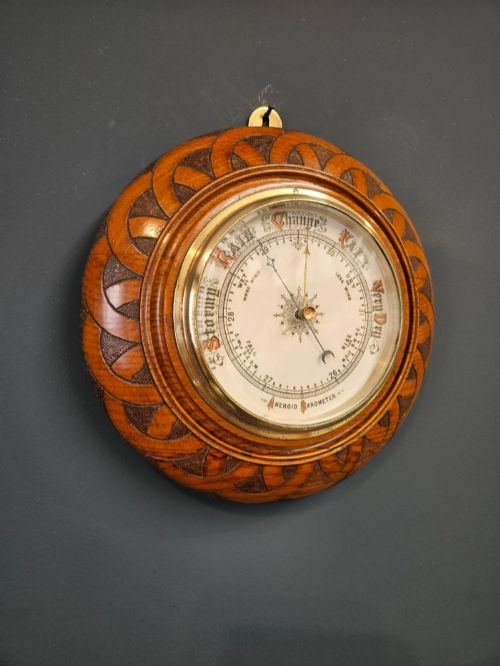
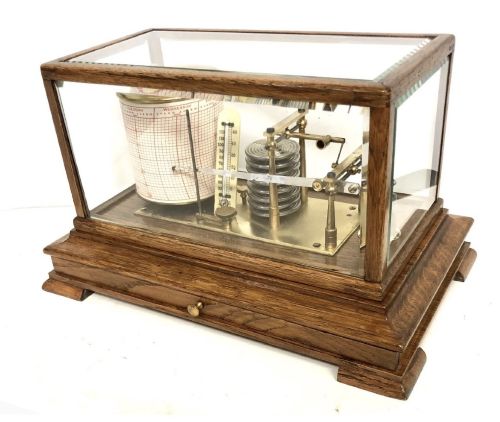
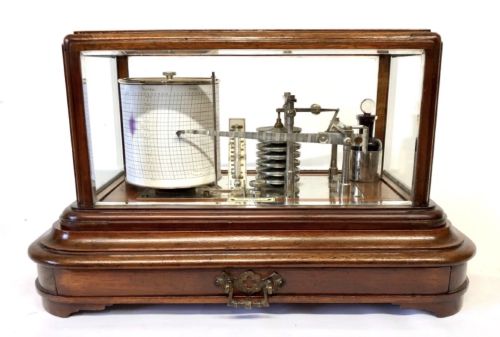
A victorian cased barometer encompasses various meteorological instruments designed to measure atmospheric changes, including stick barometers, wheel barometers, banjo barometers, and continuous recording barographs. The examples found here span the Victorian era, Edwardian period, and early twentieth century.
Makers range from notable scientific instrument firms in London and provincial towns to French makers and international retailers. These instruments frequently combine utility with decorative cabinetry suited to domestic halls and libraries.
Materials and Construction
Cabinet makers utilised solid and veneered timbers including oak, mahogany, and walnut to construct the protective housings, often applying turned, carved, or geometric designs to the wood.
Glass protected the dials, pointers, and revolving paper chart drums, whilst brass and steel provided the structural framework for aneroid movements, linkages, and barometer tubes.
Victorian Cased Barometer Retail Price Guide 2026
Typical asking prices for victorian cased barometer among the pieces listed under this phrase on Sellingantiques today, from the lower quarter to the upper quarter. They describe what is for sale here now, not the wider market.
Gradations in Quality
The refinement of the cabinetry distinguishes different tiers of these instruments, moving from plain turned softwood or oak frames to deeply carved mahogany, figured walnut, and cast brass marine housings.
The reputation of the maker and the complexity of the mechanism, such as the inclusion of a clockwork recording drum or supplementary thermometers by firms like Negretti & Zambra, separate standard domestic models from superior scientific pieces.
GAUPP & CO HONGKONG & SINGAPORE·SHORT & MASON LONDON·BAINES HARROGATE·J Hughes London·Negretti & Zambra·Robson of Newcastle·Alexander Wright Westminster·W.E. Pain of Cambridge·Richard Freres·Dollond of London·R & J Beck London·TS & JD Negus of New York
The Victorian Cased Barometer Glossary
- Barograph
- An instrument that records atmospheric pressure continuously over a week on a revolving paper chart driven by a clockwork mechanism. These devices utilise multiple aneroid chambers to drive the recording arm.
- Aneroid Barometer
- A barometer that measures pressure through the expansion and contraction of a sealed metal capsule without the use of liquid mercury. This design allowed barometers to be built into portable pocket formats and compact domestic cases.
- Stick Barometer
- A tall, vertical barometer containing a column of mercury that rises and falls in a glass tube against a scale. These instruments represent traditional mercurial measurement.
- Banjo Barometer
- A wall barometer housed in a distinctive symmetrical wooden case shaped like a banjo, typically featuring a hygrometer, thermometer, and large round dial. They were widely produced during the nineteenth century.
- Fortin Stick Barometer
- A precise mercurial barometer featuring an adjustable leather bag at the base of the cistern to set the mercury level to an ivory point. Alexander Wright produced notable examples of this type.
Victorian Cased Barometer: Frequently Asked Questions
What is a barograph?
A barograph is a self-recording meteorological instrument that tracks changes in air pressure onto a rotating paper chart over the course of a week.
Driven by clockwork and actuated by stacked aneroid metal boxes, it provides a visual history of weather patterns directly on the desk or shelf.
How do aneroid and mercurial barometers differ?
Mercurial barometers rely on a column of liquid mercury balancing against atmospheric weight in a sealed glass tube. Aneroid barometers use a flexible metal capsule that expands or contracts with pressure changes, eliminating liquid entirely.
This mechanical approach allowed makers to build compact wall cases and portable pocket instruments during the nineteenth century.
Who was Admiral Fitzroy?
Admiral Robert Fitzroy developed a specific type of barometer equipped with detailed instructions and chemical storm glasses to help fishermen predict approaching gales. These instruments were widely adopted around British coasts.
Oak-cased versions bearing his name remain recognisable forms of nineteenth-century domestic weather forecasting equipment.
Where were these barometers displayed?
These instruments were traditionally mounted on walls or placed on heavy furniture in the halls, libraries, and studies of Victorian homes. They served as both practical forecasting tools and decorative wooden furnishings.
Marine barometers were similarly secured in ship cabins to assist navigation at sea.