

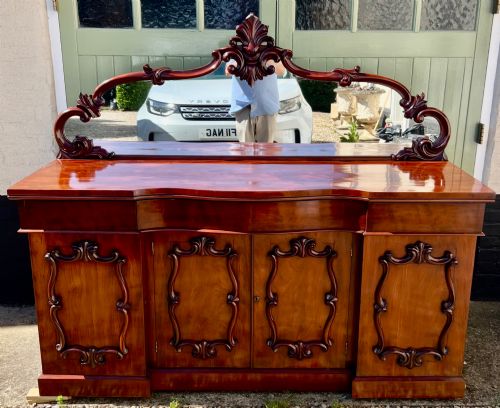
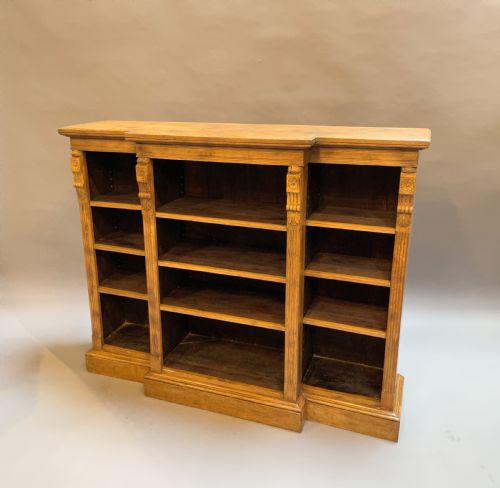

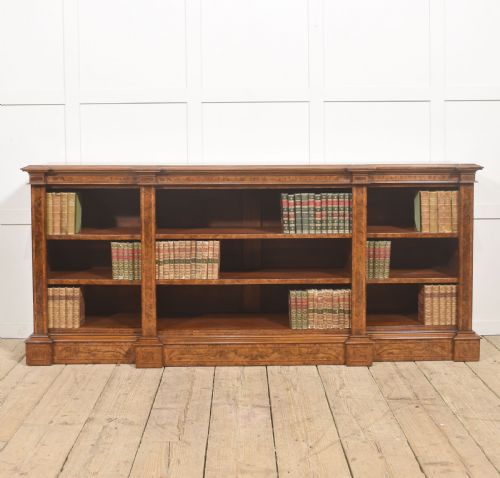


Victorian Breakfront Unit
A victorian breakfront unit offers commanding presence and practical shelving, built to anchor a serious library or grand reception room.
Victorian Breakfront Unit
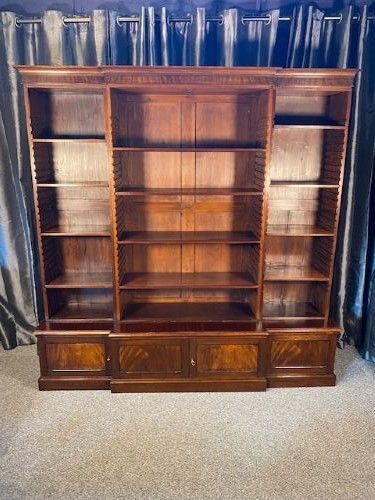
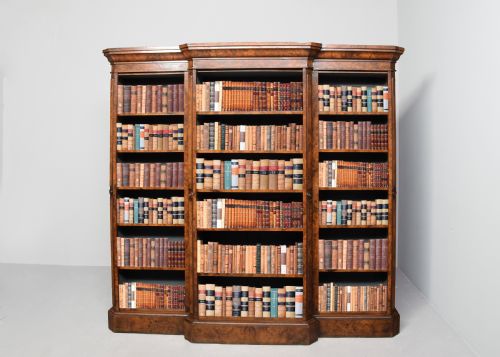
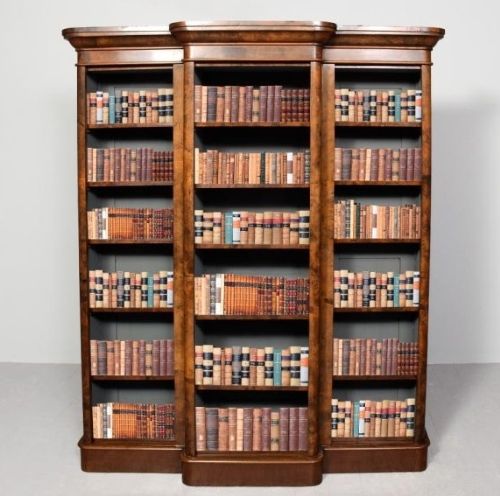
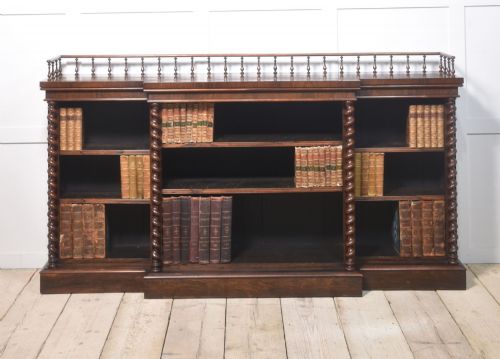
A victorian breakfront unit generally takes the form of a large open bookcase or bookcase and shelving, distinguished by a central section that projects forward from flanking wings. These substantial pieces emerge from the nineteenth century in various iterations, spanning early, mid, and late Victorian periods.
Bookcases dominate the selection, though sideboards, wardrobes, and display cabinets also appear with this characteristic projecting central architectural layout. Buyers encounter configurations with adjustable shelves designed for extensive private libraries and refined domestic display.
The profile creates deep visual rhythm along a wall, separating large volumes into distinct vertical bays. Most examples rely on open frontages rather than glazed doors, offering immediate access to rows of bound books.
How they were made
Cabinet makers constructed these large carcasses from dense timbers like mahogany, walnut, and rosewood, frequently applying burr walnut or flame mahogany veneers across prominent surfaces. Pine and softwood served as secondary timbers for internal linings and carcass construction.
The joinery accommodated multi-section designs, allowing grand pieces to be dismantled for transport into substantial Victorian homes. Polishing brought out the deep natural grain patterns of the figured veneers without masking the inherent character of the timber.
Victorian Breakfront Unit Retail Price Guide 2026
Typical asking prices for victorian breakfront unit among the pieces listed under this phrase on Sellingantiques today, from the lower quarter to the upper quarter. They describe what is for sale here now, not the wider market.
Some large bedroom units cleverly conceal their massive scale by dismantling entirely into manageable pieces for recalcitrant stairwells.
What varies in quality
The grade of timber and the choice of veneer dictate the initial visual impact, with figured burr walnut and rich flame mahogany standing apart from plainer mahogany or softwood carcases. Superior examples display careful grain matching across the projecting breakfront sections and flanking wings.
Internal engineering accounts for refinement, particularly the smoothness of adjustable shelf mechanisms and the structural integrity of multi-section breaks. Higher quality pieces maintain rigid alignment across all segments while offering straightforward dismantling when required.
Robert Strahan
The Victorian Breakfront Unit Glossary
- Breakfront
- A cabinet design where the central section projects forward from the flanking wings. This architectural arrangement creates shadow lines and breaks up the flat expanse of a long wall.
- Burr walnut
- A highly figured timber harvested from the wart-like growths on walnut trees. Cabinet makers sliced this wood into decorative veneers for high-status furniture.
- Flame mahogany
- A distinctive veneer pattern displaying leaping, flame-like grain figures. It was cut from the fork of the mahogany tree where branches joined the trunk.
- Adjustable shelves
- Shelving supported by movable pegs or ratchets rather than fixed partitions. This feature allowed owners to alter shelf heights for varying book sizes.
Victorian Breakfront Unit: Frequently Asked Questions
What is a breakfront unit?
A breakfront unit is a large piece of furniture, most commonly a bookcase, where the central section steps forward from the side sections. This layout breaks up long runs of shelving and adds architectural depth to a room.
Cabinet makers used this design to create commanding focal points in libraries and large studies during the nineteenth century. The projecting centre often housed larger volumes while the wings held standard sizes.
Are Victorian bookcases adjustable?
Many Victorian bookcases feature adjustable shelves supported by internal wooden racks, brass studs, or shelf slips. This allowed libraries to accommodate books of varying heights without wasting vertical space.
Buyers should examine the interior pilasters or uprights to see how the shelving is held in place. Original mechanisms move smoothly and match the surrounding internal woodwork.
How do I fit a large bookcase?
Large nineteenth-century bookcases often dismantle into multiple sections to ease transport and placement. Checking the sectional breakdown helps determine how the carcass travels through doorways and into position.
Measure the ceiling height and wall length carefully before selecting a multi-section breakfront. These units demand generous proportions to sit comfortably within a room.
Which woods did makers use?
Victorian cabinet makers primarily worked with dense hardwoods including mahogany, walnut, and rosewood. They frequently applied figured veneers such as burr walnut or flame mahogany to the primary visible facades.
Secondary timbers like pine and softwood appear on internal partitions and concealed framing. The exterior finish relies on traditional polishing to highlight the natural grain patterns of the primary wood.