




Victorian Brass Tea Kettle
A victorian brass tea kettle brings a warm, heavy glow to the hearth, combining period metalwork with daily ritual.
Victorian Brass Tea Kettle
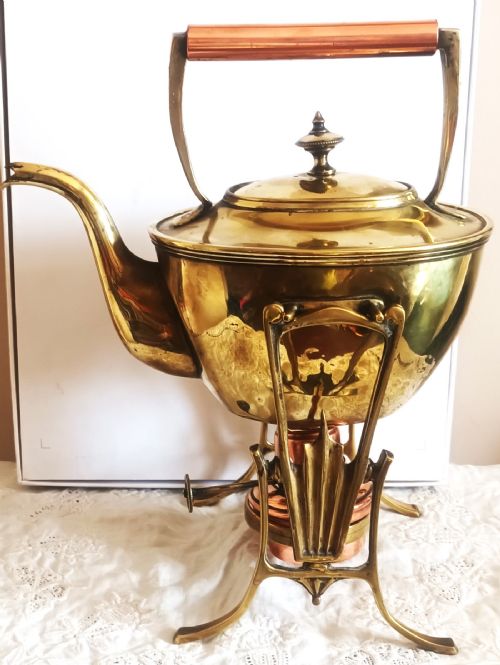
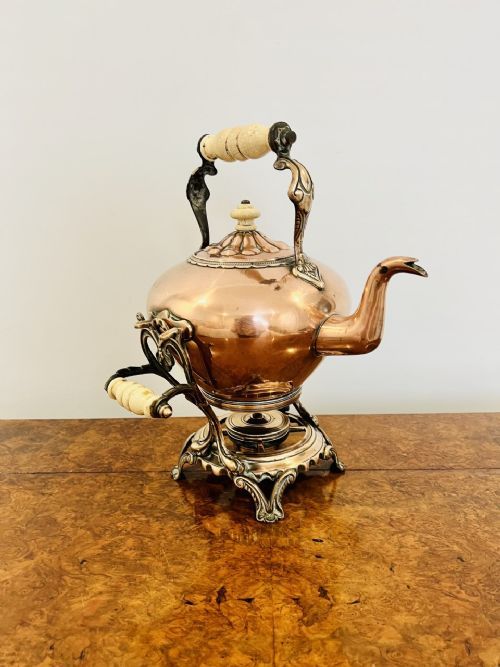
When you search for a victorian brass tea kettle, you encounter spirit kettles on stands, large samovars, and standard hearth kettles dating from the mid-nineteenth century through to the Edwardian period and the early twentieth century. The most common form on this page combines warm copper bodies with bright brass mounts, often raised on dedicated metal stands for the table.
The material palette spans brass, copper, and ebonised wood handles, with occasional bone, cane, or glass insulators integrated into the lifting grips. Makers such as William Soutter & Sons produced notable English spirit kettles, while heavier samovars and tea urns served larger gatherings.
Stylistic variations range from simple round vessels of eighteen fifty to late nineteenth century Aesthetic Movement designs and early twentieth century dresser style models. You also find companion pieces like two tier brass trivets designed specifically to hold these kettles by the fire.
Markers of quality and finish
Quality rests in the heaviness of the metal gauge, the crispness of the turned wooden or bone handle grips, and the structural integrity of the stands and burners. Superior examples display balanced proportions, neat joinery, and retaining all original components such as the spirit burner and cover.
Simpler everyday kettles show lighter construction and plain surfaces, whereas finer pieces feature decorative engraving, Aesthetic Movement motifs, or substantial cast brass framework designed to impress in a Victorian interior.
Listings feature periods spanning from eighteen fifty through the Victorian era, the Aesthetic Movement, and into early twentieth century Edwardian styles.
William Soutter & Sons
The Victorian Brass Tea Kettle Glossary
- Spirit kettle
- A tea kettle mounted on a metal stand above a small spirit burner used to keep the water hot at the table.
- Samovar
- A large heated metal urn traditionally used to boil water for tea, featuring a central internal heating pipe or tap.
- Trivet
- A three or four legged metal stand placed near the fire or on a table to elevate a hot kettle or urn.
- Ebonised wood
- Hardwood stained or painted black to imitate expensive ebony, frequently used for cool touch kettle handles.
- Aesthetic Movement
- A late nineteenth century design style emphasising visual beauty over narrative meaning, often seen on decorative metalwork.
Victorian Brass Tea Kettle: Frequently Asked Questions
What is a spirit kettle?
A spirit kettle is a tea kettle suspended on a metal stand above a small fuel burner. This allowed Victorians to keep water hot directly at the tea table without returning to the kitchen hearth.
These pieces typically date from the late nineteenth century and include matched stands, burners, and lids designed as a single portable unit.
How do I use a samovar?
A samovar is a large metal urn designed to heat and dispense water for tea. Water fills the main body, while a spigot at the base allows easy pouring into individual cups.
They were built for large gatherings and hospitality, functioning as the centrepiece of the tea service in nineteenth century homes.
How do I clean brass and copper?
Maintaining these metals requires gentle cleaning to preserve the natural aged patina rather than achieving a bright modern shine. Mild soapy water and soft cloths remove surface dust without stripping the character built over the decades.
Avoid harsh abrasive compounds that scratch the soft copper and brass surfaces or remove historical marks left by makers and use.
How do I tell periods apart?
Dating relies on stylistic clues, construction techniques, and materials shifting from mid nineteenth century round brass kettles to late century Aesthetic Movement designs and early twentieth century Edwardian pieces. Heavier cast fittings, specific handle insulators like cane or bone, and maker stamps help narrow the production era.
Comparing the form against dated examples in the archive reveals how manufacturing evolved from plain utility to ornamental tabletop display.