

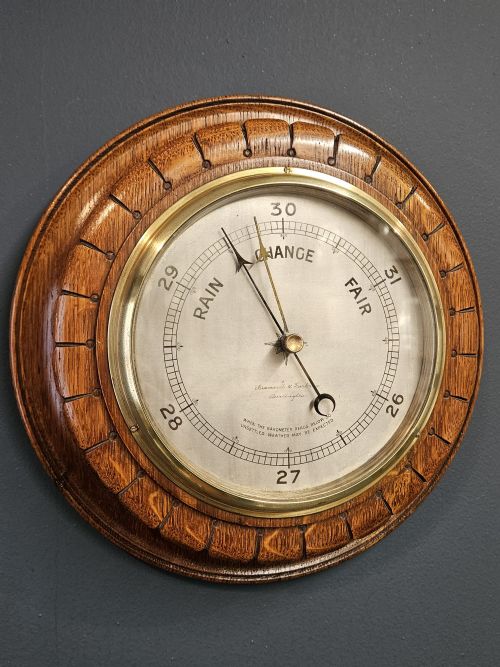


Victorian Aneroid Dial
These Victorian aneroid dial instruments measure atmospheric pressure through a sealed metal capsule without using liquid mercury.
Victorian Aneroid Dial
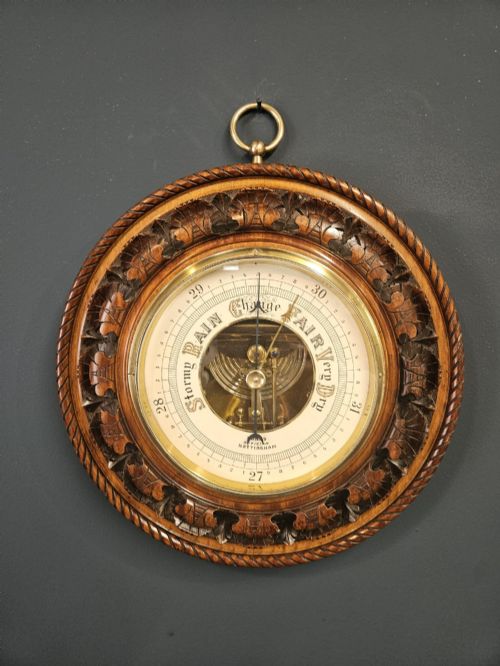
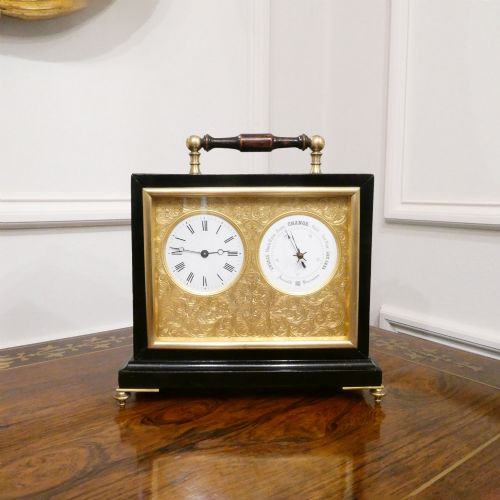
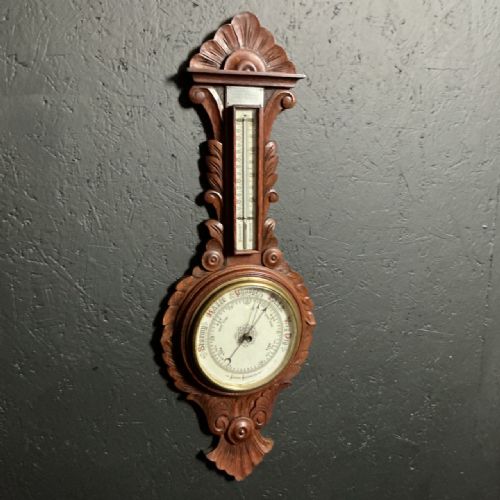
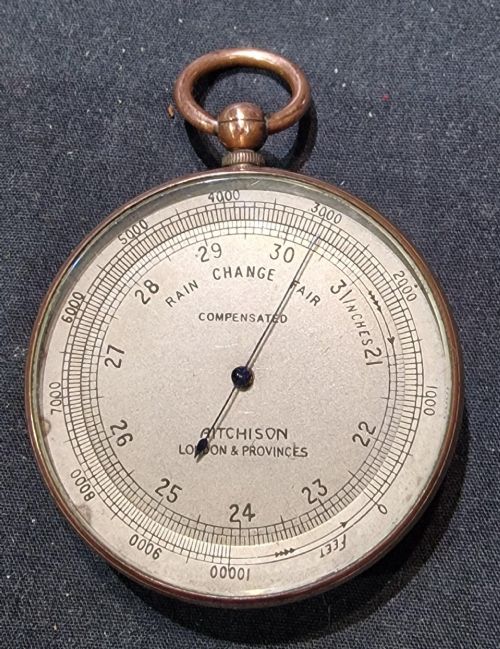
A Victorian aneroid dial instrument uses a sealed vacuum capsule to indicate changes in weather and atmospheric pressure. You encounter banjo barometers, wall clocks, desk compendiums, and pocket barometers across this selection.
Most examples originate from the nineteenth century, spanning Victorian and Edwardian periods with various dial configurations. They combine scientific utility with decorative cabinetry suitable for domestic display.
Materials and construction
Maker workshops utilised seasoned timbers such as oak, walnut, mahogany, and ebonised wood to house the delicate internal mechanisms. Carved ornamentation, bevelled glass, and brass bezels protect the paper, porcelain, or silvered metal dials.
Makers integrated thermometers and compasses alongside the main barometer dial, housing precision metallic linkages that respond to expansion and contraction of the internal vacuum chamber.
Listings feature oak, walnut, mahogany, and ebonised wood alongside brass, glass, and silvered metal.
What separates the finest examples
Quality rests upon the crispness of the timber carving and the legibility of the silvered or porcelain dial. Signed instrument makers command attention through refined mechanical precision and robust cabinetry.
Proportion and scale dictate visual success, ranging from pocket instruments to large wall-mounted banjo barometers and desk compendiums. The integrity of the glass covers and the retention of original mercury thermometers elevate specific pieces.
Short and Mason·Bramwell and Harbron·Maple and Company·Blake and Son·Dollond of London·M Pillischer·Negretti and Zambra·James Murray·R and J Beck·Naudet PNHB·WJ Hassard
The Victorian Aneroid Dial Glossary
- Aneroid barometer
- An instrument measuring atmospheric pressure by the action of the weather on the elastic lid of an evacuated metal box. This mechanism avoids the need for liquid mercury columns.
- Silvered metal dial
- A metallic face treated with silver to create a matte finish that highlights engraved numerals and graduations. This technique provides clear contrast beneath bevelled glass.
- Banjo barometer
- A wall-mounted instrument shaped like the musical instrument, typically featuring a hygrometer, thermometer, and large circular aneroid dial. It became a staple of Victorian domestic halls.
- Desk compendium
- A multi-instrument desk accessory combining a barometer with clocks, thermometers, or calendars in a unified frame. These pieces served executive and domestic writing rooms.
- Holosteric barometer
- An alternative early term for an aneroid barometer, meaning whole-solid, denoting an instrument containing no liquid. It highlights the self-contained capsule design.
Victorian Aneroid Dial: Frequently Asked Questions
How do I read a dial barometer?
You read the primary needle to observe current atmospheric pressure indicated on the graduated scale. A secondary set hand is manually adjusted over the needle to track movement up or down.
Changes in pressure indicate shifting weather patterns, rising for fair conditions and falling for unsettled weather or rain.
Where should I hang my wall barometer?
Mount the instrument securely on an interior wall away from direct sunlight, central heating radiators, and draughty doorways. Stable ambient temperatures ensure the internal aneroid mechanism operates accurately.
Avoid exterior walls where dampness can affect the timber case and delicate paper or silvered dials.
Can these barometers be calibrated?
Most aneroid instruments feature a small adjustment screw accessible from the back or through the bezel. You calibrate the instrument against a reliable local meteorological reading for your exact altitude.
Gentle adjustments align the mechanical linkage with known barometric pressure without damaging the interior capsule.
What is the difference between an aneroid and mercury barometer?
Aneroid barometers use a sealed metal vacuum chamber that flexes with air pressure changes, moving a needle via mechanical levers. Mercury barometers rely on a column of liquid metal balancing against atmospheric pressure.
Aneroid versions offer portability and safety without liquid mercury, making them practical for domestic walls and travel.