






Victorian Altar Sticks
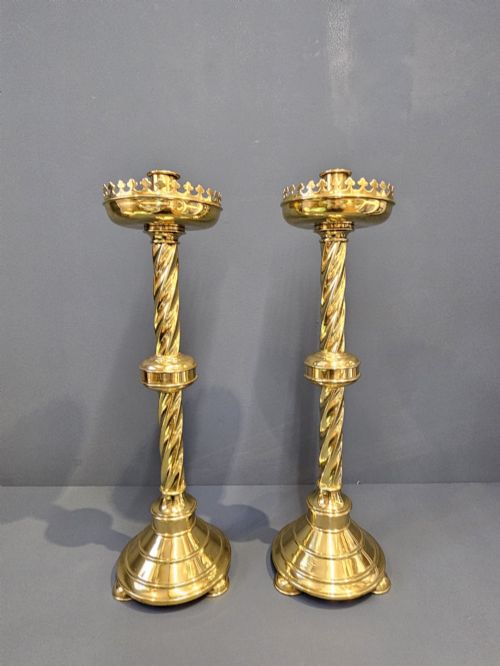
Victorian altar sticks are monumental brass and bronze church candlesticks that bring height and architectural presence to a room.
Victorian Altar Sticks
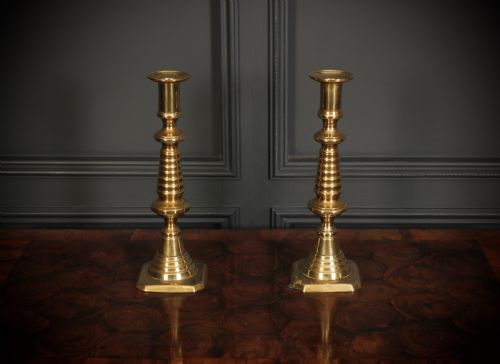
Victorian altar sticks are heavy, church-scale candlesticks designed for ecclesiastical settings, frequently encountered in matched pairs. When you search for victorian altar sticks, you meet substantial brass and bronze fixtures standing with notable height and sturdy bases.
The pieces on this page span the Victorian era, the nineteenth century, and into nineteen-thirty, reflecting long-standing ecclesiastical demand. Most examples follow Gothic Revival and Victorian Gothic styles, often featuring structural turned stems and wide drip pans.
How they were made
Foundry workers cast these sticks primarily in brass and bronze, utilising durable metal components to support heavy candles or pricket stands. Selected pairs incorporate cast brass elements shaped with architectural moulding and stepped bases.
Makers occasionally integrated decorative details such as fabric, silk fringe, damask fabric, and glass beads into related church furnishings, though standard altar sticks rely on solid metal construction.
Victorian Altar Sticks Retail Price Guide 2026
Typical asking prices for victorian altar sticks among the pieces listed under this phrase on Sellingantiques today, from the lower quarter to the upper quarter. They describe what is for sale here now, not the wider market.
Some sturdy altar sticks survived centuries of choir practice by doubling as impromptu hat stands in the vestry.
What varies in quality
Quality rests in the crispness of the casting and the proportional balance of the stem, base, and drip pan. Superior examples show deep, clean moulding work rather than softened surface detail.
Substantial weight and thick gauge metal separate imposing church pieces from lighter domestic imitations. Taller forms with heavy bases command attention through sheer presence and material heft.
T Thomason & Co
The Victorian Altar Sticks Glossary
- Pricket stand
- A candlestick featuring an upward-pointing spike designed to hold a large candle in place. This form is common in ecclesiastical settings.
- Gothic Revival
- An architectural and decorative style drawing on medieval forms, featuring pointed arches and structural verticality. This style dominates Victorian church metalwork.
- Cast brass
- Metal shaped by pouring molten alloy into a mould to create rigid, decorative forms. It provides the heavy structure seen in altar sticks.
- Drip pan
- A wide collar positioned beneath the candle socket to catch melting wax. It protects the stem and the surface below.
Victorian Altar Sticks: Frequently Asked Questions
What are Victorian altar sticks?
These are heavy brass or bronze candlesticks originally manufactured for church altars during the nineteenth century. They are typically tall and robustly constructed to hold large candles.
Most surviving examples appear in pairs and reflect Gothic Revival design influences with tiered bases and structural stems.
How were altar sticks used?
Priests and sacristans placed them upon church altars to illuminate liturgical services and mark sacred spaces. Their elevated height ensured the light carried across large chancels.
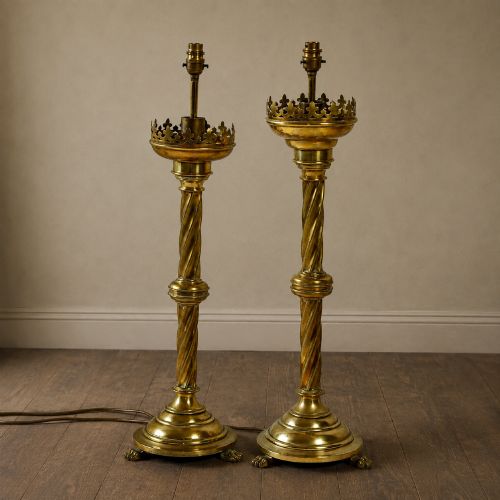
Today, collectors repurpose them as floor or table lighting, sometimes incorporating electrical conversions while retaining their original ecclesiastical character.
How do you date them?
Dating relies on stylistic clues like Gothic Revival ornamentation, manufacturing techniques such as heavy brass casting, and documented maker marks. Nineteenth-century examples often exhibit heavier metal gauges.
Comparing base construction and turnings against dated church metalwork catalogues helps narrow the production window.
Can they be converted to lamps?
Many pairs are adapted into table lamps by running a cord through the centre stem while preserving the outer metal body. This adaptation allows heavy church brass to function safely in domestic interiors.
Conversions range from simple cord routing to more complex wiring setups fitted with fabric shades.