

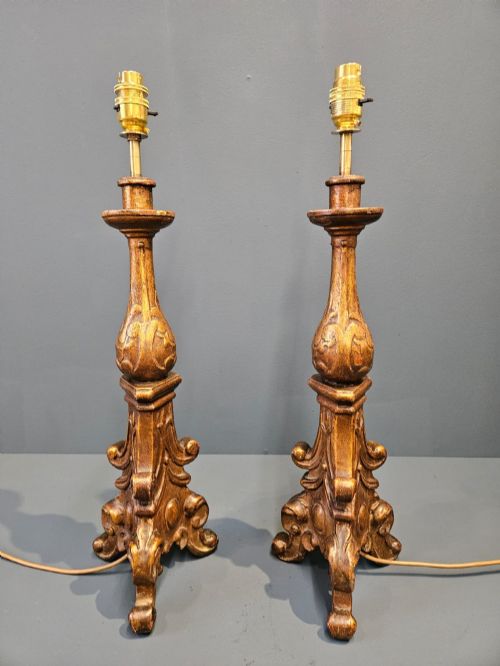


Victorian Altar Candlesticks
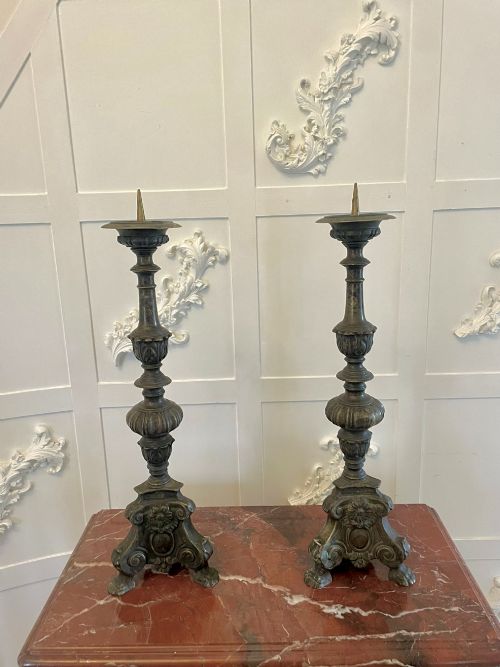
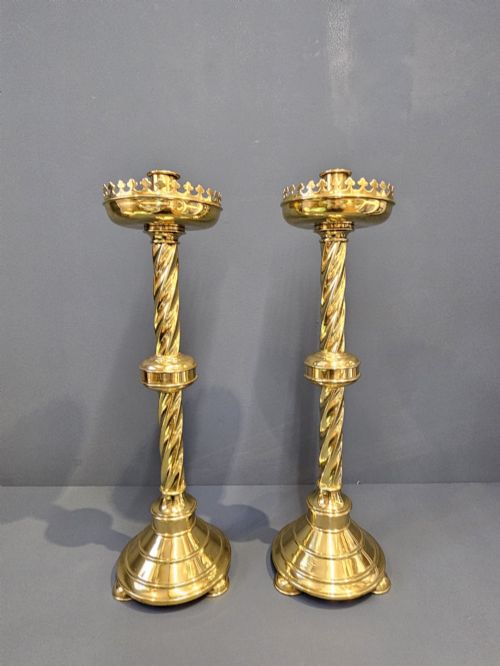
These Victorian altar candlesticks bring heavy brass, bronze and ecclesiastical Gothic styling straight from church sanctuaries into domestic rooms.
Victorian Altar Candlesticks
When you search for Victorian altar candlesticks, you encounter heavy metal lighting designed for ecclesiastical settings, predominantly shaped by Gothic Revival tastes during the nineteenth century. Most examples found here appear as substantial pairs, ranging from tall column forms to ornately decorated pricket designs intended to support large candles.
The objects frequently cross over into domestic lighting through later conversions into table lamps and standard lamps while retaining their original ecclesiastical character. Dating spans the broader Victorian and Edwardian periods, with many pieces originating around the middle to late nineteenth century.
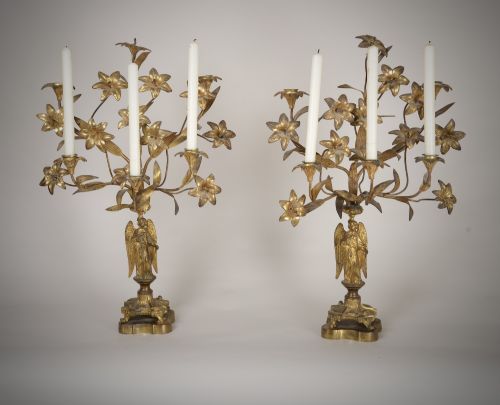
Makers and designers drew heavily on architectural motifs, producing graduated sets, corinthian column configurations and specialised church candle holders. Brass and bronze dominate the forms, supplemented by gilt metal and timber elements reflecting period revival styles.
Materials and construction
Makers utilised cast brass, heavy bronze and gilt metals, shaping the dense components through traditional foundry techniques to achieve structural stability. Surface treatments include gilding, painting and patination applied directly to the metalwork.
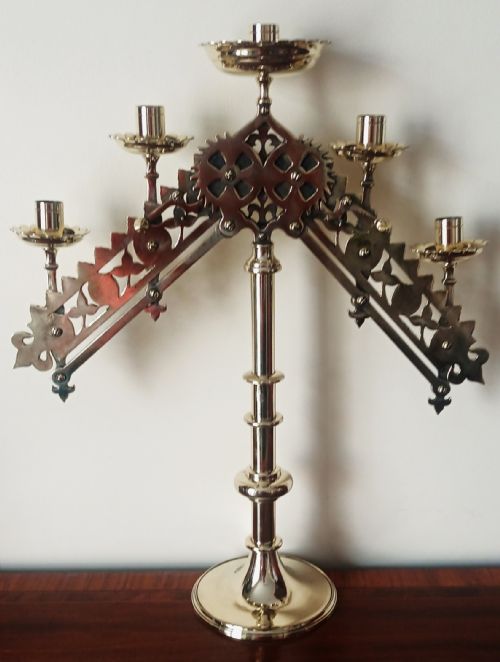
Certain pieces incorporate carved timber and applied decorative details, while others rely entirely on the structural integrity of cast metal columns and bases. Articulated joints and multi-tiered sections appear on specific candelabra configurations, requiring precise mechanical assembly.
Listings demonstrate a strong predominance of cast brass and bronze materials shaped into Gothic Revival forms across the nineteenth century.
Distinctions in craftsmanship
The distinction between ordinary production and superior work lies in the crispness of the cast detailing, particularly within Gothic Revival foliage and architectural mouldings. Heavier gauge metalwork and substantial proportions differentiate the more impressive ecclesiastical examples from standard domestic pieces.
Completeness of original matching sets and the retention of integral pricket spikes or bobeches elevate specific items. The quality of the original foundry work determines how sharply defined the decorative elements remain after decades of handling.
T Thomason & Co
The Victorian Altar Candlesticks Glossary
- Pricket candlestick
- A candlestick featuring a sharp metal spike at the top designed to impale and secure the base of a large wax candle.
- Gothic Revival
- An architectural and decorative style drawing inspiration from medieval design, featuring pointed arches, trefoils and heavy ecclesiastical motifs.
- Ecclesiastical
- Pertaining to the Christian church or clergy, describing items specifically manufactured for use within religious buildings and altars.
- Gilt-brass
- Brass that has been treated with a thin layer of gold or gold-coloured finish to provide a bright, reflective metallic surface.
- Candelabra
- A multi-branched lighting fixture designed to hold several candles simultaneously from a single central stem and base.
Victorian Altar Candlesticks: Frequently Asked Questions
What is a pricket candlestick?
A pricket candlestick uses an upward-pointing metal spike rather than a socket to hold the candle in place. This design is typical of church altars where large wax tapers rested directly upon the spike.
Such examples often appear in heavy brass or bronze construction dating from the nineteenth century.
Were these used in ordinary homes?
Original Victorian altar candlesticks were manufactured specifically for religious worship within churches and chapels. They entered domestic interiors later through dispersal from ecclesiastical settings or subsequent conversion into lamps.
Their substantial weight and architectural Gothic styling made them desirable for period home decoration.
How do I identify Gothic Revival style?
Gothic Revival metalwork borrows heavily from medieval church architecture, displaying pointed arches, quatrefoils, heavy knops and structural column designs. These elements appear frequently on nineteenth-century ecclesiastical brassware.
The aesthetic emphasises vertical lines and robust construction suited to religious environments.
Can converted lamp versions be restored?
Many ecclesiastical candlesticks were adapted during the twentieth century to house electrical wiring for table lamps or standard lamps. The extent of alteration depends on whether original components were drilled or modified during the conversion.
Collectors often weigh the historical value of the original pricket form against the practical utility of the electrified lamp.