


Venice Cityscape Wall Art
Venice cityscape wall art captures the light and architecture of the lagoon through historic paintings and works on paper.
Venice Cityscape Wall Art
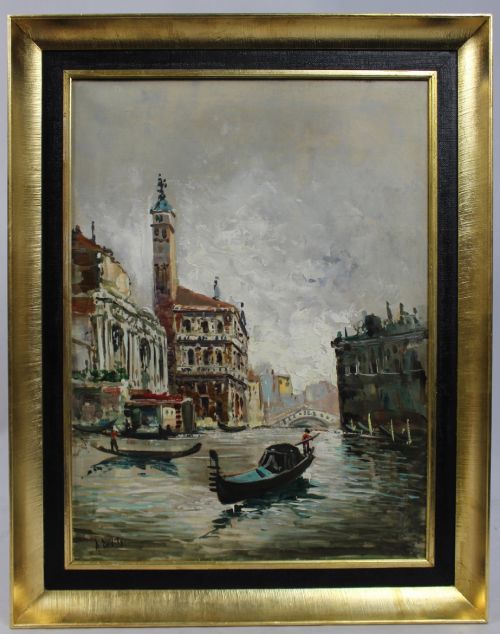
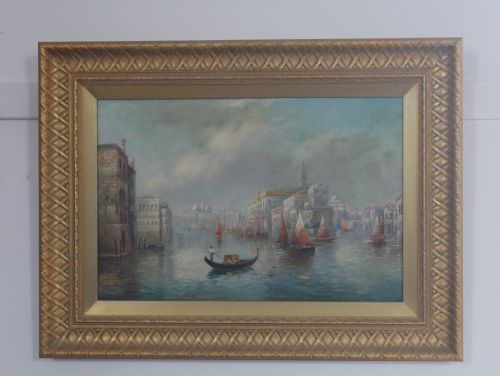
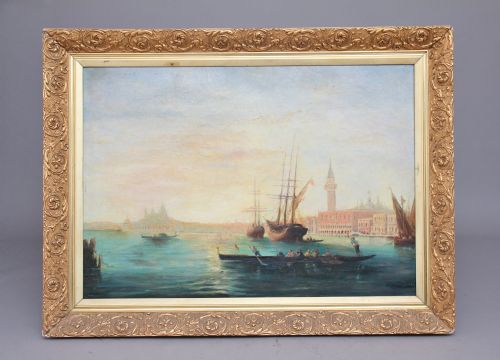
Venice cityscape wall art comprises historic paintings and works on paper depicting canals, palazzos, and landmarks such as the Grand Canal, the Doge's Palace, and Santa Maria della Salute. These pieces span from the Victorian period through mid-century styles, recording the changing light across the lagoon over decades.
The most common format you will meet on this page is the oil painting on canvas, often presented in its period frame. Subjects range from busy Venetian canal scenes with gondolas to quiet morning views of old mansions and the lagoon.
Originating largely from British and continental European artists working across the nineteenth and twentieth centuries, these works reflect diverse movements including Romanticism, Impressionism, and traditional Italian townscape painting.
How they were made
Artists built these compositions primarily using oil paint applied to canvas or wood panels, sometimes employing mixed media, pastel, gouache, or watercolour on paper. Brushwork varies from tight, detailed architectural studies to looser impressionistic strokes that capture the shimmering water and shifting daylight.
Many of these works are housed in giltwood frames that complement the traditional subjects and protect the edges of the canvas or paper substrate.
Gondolas feature in so many of these scenes that visitors often spend hours trying to spot the exact bridge where the artist stood.
What varies in quality
Quality rests in the handling of light and perspective, distinguishing works with atmospheric depth and confident brushwork from rigid, formulaic topographical records. The strongest pieces demonstrate a genuine engagement with the specific colours of the Venetian lagoon rather than relying on generic palettes.
The integration of the artwork with its period frame also alters the visual success of the piece, as original giltwood surrounds enhance the presence of nineteenth and early twentieth-century canvases.
Antonio DeVity·Claude Jousset·F.D. Campo·Jane Vivian·Alfred Pollentine·Charles Clement Calderon·Helen Donald-Smith
The Venice Cityscape Wall Art Glossary
- Canvas
- A heavy woven fabric used as a surface for oil painting. It is typically stretched over a wooden frame before application.
- Giltwood
- Wood carved and coated with gold leaf or a gold-coloured finish. This material is standard for traditional picture frames.
- Impressionism
- An art style characterised by relatively small, thin, yet visible brush strokes and an emphasis on accurate depiction of light. It emerged in the nineteenth century.
- Gouache
- A water-based paint consisting of pigment and other inert material designed to be opaque. It is frequently found in works on paper alongside pastels and ink.
- Lagoon
- A stretch of salt water separated from the sea by a low sandbank, forming the distinct body of water around which Venice is built.
Venice Cityscape Wall Art: Frequently Asked Questions
What periods do these paintings date from?
The selection includes works originating from the Victorian era, through the late nineteenth century, and into the mid-twentieth century. Artists recorded the city across these decades using distinct stylistic approaches.
Dates span from the eighteen-seventies up to nineteen-sixty, showing both traditional townscape painting and mid-century impressionism.
What mediums are used in these artworks?
Most works utilise oil paint on canvas or wood, capturing the deep tones of the canals and skies. Other pieces employ watercolour, pastel, gouache, and ink on paper.
Frames are commonly constructed from wood with gilt finishes to match the period of the painting.
How should I hang a framed oil painting?
Ensure your wall can support the weight of the framed canvas, utilising appropriate fixings for plaster or brick. Heavy giltwood frames require secure wall anchors.
Position the artwork away from direct sunlight and moisture sources to protect both the oil paint and the wooden substrate over time.
How do I identify a nineteenth-century Venetian painting?
Look for the characteristic architecture of the city, such as the Doge's Palace, the Grand Canal, or the Dogana, rendered in styles typical of nineteenth-century Romanticism or early Impressionism. Canvas types, stretcher frames, and framing materials often provide further clues.
Signatures or period inscriptions on the reverse of the canvas can also help confirm the era in which the work was produced.