
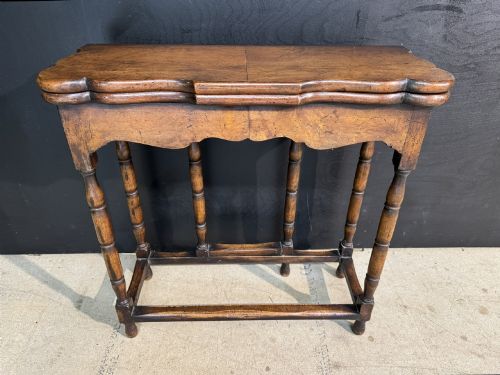
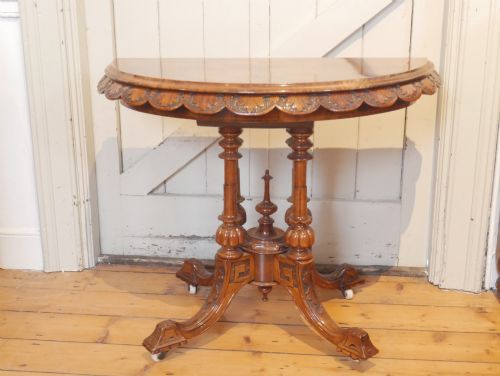
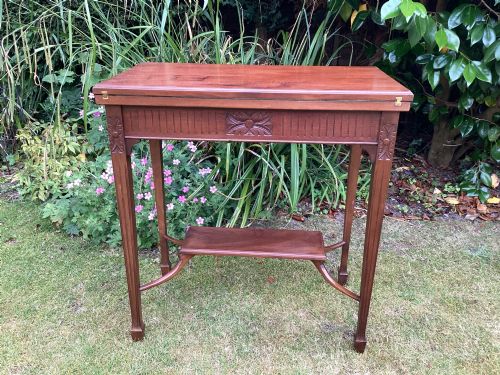


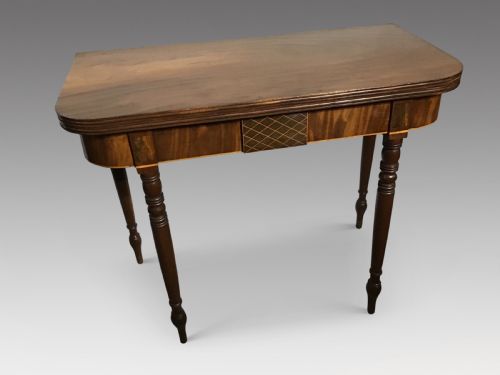


Turn Over Side Table
These turn over side table pieces transform from compact surfaces into full gaming or tea boards, giving period rooms a clever dual-purpose focal point.
Turn Over Side Table
When you search for a turn over side table, you encounter adaptable furniture designed to adapt its surface area for card games, tea service, or general display. The pieces on this page span several centuries, with prominent examples originating from the Georgian, Victorian, and Edwardian eras.
You are most likely to meet mahogany or walnut versions featuring folding mechanisms that reveal baize-lined playing surfaces or polished timber tops. These tables function equally well as console tables against a wall or pulled into the centre of a room for entertaining.
Regional variations appear across the selection, including Scottish and Irish interpretations alongside English forms. Styles range from simple Queen Anne and Jacobean influences to ornate Arts and Crafts and William IV designs.
How they were made
Cabinetmakers utilised dense timbers like mahogany, walnut, and oak to construct these versatile frames, often incorporating satinwood or ebony for decorative contrast. Timber selection dictated the structural stability required for the hinged folding leaves and rotating mechanisms.
Brass fittings and ceramic castors frequently support the heavier console and card table bases, allowing the folding leaves to pivot safely without straining the hinges. Inlays and fine grain figuring demonstrate the joinery skill applied to both the visible top surfaces and the concealed framing.
Some card tables hide secret compartments for counters, proving ancestors took their evening games very seriously indeed.
What varies in quality
The distinction between standard examples and superior pieces rests on the choice of timber figuring and the precision of the folding mechanism. Figured walnut and carefully matched mahogany veneers elevate a simple side table into a refined piece of parlour furniture.
Construction integrity in the hinges and the alignment of the folding top determine daily utility. Higher quality items maintain smooth operation in the rotating or pivoting leaves without sagging or shifting when fully extended.
W.F. Greenwood & Sons York
The Turn Over Side Table Glossary
- Turn Over Top
- A hinged tabletop design that folds out to double its surface area for dining or gaming. This mechanism defines the primary function of the category.
- Card Table
- A specialised table featuring a lined interior surface intended for playing cards. These often include small corner wells for counters or coins.
- Tea Table
- A domestic surface designed to hold porcelain tea service equipment during the eighteenth and nineteenth centuries. They frequently employ fold over leaves to save space when not in use.
- D End
- A semicircular table end resembling the capital letter D. These forms often join together or stand independently as console furniture.
- Credence Table
- A medieval and later form featuring a folding leaf supported by a swinging gate leg. They share structural similarities with later turn over designs.
Turn Over Side Table: Frequently Asked Questions
How do I use a turn over side table?
Position the piece against a wall as a slim console or side table for daily display. Lift and rotate the hinged top leaf to expand the surface when you need a card table or tea setting.
Ensure the folding leaf rests securely on its support gate or swing leg before placing heavy items on the extended surface.
What woods were used for these tables?
Cabinetmakers primarily employed mahogany and walnut for their strength and rich grain patterns. Oak appears in earlier or regional vernacular pieces.
Accents of satinwood, ebony, and brass inlay frequently decorate the top surfaces and borders of finer Victorian and Georgian examples.
How do I date a turn over table?
Examine the secondary woods, leg styles, and hinge construction to determine the period. Straight geometric lines often point to earlier Georgian or Jacobean influences, while carved pedestal bases signal William IV or Victorian manufacturing.
Figured veneers and specific inlay patterns also help align pieces with Arts and Crafts, Edwardian, or Regency aesthetics.
Are these tables sturdy enough for daily use?
Solid timber construction and sturdy pivot mechanisms make these tables durable for regular domestic environments. The structural integrity depends heavily on the condition of the internal hinges and gate legs.
Treat the folding leaves with care during transformation to avoid placing undue strain on the original pivot joints.