

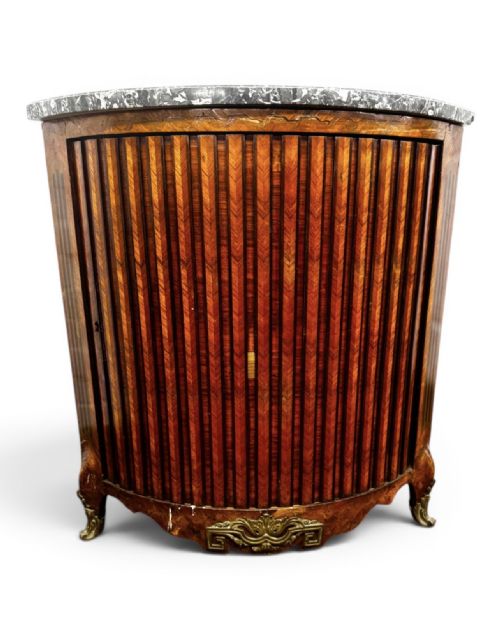
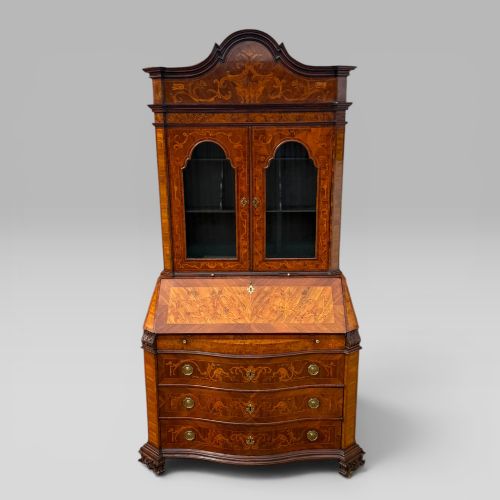


Tulipwood Cabinet
A tulipwood cabinet brings distinct continental flair to a room, combining pale figured veneers with rich decorative mounts.
Tulipwood Cabinet
The version most commonly met on this page is the nineteenth-century French piece influenced by Louis styles, often featuring intricate parquetry or marquetry. Alongside these, buyers encounter eighteenth-century examples and compact items such as miniature furniture and bonheur du jours.
Makers and workshops of the period utilised tulipwood alongside walnut, kingwood, rosewood, and mahogany to create functional display and storage items. The scale varies from small bedside cabinets to large bureau bookcases designed to anchor a principal room.
How they were made
Cabinet makers built these pieces using solid carcases of supportive timbers like walnut or fruitwood, onto which thin veneers of tulipwood were applied. The distinctive grain patterns were arranged symmetrically in geometric parquetry or floral marquetry designs.
Gilded bronze, known as ormolu, was cast and chased to form mounts, handles, and sabots that framed the veneer panels. Marble tops, particularly in white or coloured varieties, were frequently fitted to commodes and side cabinets to provide durable and decorative surfaces.
Tulipwood Cabinet Retail Price Guide 2026
Typical asking prices for tulipwood cabinet among the pieces listed under this phrase on Sellingantiques today, from the lower quarter to the upper quarter. They describe what is for sale here now, not the wider market.
Surviving nineteenth-century pieces frequently adopt Louis XVI transitional design, merging curved rococo lines with straight neoclassical geometry.
What varies in quality
The division between standard production and exceptional work rests on the precision of the veneer matching and the crispness of the bronze mounts. Finer cabinets display continuous grain across drawer fronts and seamless transitions in complex parquetry patterns.
The weight and depth of the ormolu casting also separate the workshop tiers, with superior pieces showing hand-chased detail rather than flat, mass-produced surface finishing. Structural integrity in the carcase and the retention of original marble tops influence the standing of any given piece.
MILLET·Town and Emanuel
The Tulipwood Cabinet Glossary
- Tulipwood
- A dense hardwood prized for its creamy yellow ground and striking pinkish-brown streaks. It is frequently sliced into veneers for decorative cabinet work.
- Ormolu
- Gilded bronze used for decorative mounts, feet, and keyhole escutcheons on furniture. The metal is cast and then treated with a gold amalgam.
- Parquetry
- A geometric mosaic of wood veneers arranged in repeating patterns such as cubes or chequers. It creates texture across flat cabinet surfaces.
- Marquetry
- The art of forming decorative pictures or abstract designs by fitting together thin slices of various coloured woods. It differs from parquetry through its pictorial or floral emphasis.
- Tambour
- A sliding door made of narrow vertical strips of wood glued to a canvas backing. It allows access to enclosed shelving within tight spaces.
Tulipwood Cabinet: Frequently Asked Questions
What is a tulipwood cabinet?
A tulipwood cabinet is a piece of storage furniture veneered in distinctively striped exotic timber, usually produced in eighteenth or nineteenth-century European workshops.
These pieces include commodes, corner cupboards, and writing desks embellished with parquetry and bronze mounts.
How do I clean a tulipwood cabinet?
Cleaning requires a soft, dry cloth to remove dust without disturbing the delicate surface veneers. Avoid modern chemical polishes that can degrade historical finishes.
Wax formulated for antique furniture can be applied sparingly to nourish the wood and maintain a gentle sheen.
Where were tulipwood cabinets made?
The majority of these cabinets originated in France, particularly Paris workshops adhering to transitional and revival Louis styles. English and Italian makers also produced comparable pieces.
Continental makers often incorporated local walnut or fruitwood carcases beneath imported exotic veneers.
How do I identify a period piece?
Period identification relies on examining the construction methods, timber preparation, and the style of the bronze mounts. Hand-cut dovetails and natural wax build-up indicate earlier manufacture.
Design motifs such as transitional straight lines or curved rococo forms align with documented historical periods.