





Tufted Leather Captain Chair
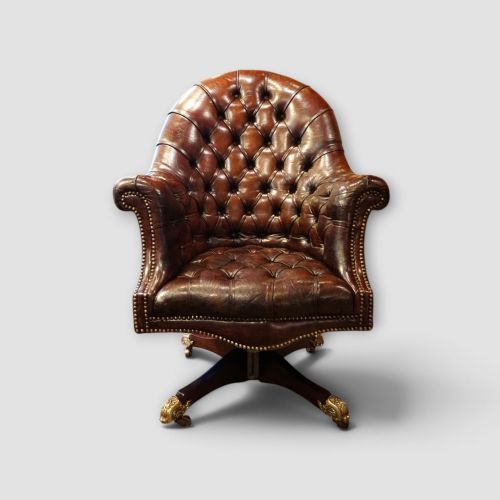
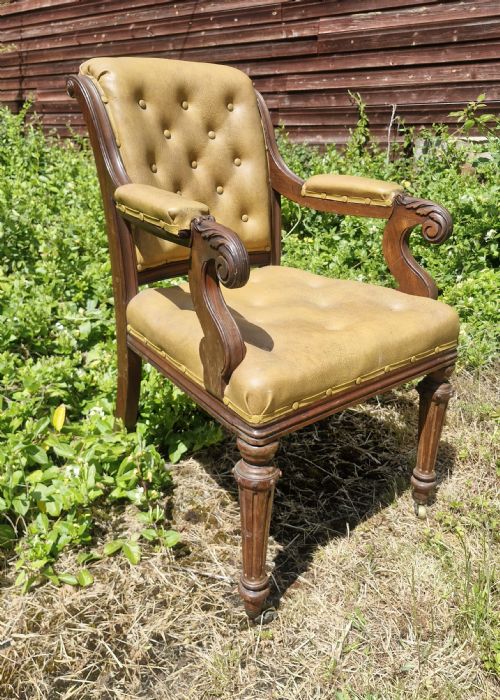
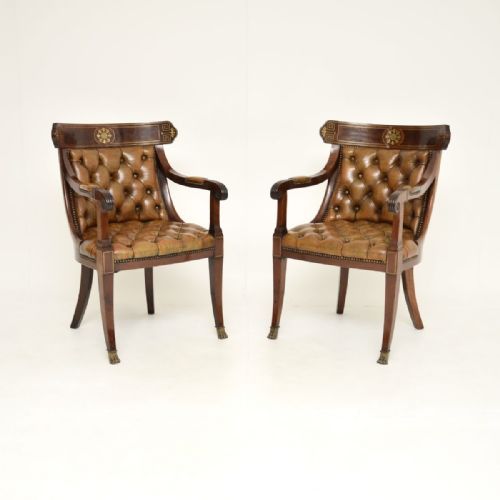
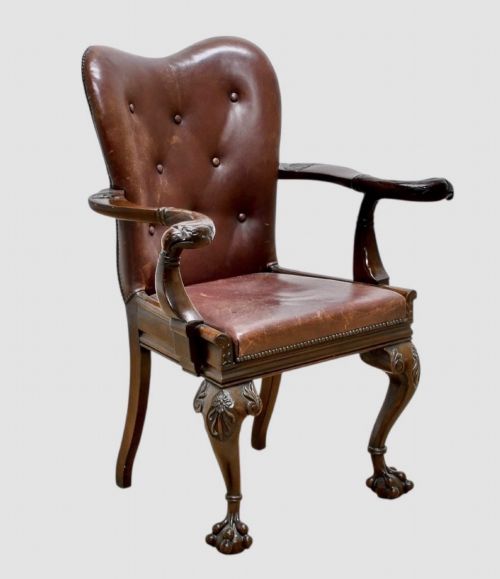
A tufted leather captain chair brings substantial timber frames and deep upholstery together for serious study at a desk.
Tufted Leather Captain Chair
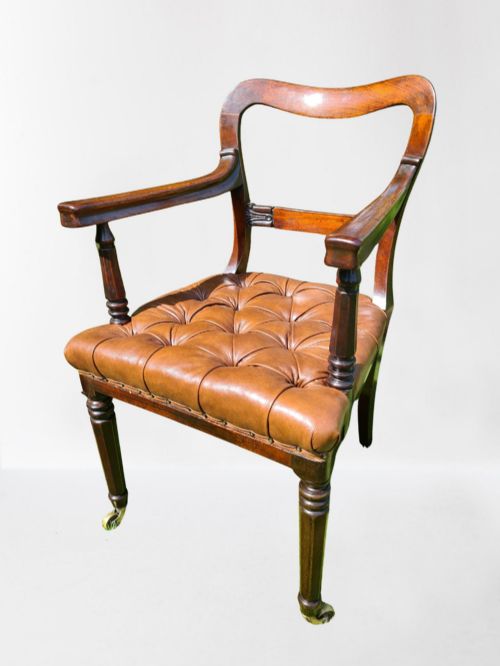
A tufted leather captain chair serves as a robust seat designed for desks and libraries, combining deep padding with a stable wooden frame. The examples you encounter on this page span the nineteenth century, including Victorian, Regency, and William IV periods.
Most pieces take the form of desk chairs, library armchairs, or club elbow chairs, frequently executed in mahogany or oak. You will find both stationary library models and revolving desk variants equipped for movement.
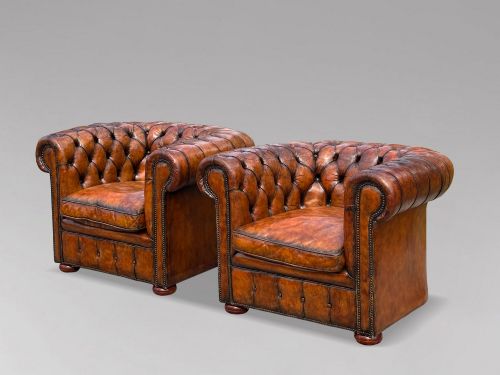
The aesthetic bridges traditional English seating design with practical utility, leaning heavily on Victorian Chesterfield influences and Georgian revival forms. These chairs suit studies and offices where substantial timber and leather dominate the room.
Materials and construction methods
Makers built the foundational frames of these chairs from dense hardwoods such as mahogany and oak, often turning or carving the timber for structural support. Brass elements appear regularly, utilised for decorative inlay or mechanical fittings on revolving models.
Upholstery relies upon leather stretched over padded interiors, secured with buttoning that creates the characteristic tufted surface. Metal components such as cast iron support the pivoting mechanisms found on revolving desk variants.
Several chairs include revolving mechanisms that let nineteenth-century captains spin in circles while pretending to navigate heavy paperwork.
Judging quality and craftsmanship
The standard of timber selection and joinery sets the foundation for a chair's longevity, distinguishing simple utility pieces from finer cabinet work. Richly grained mahogany and substantial, well-carved oak command higher regard than plain or hastily assembled framing.
The execution of the leather upholstery and buttoning reveals the maker's hand, where tight, even pleating maintains its integrity through decades of use. Integration of swivel mechanisms and brass inlay demands precision engineering that separates everyday workshop output from superior examples.
The Tufted Leather Captain Chair Glossary
- Chesterfield
- A style of upholstered seating characterised by deep button tufting and rolled arms of equal height to the back.
- Cockfighting chair
- A specialised low armchair with a padded backrest designed to straddle backwards, though later adapted for general library use.
- Revolving desk chair
- A pivoting seat fitted with a central spindle and base mechanism to allow rotation while seated at a desk.
- Tub chair
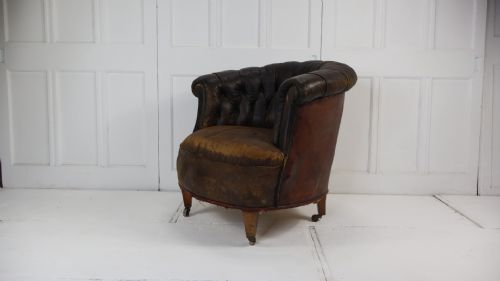
- An armchair featuring a continuous curved back and arms that form a single enclosed, rounded enclosure.
- William IV
- A British architectural and furniture style spanning the 1830s, known for heavy, robust proportions and classical revival motifs.
Tufted Leather Captain Chair: Frequently Asked Questions
How do I date a leather captain chair?
Examine the timber species, joinery methods, and hardware under the seat to determine the period of manufacture. Victorian and Regency examples show distinct turning styles and construction techniques typical of their decades.
Compare the framing details with dated pieces from the mid to late nineteenth century to narrow down the decade of production.
Were these chairs used at desks?
Most of these chairs served in libraries, studies, and offices for reading and writing tasks. The revolving variants were specifically engineered for shifting position at large partner desks.
Stationary models typically functioned as library armchairs or elbow chairs pulled up to reading tables.
How should I care for antique leather?
Maintain the leather by applying appropriate conservation balms to keep the hide supple and prevent cracking. Avoid placing the chair in direct sunlight or near heat sources that dry out the material.
Dust the buttoned crevices regularly with a soft brush to prevent grit accumulation in the tufting.
What is the difference between Regency and Victorian styles?
Regency furniture draws heavily on classical Greco-Roman influences, featuring restrained lines, brass inlay, and elegant mahogany frames. Victorian pieces tend to be heavier, with more elaborate carvings and buttoned upholstery.
Victorian designs also introduced more widespread use of revolving mechanisms and oak framing.