




Transitional French Cabinet
A transitional french cabinet brings together curvilinear forms and rectilinear restraint, bridging eighteenth-century tastes in a single piece.
Transitional French Cabinet
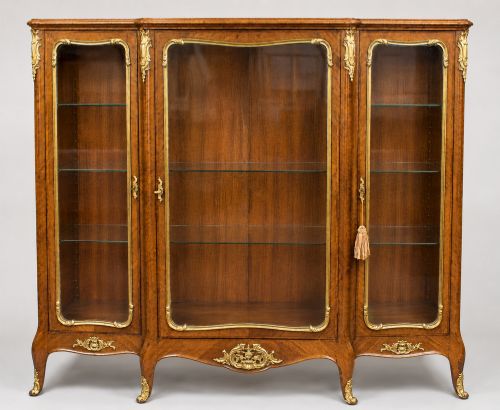
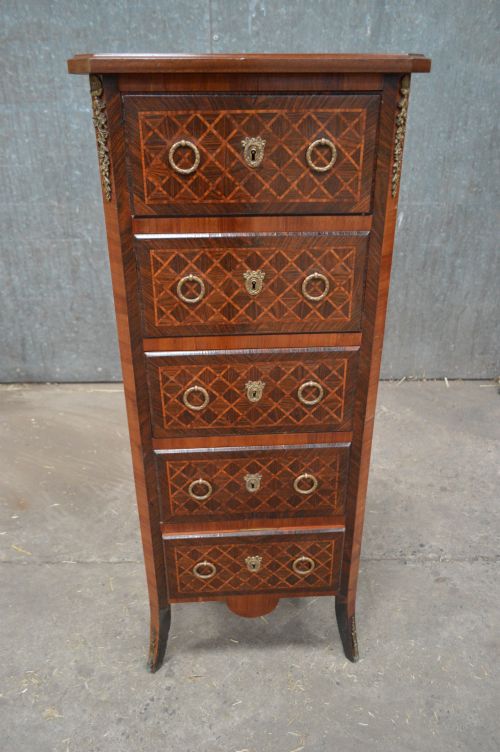
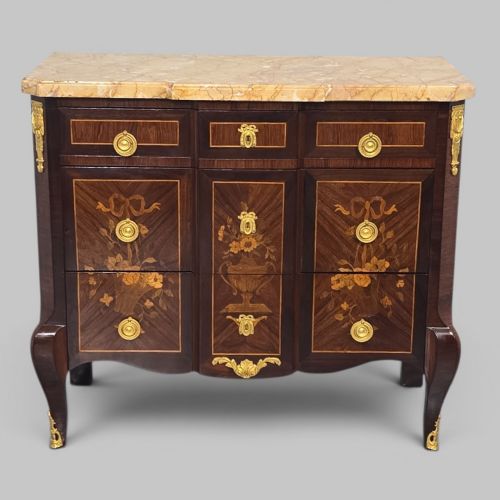
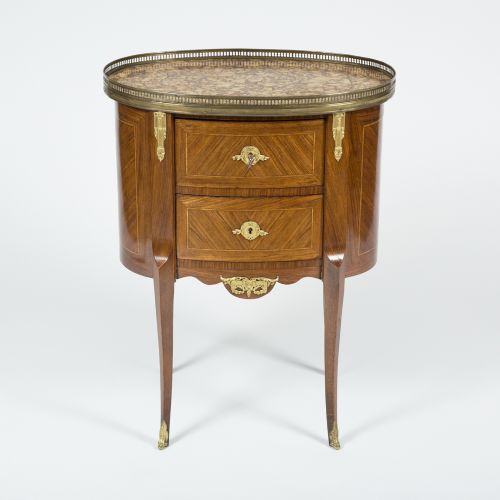
A transitional french cabinet sits between the ornate curves of the Louis XV style and the geometric rigour of Louis XVI design, uniting these aesthetics in practical forms. The pieces met here span bedside cabinets, commodes, display cabinets, and secrétaires.
Most examples hail from the nineteenth and early twentieth centuries, interpreted through historicist revivals rather than the original eighteenth-century workshops. Makers drew upon established forms like the bombé vitrine or marble-topped commode, adapting them to later domestic needs.
Materials and construction
Cabinetmakers deployed richly figured veneers such as kingwood, rosewood, satinwood, and walnut over robust carcases, often arranging parquetry and marquetry geometric patterns across drawer fronts and doors. Ormolu mounts in cast brass frame corners, keyhole escutcheons, and aprons.
Slab marble tops, frequently in shades like breche d'alep, provide heavy, smooth counter surfaces above the timber framework. Glass panels insert into display cabinets and vitrines, secured by slender timber framing and brass beadings.
Transitional French Cabinet Retail Price Guide 2026
Typical asking prices for transitional french cabinet among the pieces listed under this phrase on Sellingantiques today, from the lower quarter to the upper quarter. They describe what is for sale here now, not the wider market.
Secret compartments in transitional secretaire chests reward curious owners who check behind drop-front writing slides.
Assessments of quality
Quality rests in the precision of the veneer work and the crispness of the cast ormolu mounts rather than surface gloss alone. Superior pieces exhibit seamless matching of timber grains and tight joints across curved surfaces.
The weight and thickness of the marble top, alongside the refinement of interior drawer construction, separate standard production from finer workshop output.
The Transitional French Cabinet Glossary
- Transitional
- A design style marking the shift from Louis XV rococo curves to Louis XVI neoclassical straight lines. It reconciles asymmetrical flourishes with symmetrical order.
- Ormolu
- Gilded bronze or brass mounts applied to furniture edges and corners. These cast elements protect vulnerable timber and enhance visual contrast.
- Marquetry
- Inlaid wood veneers forming pictorial or geometric patterns on the furniture surface. Craftsmen cut contrasting timbers together to achieve precise interlocking shapes.
- Vitrine
- A glazed display cabinet designed for porcelain or curiosities. The glass panels permit visibility from multiple angles.
- Commode
- A low chest of drawers standing on legs, distinct from a tallboy or standard bureau. They frequently feature marble tops and decorative veneer panels.
Transitional French Cabinet: Frequently Asked Questions
What is a transitional french cabinet?
It is a storage or display piece whose design reflects the stylistic bridge between the curves of Louis XV and the straight lines of Louis XVI.
These pieces typically date from the nineteenth century onwards, adopting historical forms such as commodes and vitrines with veneered timber surfaces and marble tops.
Where were these cabinets placed?
Bedside tables and small cabinets sat in bedrooms for personal storage, while commodes and vitrines functioned in reception rooms.
Display cabinets housed precious ceramics and ornaments, whereas secretaires provided writing surfaces alongside drawer space.
How do I care for the marble top?
Marble requires gentle cleaning with warm water and a soft cloth to avoid scratching the polished stone surface. Acidic liquids like wine or citrus should be wiped away immediately to prevent staining.
Polishing the timber frame separately with a suitable wax maintains the lustre of veneers like kingwood and rosewood.
How are periods told apart?
The transition style shows a blend of curved cabriole legs or bombé shapes with straighter aprons and neoclassical mounts. Pure Louis XV leans into asymmetry, while Louis XVI relies on strict symmetry and fluted columns.
Later nineteenth-century interpretations often mix these vocabulary elements freely, reflecting the historicist tastes of their specific decade of manufacture.