
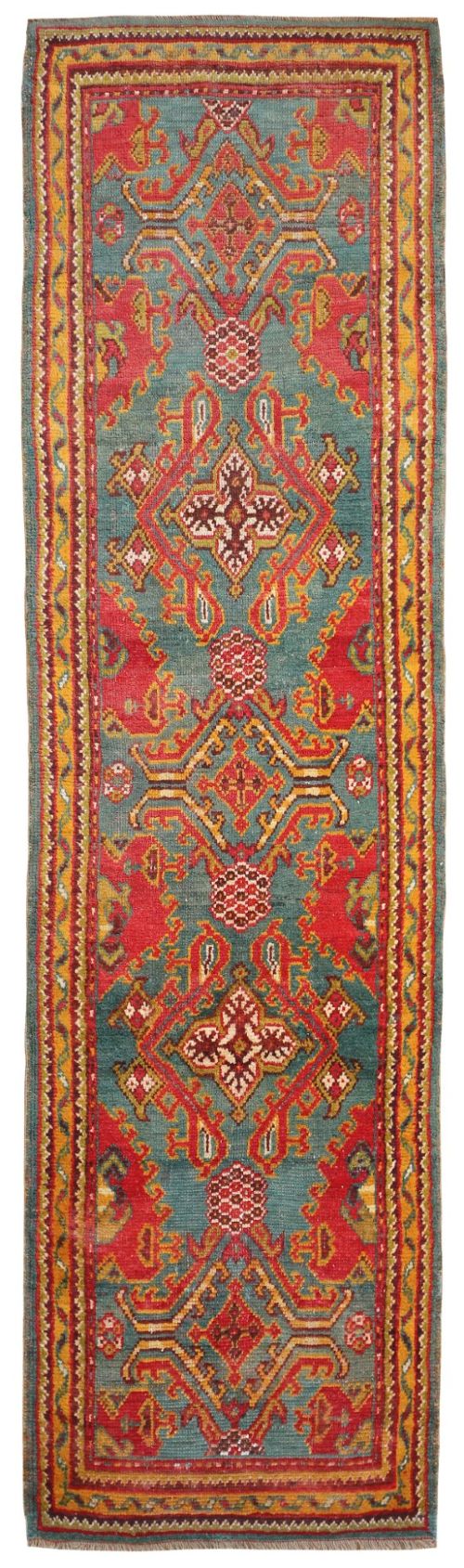



Traditional Ushak Rug
A traditional ushak rug brings the muted tones and grand medallions of Anatolian weaving into a room.
Traditional Ushak Rug
When you search for a traditional ushak rug, you encounter floor coverings that span from runner formats to oversized carpets and kilims, alongside occasional club armchairs upholstered in carpet fragments. Most examples date from the nineteenth century through the early decades of the twentieth century, originating from Turkish workshops.
The prevalent form on this page is the large decorative carpet, often featuring ivory grounds and central medallions. These pieces reflect Ottoman designs that evolved across different decades, from eighteen seventy up to nineteen twenty.
Materials and construction
Makers built these textiles using wool and cotton foundations, occasionally incorporating angora wool for a softer pile. Structural elements in related seating pieces include wood and brass.
Weavers knotted these materials by hand, following Ottoman and Anatolian aesthetic traditions that prioritised subdued palettes and expansive field designs.
At least one nineteenth-century carpet found a second life upholstered onto a club armchair.
Distinctions in quality
Quality separates through the fineness of the knotting and the subtlety of the colour fading across the wool pile. Finer examples display precise execution in their medallions and borders.
The choice between standard wool and angora wool alters the texture significantly. Larger formats demand greater structural integrity in the cotton and wool foundations to support the scale.
Howard And Sons·Maples
The Traditional Ushak Rug Glossary
- Ushak
- A style of carpet originating from the town of Ushak in western Turkey. These pieces are known for large-scale floral motifs and muted colourways.
- Kilim
- A flatweave textile produced without a pile. These items offer a lighter weight alternative to knotted carpets.
- Medallion
- A central ornamental design motif placed in the middle of the carpet field. It serves as the primary focal point of the composition.
- Runner
- A long, narrow carpet format designed for corridors and hallways. They share the same material construction as their larger counterparts.
- Angora wool
- A soft fibre derived from angora goats or rabbits. Its inclusion in specific pieces yields a distinct tactile quality.
Traditional Ushak Rug: Frequently Asked Questions
How do I date a traditional ushak rug?
Dating relies on stylistic markers, structural analysis, and records pointing to periods between eighteen seventy and nineteen twenty. Variations in the handling of Ottoman motifs help narrow the decade of production.
Examining the materials, such as the presence of angora wool or specific cotton foundation types, provides further clues regarding age.
Where were these rugs made?
These textiles originated in Anatolia, specifically within and around the Turkish town of Ushak. They belong to broader Ottoman traditions.
Workshops in this region supplied both domestic and international markets with distinct geometric and floral designs.
How do I care for wool pile?
Maintenance involves regular gentle vacuuming without rotary brushes to protect the pile. Professional cleaning suited for antique textiles is essential for longevity.
Keeping pieces out of direct sunlight prevents the natural dyes from fading unevenly.