


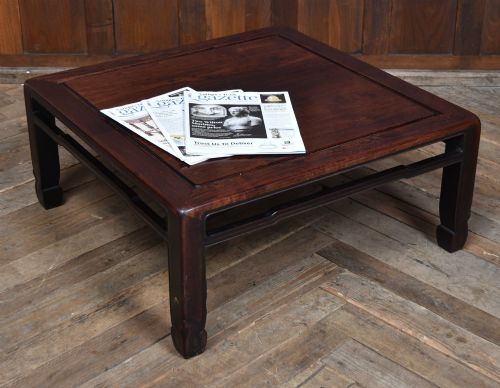


Traditional Rosewood Low Table
These traditional rosewood low tables bring a distinct low-profile silhouette to a room, offering practical surface space rooted in centuries of craftsmanship.
Traditional Rosewood Low Table
A traditional rosewood low table takes several familiar forms across our current selection, most notably as low coffee tables, kang tables, and opium tables. These surface heights suit traditional seating arrangements or modern living spaces that favour low-level furniture.
The pieces listed on this page span the nineteenth century and the early twentieth century, alongside Regency examples. Chinese Qing Dynasty aesthetics and traditional Chinese styles predominate among the offerings, providing scroll ends and carved details.
Origins range from nineteenth-century workshops to early twentieth-century makers, incorporating related forms such as side tables and magazine racks. Buyers encounter both compact scroll-end kang tables and larger-scale low coffee tables.
Materials and construction
Makers utilised dense timbers such as rosewood, padouk, huali wood, and general oriental hardwood. These heavy woods provided the structural integrity needed for low tables without the need for tall, slender legs.
Carving is a central technique visible across the pieces, with artisans rendering dragon details and scroll ends directly into the timber. Brass hardware also appears occasionally on specific formats like the Regency newspaper stands.
Traditional Rosewood Low Table Retail Price Guide 2026
Typical asking prices for traditional rosewood low table among the pieces listed under this phrase on Sellingantiques today, from the lower quarter to the upper quarter. They describe what is for sale here now, not the wider market.
Listings feature periods spanning the nineteenth century, the Regency era, and the early twentieth century up to nineteen-twenty.
Quality variations
Depth of carving and clarity of detail separate standard examples from finer works, particularly where dragon motifs and scroll ends are shaped by hand. The choice of timber also dictates quality, with figured rosewood and huali wood displaying superior grain patterns compared to plain hardwoods.
Proportion and scale influence desirability, as larger-scale kang tables and balanced coffee tables require careful architectural design to maintain stability at a low height.
The Traditional Rosewood Low Table Glossary
- Kang table
- A traditional Chinese low table designed to sit on a heated brick bed, known as a kang, or used independently on the floor. These tables typically feature short legs and scroll ends.
- Opium table
- A common descriptor for low tables originating from China, traditionally used for resting smoking paraphernalia or serving tea. They share a low profile with kang tables.
- Padouk
- A dense, durable tropical hardwood with a reddish hue utilised in several listed tables. It resists wear while taking fine carved details.
- Scroll end
- A table end featuring outward-curling carved wood terminations. This shape characterises traditional Chinese low and kang tables.
Traditional Rosewood Low Table: Frequently Asked Questions
What is a kang table?
A kang table is a low-profile surface traditionally used in Chinese homes on a platform bed or directly on the floor. They provide sturdy surfaces for serving tea or displaying objects.
Today, these tables function well as low coffee tables in contemporary living rooms, pairing easily with modern or traditional seating.
How are these low tables used today?
Buyers use these low tables primarily as coffee tables in living spaces where a lower surface height creates a sense of openness. Their compact proportions fit smaller rooms or act as statement centrepieces.
They also serve as side tables or display stands for decorative objects, ceramics, and books.
What woods were used for these tables?
Makers relied on dense tropical hardwoods, specifically rosewood, huali wood, and padouk. These heavy timbers provided the necessary strength for low-slung furniture.
Figured grain patterns and natural colour variations in the wood add visual depth to the finished surfaces.
How do I identify a Qing Dynasty style table?
Qing Dynasty style tables often feature distinct architectural elements like scroll ends and hand-carved dragon motifs. The joinery and proportions reflect traditional Chinese woodworking methods.
Dates generally range from the nineteenth century into the early twentieth century, reflecting the longevity of these classic forms.